

Radix Bupleuri Thorowax Root , Bupleurum
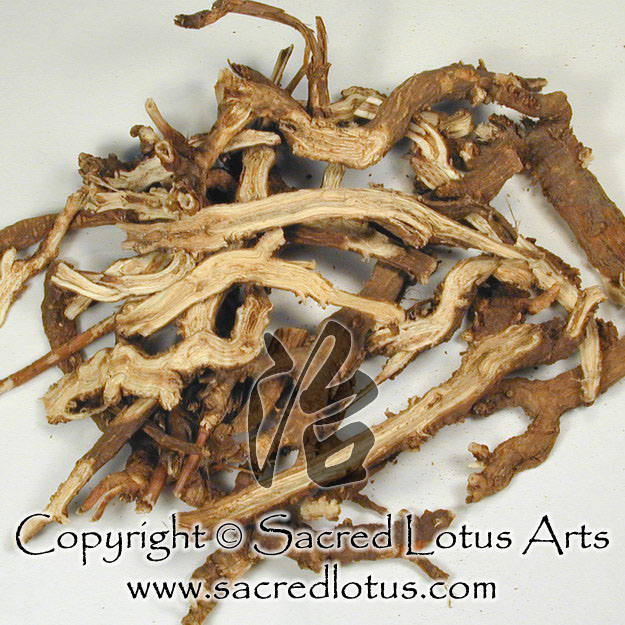
Materia Medica Data
- Temperature
- Cool
- Nature & Flavour
- Bitter, Spicy, Cool
- Channels Entered
- GB, LIV, PER, TB
- Latin (pharmaceutical)
- Radix Bupleuri
- Chinese
- 柴胡
- Tone Marks
- chái hú
- Translation
- Kindling of the Barbarians
Chinese Herb Actions
What is Chai Hu (Bupleurum) used for in Chinese medicine?
Chai Hu (Radix Bupleuri) is a cool, bitter–acrid herb chiefly used to resolve Shao Yang (half-exterior/half-interior) disorders, spread constrained Liver qi, and raise sunken Middle-Jiao yang qi — reflecting its Sacred Lotus category (Cool, Acrid Herbs that Release the Exterior) and its entry into the Gallbladder, Liver, Pericardium, and San Jiao (Triple Burner) channels.
Its main traditional actions:
- Resolves Shao Yang disorders and lowers fever — for alternating chills and fever, a bitter taste in the mouth, flank/rib-side pain, vomiting, irritability, and chest constriction; the classic presentation treated by Xiao Chai Hu Tang, in which Chai Hu is the principal herb.
- Relieves Liver qi constraint — for dizziness, vertigo, chest/hypochondriac pain, menstrual disorders, and emotional tension; also used for “wood attacking earth” (Liver-qi invading Spleen/Stomach) symptoms. Core herb of Si Ni San and Xiao Yao San.
- Raises the yang qi in Middle-Jiao (Spleen/Stomach) deficiency — for hemorrhoids, anal and uterine prolapse, and chronic diarrhea from sinking yang; core herb of Bu Zhong Yi Qi Tang.
Source: legacy Sacred Lotus content, reviewed against Bensky, Materia Medica (3rd ed.) category/channel placement and the Sacred Lotus formula database (Xiao Chai Hu Tang, Si Ni San, Xiao Yao San, Bu Zhong Yi Qi Tang). Traditional-use framing; not medical advice.
Chinese Herb Dosage
What is the typical dosage of Chai Hu?
3–12 g in decoction, using the root, consistent with standard materia medica ranges.
Processing changes emphasis: raw (sheng) Chai Hu is preferred for releasing the exterior and resolving Shao Yang disorders, while vinegar-fried (cu chao) Chai Hu is favored for soothing Liver-qi constraint — the vinegar-processing is traditionally said to direct the herb more into the Liver blood aspect and moderate its dispersing, upward-moving tendency.
Source: legacy Sacred Lotus dosage (3–12 g; part used: root); processing distinction per Bensky/Chen & Chen materia medica consensus. Reference only — not a prescription.
Chinese Herb Combinations:
- Bai Shao (Radix Albus Paeoniae Lactiflorae)
- Chai Hu (Radix Bupleuri)
Chinese Herb Contraindications & Cautions
Are there cautions for Chai Hu?
Chai Hu is contraindicated in cases of Liver Heat (Liver-fire/Liver-yang rising) and in cough from Yin deficiency — its dispersing, upward-and-outward-moving nature can aggravate yin-deficiency heat and Liver-yang/wind-rising patterns, consistent with Bensky’s caution on herbs of this type.
- Overdose — may cause nausea and vomiting.
- Other side effects — may include increased bowel movement and drowsiness.
- Dose/duration (reference note) — a large pharmacoepidemiology study found a dose-response increase in liver-injury hospitalization risk with Radix Bupleuri-containing formulas in patients with hepatitis B; professional guidance is advisable for prolonged or high-dose use, especially with pre-existing liver disease (see research).
Source: legacy Sacred Lotus cautions (contraindications, overdose, side effects); Bensky materia medica consensus; dose-response liver-injury study (below). Reference note, not a safety guarantee.
Chinese Herb Toxicity & Overdose
Low-to-moderate at standard decoction doses; risk rises with high cumulative dose, prolonged use, or pre-existing liver disease. Saikosaponin d, one of Chai Hu’s principal active triterpene saponins, is described in the pharmacology literature as both the main antitumour-active component and the main toxic component, with preclinical hepatotoxicity, neurotoxicity, haemolysis, and cardiotoxicity reported at higher exposures. A large Taiwanese case-control/case-crossover study of 639,779 hepatitis-B-infected patients found a dose-response relationship between Radix Bupleuri-containing formulas and hospitalisation for liver injury (adjusted odds ratio 1.90 overall; 2.19 per additional 19 g of radix bupleuri), with Xiao-Chai-Hu-Tang and Long-Dan-Xie-Gan-Tang carrying the highest signal.
Source: PMID 34714209, PMC 8567945 (saikosaponin d toxicity review); PMID 21264326, PMC 3020221 (dose-response liver-injury epidemiology in HBV patients). Reference note, not a safety guarantee.
Herb-Drug Interactions
The best-documented interaction is with interferon: a case series reported acute interstitial pneumonitis in patients with chronic hepatitis receiving interferon and/or the Kampo formula Sho-saiko-to (the Japanese preparation of Xiao Chai Hu Tang, in which Chai Hu is the principal herb), with an allergic/immunological mechanism proposed rather than direct toxicity; all cases resolved with corticosteroid therapy. Practitioner awareness is warranted when Bupleurum-based formulas are combined with interferon therapy.
Separately, a 2025 mechanistic (mouse) study found that saikosaponin d in Radix Bupleuri can impair protective liver autophagy and worsen acetaminophen (paracetamol)-induced liver injury, flagging a possible risk with co-administration or overlapping hepatotoxic exposure — preclinical evidence, not a demonstrated clinical interaction. Saikosaponin d has also been reported to affect cytochrome P450 enzymes and P-glycoprotein, which could in principle alter the pharmacokinetics of co-administered conventional drugs. (Flagged for practitioner confirmation; no large clinical drug-interaction trials exist.)
Source: PMID 8980988 (interferon/Sho-saiko-to pneumonitis case series); PMID 39874796 (saikosaponin d–acetaminophen mechanistic interaction, preclinical); PMID 34714209, PMC 8567945 (CYP/P-gp pharmacokinetic interaction potential).
Western / Biomedical Research
Chinese Herb Clinical Studies & Research
Provided as research context — a summary of published biomedical study, not a therapeutic or medical claim.
Is there modern research on Chai Hu (Radix Bupleuri)?
Yes — an active pharmacology literature on Bupleurum’s saikosaponins covers anti-inflammatory, dose-dependent hepatoprotective/hepatotoxic, antitumour, and antidepressant-relevant research, alongside real-world safety data and a documented drug interaction. Chemically, the roots contain saikosaponins (chiefly saikosaponin a and d), polysaccharides, flavonoids, and volatile oils.
- Comprehensive pharmacology review (2025) — a systematic literature review found anti-tumour, anti-inflammatory, neuroprotective, antipyretic, and antiviral activity across cell and animal studies, while noting that clinical dosing, administration routes, and safety data remain insufficient and further trials are needed.
- Saikosaponin d review — multi-targeted antitumour mechanisms (anti-proliferative, anti-metastatic, pro-apoptotic/autophagic) are documented, alongside saikosaponin d’s status as the main toxic component (hepato-, neuro-, cardio-toxicity and haemolysis in preclinical models) and its potential to alter drug pharmacokinetics via CYP enzymes and P-glycoprotein.
- Depression (systematic review and meta-analysis of RCTs) — Bupleurum chinense-based formulas were found more effective than antidepressants alone at improving Hamilton depression scores, and combined with SSRIs outperformed SSRIs alone, with fewer adverse events than the antidepressant-only groups; the authors caution that heterogeneity was high and study quality low, so evidence is preliminary.
- Real-world hepatotoxicity signal — the 639,779-patient Taiwanese HBV cohort study (above) found a dose-response increase in liver-injury hospitalisation risk with Radix Bupleuri-containing formulas.
- Interferon interaction — a case series linked acute interstitial pneumonitis to interferon and/or Sho-saiko-to therapy in chronic hepatitis patients (above).
Human clinical evidence is strongest (though still preliminary) for the depression meta-analysis and the HBV liver-injury epidemiology; the anti-tumour, anti-inflammatory, and neuroprotective findings remain largely preclinical.
Sources: PMID 41011202, PMC 12473030 (comprehensive review, 2025); PMID 34714209, PMC 8567945 (saikosaponin d review); PMID 31328996 (depression meta-analysis, J Altern Complement Med 2020); PMID 21264326, PMC 3020221 (HBV liver-injury epidemiology); PMID 8980988 (interferon/Sho-saiko-to pneumonitis case series); PMID 39874796 (saikosaponin d–acetaminophen mechanistic study). Research context, not a therapeutic claim.
Chinese Herb Notes
How is Chai Hu different from Bo He and Ge Gen, and what does it combine with?
All three release the exterior, but Chai Hu is distinguished by its affinity for the Liver/Gallbladder and its unique role in resolving Shao Yang (half-exterior/half-interior) disorders — a pattern neither Bo He nor Ge Gen addresses.
- Bo He — a purer wind-heat exterior-releasing herb, aromatic and cooling, favored for head, eye, and throat symptoms; does not address Liver-qi constraint the way Chai Hu does.
- Ge Gen — releases the Yang Ming/muscle layer, generates fluids, and raises clear yang for a different mechanism of diarrhea (Spleen/Stomach); lacks Chai Hu’s Shao Yang and Liver-qi actions.
- Sheng Ma — also raises sunken yang qi and is paired with Chai Hu in Bu Zhong Yi Qi Tang, but is used more broadly for Yang Ming-related toxin-clearing and rash-transformation, whereas Chai Hu’s yang-raising role is tied to its Liver/Gallbladder and Shao Yang affinity.
Common combination: Chai Hu is classically paired with Bai Shao (recorded together in the Sacred Lotus herb-combination data) — Chai Hu spreads constrained Liver qi while Bai Shao nourishes blood and softens the Liver, restraining Chai Hu’s dispersing, drying tendency; this pairing underlies Si Ni San and Xiao Yao San.
Chai Hu appears across several formula groups in the Sacred Lotus database: the Shao Yang-harmonizing group (Xiao Chai Hu Tang, Da Chai Hu Tang, Chai Hu Jia Long Gu Mu Li Tang, Chai Ge Jie Ji Tang), the Liver-qi group (Si Ni San, Xiao Yao San), the yang-raising group (Bu Zhong Yi Qi Tang), and others including Long Dan Xie Gan Tang, Ren Shen Bai Du San, Wan Dai Tang, Xue Fu Zhu Yu Tang, Pu Ji Xiao Du Yin, and Fu Yuan Huo Xue Tang. (Traditional formula context, not treatment advice.)
Sacred Lotus records the classical translation of Chai Hu as “Kindling of the Barbarians,” reflecting its historical use as a coarse firewood plant on the northern frontier before its adoption as a medicinal root.
Source: Sacred Lotus herb-combination and formula database; Bensky/Chen & Chen differentiation chapters for Bo He, Ge Gen, and Sheng Ma comparisons.
Sources & References
Compiled and edited by Thomas Dehli, Founder & Editor, Sacred Lotus Updated
The information here is referenced from numerous sources — teachers, practitioners, class notes from Five Branches University, the books below, and the published research literature, with citations given as resolvable PubMed identifiers. Where sources disagree, I have flagged the discrepancies directly. If facts couldn't be verified, I have left them out. How we source our content.
Reference information for students and practitioners — not medical advice. Consult a qualified practitioner. Terms of use.
Chinese Herbs Books & References
 https://amzn.to/3WfB3DK
 https://amzn.to/3DR1VUh
 https://amzn.to/42aMz73
 https://amzn.to/3PuD4bt