
Actions
What does Xiao Chai Hu Tang do?
Xiao Chai Hu Tang harmonizes the Shaoyang stage — it vents a pathogen that is lodged neither purely at the exterior nor purely at the interior by releasing it outward while simultaneously clearing the heat it has generated internally, and it shores up Middle Jiao qi so the body has the reserve to finish the job rather than let the pathogen sink deeper.
- Harmonizes Shaoyang: resolves a half-exterior, half-interior (半表半裏) disorder that plain sweating or purging cannot touch.
- Disperses constrained Shaoyang/Gallbladder qi and clears Shaoyang heat: the Chai Hu–Huang Qin pair vents outward and drains inward at the same time.
- Harmonizes the Stomach and descends rebellious qi: Ban Xia and Sheng Jiang stop the nausea and vomiting that accompany this pattern.
- Tonifies qi to support the body’s resistance: Ren Shen, Zhi Gan Cao, and Da Zao bolster a constitution that is not strong enough on its own to expel the pathogen.
Source: Sacred Lotus sources & references + Bensky & Barolet, Formulas & Strategies; Chen & Chen, Chinese Medical Herbology and Pharmacology (own-words synthesis of the harmonizing-method action).
Indications
What is Xiao Chai Hu Tang used for?
Xiao Chai Hu Tang treats the classic Shaoyang pattern — alternating chills and fever, fullness or pain in the chest and hypochondriac region, and a bitter taste in the mouth, with a wiry pulse. Formulary tradition holds that any one of the characteristic Shaoyang signs below is sufficient to indicate the formula; the full complex need not be present.
- Alternating chills and fever (寒热往来), the hallmark Shaoyang sign
- Fullness, distension, or pain in the chest and hypochondriac (rib-side) region
- Bitter taste in the mouth, dry throat, dizziness or blurred vision
- Vexation and irritability, reduced appetite
- Nausea and a tendency toward vomiting
- Traditionally extended, with modification, to lingering low-grade fever, hepatobiliary complaints, and other conditions where a Shaoyang-stage pattern is judged present (reference to traditional use, not a treatment claim)
Source: Sacred Lotus sources & references on pattern + Bensky & Barolet, Formulas & Strategies; Shang Han Lun formulary tradition (secondary commentary). Traditional-use framing; not medical advice.
Western Uses:
What conditions is Xiao Chai Hu Tang used for in modern practice?
Xiao Chai Hu Tang harmonises a "half-exterior, half-interior" Shao-Yang disorder (alternating fever and chills, a bitter taste, fullness under the ribs, nausea and poor appetite), so it is referenced very broadly for these presentations: upper respiratory infections, influenza, bronchitis, pulmonary tuberculosis, mumps (epidemic parotitis), malaria, cholecystitis, hepatitis, jaundice, amenorrhoea, postpartum fever, lymphadenitis, and intercostal neuralgia.
The thread is the Shao-Yang pattern, not any one diagnosis. Malaria is a life-threatening emergency, tuberculosis is a notifiable infection needing treatment, jaundice always requires assessment, and postpartum fever must be evaluated for infection. Traditional-use correlates only, not a treatment claim.
Source: Sacred Lotus sources & references (pattern) + Bensky & Barolet, Formulas & Strategies; biomedical correlates as reference only. Not medical advice.
Ingredients
7 substances in Xiao Chai Hu Tang — each links to its full herb monograph.
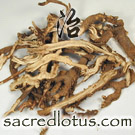 Chai Hu24 gCool, Spicy Herbs that Release the Exterior
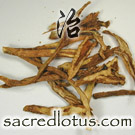 Huang Qin9 gClear Heat and Dry Dampness
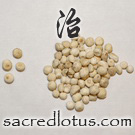 Ban Xia24 gWarm Herbs that Transform Phlegm-Cold
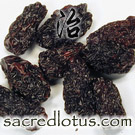 Da Zao12 piecesTonify Qi
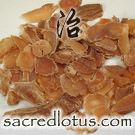 Ren Shen9 gTonify Qi
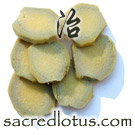 Sheng Jiang9 gWarm, Spicy Herbs that Release the Exterior
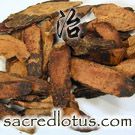 Zhi Gan Cao9 gTonify Qi
Preparation & dosage
How is Xiao Chai Hu Tang prepared?
Classically it is a water decoction of the seven herbs, cooked in two stages and taken warm in three divided doses. The Shang Han Lun method calls for boiling all seven ingredients together, straining off the dregs, then reducing (re-boiling) the strained liquid before dividing it — a technique described in formulary tradition as 去滓再煎 (“discard the dregs, decoct again”), traditionally reserved for harmonizing formulas that straddle the exterior and interior.
- Sheng Jiang is used fresh/uncooked (per our Sacred Lotus’s herb annotation), sliced.
- Zhi Gan Cao is honey-fried licorice, as its name (“Zhi”) indicates — the standard processing for a Middle-Jiao-tonifying role.
- Ban Xia is used in its processed (Fa Ban Xia) form, as is standard pharmacopeia practice, since the raw rhizome is irritating to mucosa.
- Modern practice: a standard water decoction (herbs simmered roughly 30–45 minutes after an initial boil, then strained) or a granule/powder preparation reconstituted per label; reference gram amounts are carried in Sacred Lotus sources & references record for this formula.
Source: Shang Han Lun preparation method (secondary formulary commentary) + Bensky & Barolet, Formulas & Strategies (processing notes); Sacred Lotus sources & references record for herb identities and uncooked/fresh Sheng Jiang annotation.
Safety — read before use
What are the cautions for Xiao Chai Hu Tang?
Xiao Chai Hu Tang is intended for a genuine Shaoyang pattern and is not appropriate where the disorder is purely exterior, purely interior-excess, or rooted in Yin deficiency or Liver-Yang excess. Its warming, ascending, and qi-tonifying components can aggravate patterns of rising Liver Yang/fire, deficient Yin with heat signs, or bleeding tendencies.
- Do not use for excess conditions above with deficiency below, or for Liver fire / Liver Yang rising / hypertension-type patterns.
- Avoid in Yin deficiency presenting with vomiting of blood or other bleeding signs.
- Prolonged use of this ascending, qi-moving combination has been associated in formulary sources with dizziness, headache, or gum bleeding.
- Ban Xia (Pinellia) is a restricted-processing herb by pharmacopeia convention — the unprocessed rhizome is toxic/irritating and is not used raw; this formula specifies the processed form, noted here as a neutral identity/safety reference, not administration guidance.
Source: Bensky & Barolet, Formulas & Strategies (contraindication pattern); Chinese Pharmacopoeia processing convention for Pinellia (Ban Xia). Traditional-use framing; not medical advice.
Originally Appeared In:
- On Cold Damage (Shang Han Lun)
Notes:
How does Xiao Chai Hu Tang differ from other Chai Hu formulas, and where does it come from?
Xiao Chai Hu Tang is the harmonizing archetype of the Chai Hu family; related formulas add or subtract herbs for a shifted pattern. It was first recorded in the Shang Han Lun (Treatise on Cold Damage) by Zhang Zhongjing, Eastern Han dynasty (compiled c. 200–220 CE), and also appears in the companion text Jin Gui Yao Lue (Essentials from the Golden Cabinet), attributed to the same author.
- vs Da Chai Hu Tang (Major Bupleurum Decoction): shares the Chai Hu–Huang Qin base but drops the tonifying Ren Shen/Zhi Gan Cao and adds Da Huang and Zhi Shi, for a combined Shaoyang–Yangming excess pattern with constipation or more pronounced interior heat — a purging strategy rather than a harmonizing-with-tonification one.
- vs Chai Hu Gui Zhi Tang: combines this formula (at reduced dosage) with Gui Zhi Tang, for simultaneous Taiyang (exterior) and Shaoyang involvement.
- vs Si Ni San: both feature Chai Hu, but Si Ni San (Zhi Shi, Bai Shao, Zhi Gan Cao) treats Liver-Spleen qi stagnation without an external pathogen or Stomach-disharmony signs, and carries no anti-nausea or qi-tonifying herbs.
A well-known classical principle associated with this formula in Shang Han Lun commentary is that presence of just one characteristic Shaoyang sign (e.g., alternating chills and fever, or chest-and-hypochondriac fullness) is sufficient grounds to use it — the complete symptom picture need not all be present at once.
Documented classical modifications include removing Ban Xia and adding Tian Hua Fen (trichosanthes root) for pronounced thirst, and adding Fu Ling for palpitations with abdominal fullness.
Source: Shang Han Lun (classical source text, secondary formulary commentary) + Bensky & Barolet, Formulas & Strategies; Chen & Chen, Chinese Medical Herbology and Pharmacology (comparative formula analysis, own words).
Clinical Studies & Research:
Is there modern research on Xiao Chai Hu Tang, and what does the Japanese sho-saiko-to safety literature say?
Yes on both counts: clinical research on efficacy exists, and a well-documented Japanese pharmacovigilance literature separately tracks interstitial pneumonitis associated with this same seven-herb combination. In Japan the formula is marketed as the Kampo medicine sho-saiko-to and has been one of the most-studied Kampo formulas for adverse-event reporting.
- Peptic ulcer (clinical, efficacy): a systematic review and meta-analysis of 13 randomized controlled trials (1,334 patients) found Xiao Chai Hu Tang-based therapy associated with favorable clinical outcomes and fewer reported adverse effects versus conventional comparators for peptic ulcer disease (PMC 8105105).
- Liver cirrhosis/hepatocellular carcinoma (clinical, efficacy and safety together): a review of sho-saiko-to in liver cirrhosis and carcinoma reported hepatoprotective associations while also flagging interstitial pneumonia as a known adverse effect, particularly when combined with interferon therapy (PMID 21682829).
- Interstitial pneumonitis (safety literature, neutral reference — not a treatment claim): a review of 73 Japanese patients with herbal-medicine-induced pneumonitis identified sho-saiko-to as the most frequently implicated agent (PMID 28274529). An earlier case series documented five patients with sho-saiko-to-induced pneumonitis that resolved after discontinuation and corticosteroid treatment (PMID 9234626). Japan’s health authorities issued formal warnings on this association in the 1990s, and combination with interferon-alpha therapy is specifically flagged in the literature as raising risk.
Sources: PMC 8105105 (peptic ulcer meta-analysis); PMID 21682829 (cirrhosis/carcinoma review); PMID 28274529 (Enomoto et al., pneumonitis review of 73 patients, Respiratory Investigation 2017); PMID 9234626 (Hatakeyama et al., five-case pneumonitis series, 1997). Research context and cited safety literature, not a therapeutic claim.
Sources & References
Compiled and edited by Thomas Dehli, Founder & Editor, Sacred Lotus Updated
The information here is referenced from numerous sources — teachers, practitioners, class notes from Five Branches University, the books below, and the published research literature, with citations given as resolvable PubMed identifiers. Where sources disagree, I have flagged the discrepancies directly. If facts couldn't be verified, I have left them out. How we source our content.
Reference information for students and practitioners — not medical advice. Consult a qualified practitioner. Terms of use.
Chinese Formulas Books & References
 https://amzn.to/4fYI3f8
 https://amzn.to/4j55NRA
 https://amzn.to/4gMROyv
 https://amzn.to/4h7msSK