
Rhizoma Cimicifugae Black Cohosh Rhizome, Bugbane Rhizome
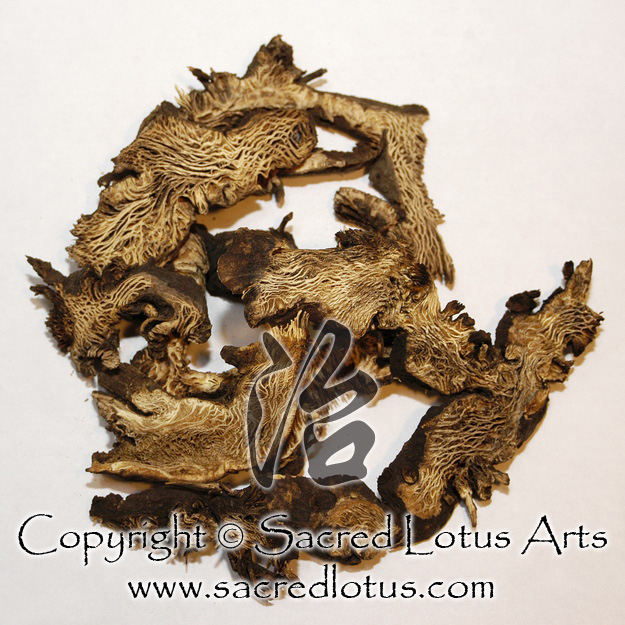
Materia Medica Data
- Temperature
- Cool
- Nature & Flavour
- Sweet, Spicy, Cool
- Channels Entered
- LI, LU, SP, ST
- Latin (pharmaceutical)
- Rhizoma Cimicifugae
- Chinese
- 升麻
- Tone Marks
- shēng má
- Translation
- Ascending Hemp
Chinese Herb Actions
What is Sheng Ma used for in Chinese medicine?
Sheng Ma — the rhizome of Cimicifuga foetida, C. dahurica, or C. heracleifolia (botanically distinct from Western “black cohosh,” Actaea racemosa; see notes) — is traditionally used to raise sunken yang qi, vent rashes to the surface, and clear heat-toxin, especially affecting the upper body.
- Raises the yang qi — Middle Jiao qi deficiency with fatigue, shortness of breath, and prolapse; the chief pairing with Chai Hu in Bu Zhong Yi Qi Tang lifts sunken qi (see notes).
- Vents rashes and disperses wind-heat toward the surface — early-stage or incompletely erupted measles; Sheng Ma Ge Gen Tang (paired with Ge Gen) is the classic formula.
- Clears heat and resolves toxicity, especially in the upper body — toothache, gum swelling/ulceration, mouth sores, and sore throat; used in Qing Wei San (clears Stomach fire) and Pu Ji Xiao Du Yin (epidemic toxic-heat swelling of the head and face).
- Guides other herbs upward — used as an assistant to direct a formula’s effect toward the upper body and head.
Source: cross-referenced against multiple online sources and Sacred Lotus sources & references (formula composition), consistent with Bensky, Materia Medica (3rd ed.) / Chen & Chen consensus.
Chinese Herb Dosage
What is the typical dosage of Sheng Ma?
Roughly 1.5–9 g in decoction, from the root/rhizome. Honey-toasted (zhi) Sheng Ma is traditionally preferred specifically for lifting sunken Middle Jiao qi (e.g., in prolapse patterns), while the unprocessed (raw) herb is favored for venting rashes and clearing heat-toxin.
Source: Sacred Lotus sources & references; cross-referenced against multiple online sources. Reference only, not a prescription.
Chinese Herb Contraindications & Cautions
Are there cautions for Sheng Ma?
Contraindicated in hyperactive-fire patterns, underlying yin deficiency with excess above and deficiency below, and in fully erupted measles (once the rash has already surfaced, the venting action is no longer needed and may be counterproductive).
- Hyperactive fire / yin deficiency — contraindicated, especially with excess symptoms above and deficiency below.
- Fully erupted measles — contraindicated once the rash has fully surfaced.
- Species-identity caution (reference note) — because “black cohosh” is used as a common name for both the TCM herb and the Western menopause supplement, cautions or interaction data researched for Western black cohosh (Actaea racemosa) products should not automatically be assumed to apply to TCM Sheng Ma decoctions of Cimicifuga foetida/dahurica/heracleifolia, or vice versa; species-accurate sourcing matters (see notes).
Source: cross-referenced against multiple online sources; Bensky/Chen & Chen cautions.
Chinese Herb Toxicity & Overdose
Chinese Sheng Ma species (Cimicifuga foetida/dahurica/heracleifolia) have not been linked, in the literature reviewed, to the hepatotoxicity case reports associated with Western black cohosh (Actaea racemosa). Those case reports and causality reviews are specific to standardized Actaea racemosa extracts — especially isopropanolic extracts — sold as menopause supplements in the West (see research). No comparable hepatotoxicity signal specific to the Chinese Sheng Ma species was identified.
Source: PMID 18340277 and related causality-assessment literature (below), specific to Actaea racemosa. Reference note distinguishing the two species, not a safety guarantee for either.
Herb-Drug Interactions
No well-established interactions specific to Cimicifuga foetida/dahurica/heracleifolia (Chinese Sheng Ma) were identified in the literature reviewed. Western black cohosh (Actaea racemosa) has separately been studied for potential caution alongside hepatotoxic medications, given its hepatotoxicity case-report literature (see research) — a caution that belongs to the Western species/products, flagged here only to prevent cross-species confusion. (Flagged for practitioner confirmation.)
Western / Biomedical Research
Chinese Herb Clinical Studies & Research
Provided as research context — a summary of published biomedical study, not a therapeutic or medical claim.
Is there research distinguishing Chinese Sheng Ma from Western black cohosh?
Yes — the hepatotoxicity literature specifically concerns Actaea racemosa (Western black cohosh, formerly Cimicifuga racemosa), not the Chinese Sheng Ma species (C. foetida/dahurica/heracleifolia).
- Western black cohosh hepatotoxicity (case reports & causality review) — a United States Pharmacopeia review examined black-cohosh hepatotoxicity case reports, and subsequent papers highlighted inconsistencies, confounding variables, and challenges in causality assessment across the suspected cases.
- Western black cohosh hepatotoxicity (RCT meta-analysis — discrepancy) — a meta-analysis of randomized controlled trials of isopropanolic black cohosh extract found no evidence of a hepatotoxicity signal, in real tension with the case-report literature above; this is presented as an open, unresolved discrepancy.
- Western black cohosh efficacy (menopausal symptoms, not a TCM indication) — a review/meta-analysis of isopropanolic black cohosh extract for menopausal symptoms found supportive evidence for this Western use.
- Cimicifuga foetida (the actual Chinese Sheng Ma species) — separately, a clinical study evaluated C. foetida extract for efficacy/safety in menopausal syndrome in Chinese women (an example of the species being applied to a Western-style indication, not a classical TCM use of Sheng Ma), and a preclinical study compared C. foetida and C. racemosa together for postmenopausal bone/osteoclast effects. Other preclinical work on C. foetida reports anti-cancer-cell and antiviral-screening activity (cell/animal models only).
This is presented as research context, not a treatment claim; preclinical findings are not clinical evidence, and none of the above supports a TCM therapeutic claim for Sheng Ma as classically used.
Sources: PMID 18340277 (USP review, black cohosh hepatotoxicity case reports); PMID 20216279, PMID 19586731 (causality-assessment challenges); PMID 21228727 (RCT meta-analysis, no hepatotoxicity signal); PMID 33021111 (isopropanolic extract, menopausal symptoms); PMID 23769553 (Cimicifuga foetida extract, menopausal syndrome, Chinese women); PMID 40680333 (C. foetida & C. racemosa, postmenopausal bone effects, preclinical); PMID 26759603, PMID 39408228, PMID 40872800 (preclinical C. foetida bioactivity screening).
Chinese Herb Notes
Is Chinese Sheng Ma the same herb as Western black cohosh used for menopause?
No — they are related but distinct plants used for different purposes. Chinese Sheng Ma is the rhizome of Cimicifuga foetida, C. dahurica, or C. heracleifolia, traditionally used to raise yang qi, vent rashes, and clear heat-toxin. Western “black cohosh,” sold for menopausal hot flashes, is Actaea racemosa — a different, North American species formerly classified under the same genus as Cimicifuga racemosa.
- Chinese Sheng Ma (Cimicifuga foetida / C. dahurica / C. heracleifolia) — raises sunken yang qi, vents rashes, clears heat-toxin; the central pairing with Chai Hu in Bu Zhong Yi Qi Tang.
- Western black cohosh (Actaea racemosa, syn. Cimicifuga racemosa) — a different North American species used in Western herbalism and dietary supplements specifically for menopausal hot flashes and related symptoms; this is not a traditional TCM use of Sheng Ma.
Note: the common name in our data (“Black Cohosh Rhizome”) reflects historical genus-level naming overlap — Actaea racemosa was formerly classified as Cimicifuga racemosa — but the two are botanically and pharmacologically distinct. Even some modern research crosses this line: one study examined Cimicifuga foetida alongside C. racemosa together for postmenopausal bone effects, and another studied Cimicifuga foetida extract specifically for menopausal syndrome in Chinese women (see research) — real overlap of research interest between the species, even though classical TCM does not use Sheng Ma this way. Readers researching black-cohosh menopause safety or hepatotoxicity should understand that literature applies to Actaea racemosa, not necessarily to the Chinese species used as Sheng Ma.
Chai Hu + Sheng Ma pairing: Bu Zhong Yi Qi Tang combines Sheng Ma with Chai Hu (alongside Huang Qi, Ren Shen, Bai Zhu, Zhi Gan Cao, Dang Gui, and Chen Pi) specifically to lift sunken Middle Jiao qi; the two herbs are considered mutually reinforcing for this ascending action. Other combinations: Sheng Ma + Ge Gen (with Chi Shao and Zhi Gan Cao) in Sheng Ma Ge Gen Tang for venting rashes; also used in Qing Wei San, Pu Ji Xiao Du Yin, Zi Xue Dan, and Ji Chuan Jian. (Traditional formula context, not treatment advice.)
Source: Sacred Lotus sources & references (formula composition); cross-referenced against multiple online sources on species identity; PMID 40680333, PMID 23769553 (below).
Sources & References
Compiled and edited by Thomas Dehli, Founder & Editor, Sacred Lotus Updated
The information here is referenced from numerous sources — teachers, practitioners, class notes from Five Branches University, the books below, and the published research literature, with citations given as resolvable PubMed identifiers. Where sources disagree, I have flagged the discrepancies directly. If facts couldn't be verified, I have left them out. How we source our content.
Reference information for students and practitioners — not medical advice. Consult a qualified practitioner. Terms of use.
Chinese Herbs Books & References
 https://amzn.to/3WfB3DK
 https://amzn.to/3DR1VUh
 https://amzn.to/42aMz73
 https://amzn.to/3PuD4bt