
Qing Wei San
Clear the Stomach Powder
- Category
- Formulas that Clear Heat
- Subcategory
- Formulas that Clear Heat from the Organs
- Ingredients
- 5 herbs
Actions
What does Qing Wei San do?
Qing Wei San (Clear the Stomach Powder) drains Stomach fire and cools heat in the blood. It is built for blazing Stomach (Yang Ming) fire that rises along the channel to the mouth, gums, and face, and that has begun to press into the blood level — hence its pairing of fire-draining herbs with blood-cooling, yin-protecting ones.
How the five ingredients work together:
- Chief — Huang Lian (Coptis): bitter and cold, it directly drains Stomach fire.
- Deputy — Sheng Ma (Cimicifuga): vents and disperses heat and fire toxin, guides the action to the Yang Ming and face, and lifts — balancing Huang Lian’s downward draining so heat is not trapped.
- Assistant — Sheng Di Huang (raw Rehmannia): cools the blood and nourishes yin injured by fire.
- Assistant — Mu Dan Pi (Moutan): cools and moves the blood, addressing blood-level heat and bleeding.
- Assistant — Dang Gui (Chinese Angelica): nourishes and invigorates the blood, helping repair fire damage and harmonize.
Source: Bensky & Barolet, Chinese Herbal Medicine: Formulas & Strategies (2nd ed.), Clear Heat from the Organs; composition confirmed against the Sacred Lotus formula record. Traditional-use framing; not medical advice.
Indications
What is Qing Wei San used for?
Qing Wei San is used for Stomach-fire patterns focused on the mouth, teeth, and gums. The classic picture is a toothache that worsens with heat and eases with cold, pain that can radiate to the head or face, and hot, swollen, sore, bleeding, or ulcerated gums — often with bad breath, a dry mouth, and thirst for cold drinks.
Typical presentation:
- Teeth: toothache aggravated by heat, relieved by cold; pain that may spread to the head/face.
- Gums & mouth: swollen, painful, bleeding, or ulcerated gums; mouth sores; halitosis.
- Heat signs: a warm/flushed face, dry mouth, thirst for cold drinks.
Tongue: red with a scanty (dry) coat. Pulse: large, slippery, and rapid.
Source: Bensky & Barolet, Formulas & Strategies (2nd ed.); tongue/pulse per the Sacred Lotus formula record. Traditional-use framing; not medical advice.
Western Uses:
What is Qing Wei San used for in modern practice?
In modern TCM practice, practitioners reference Qing Wei San when a presentation fits its blazing-Stomach-fire pattern. Reported reference conditions include gingivitis and periodontitis, recurrent mouth ulcers (stomatitis), toothache, and fire-type facial pain — the same “oral ulcer, periodontitis, and upper-gastrointestinal” territory noted in the modern literature (below).
These are pattern-based reference framings, not diagnoses or treatment claims: the formula is chosen for the TCM pattern of excess Stomach heat, and a Western label only appears when that pattern matches. A qualified practitioner confirms the diagnosis.
Source: Bensky & Barolet, Formulas & Strategies (2nd ed.); reported uses corroborated by PubMed 34980192 (Chin Med, 2022). Reference framing only; not a medical claim.
Ingredients
5 substances in Qing Wei San — each links to its full herb monograph.
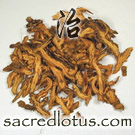 Huang Lian3-6 gClear Heat and Dry Dampness
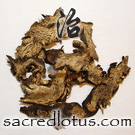 Sheng Ma3-6 gCool, Spicy Herbs that Release the Exterior
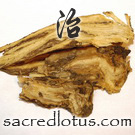 Dang Gui6-12 gTonify Blood
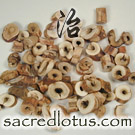 Mu Dan Pi6-9 gCool the Blood
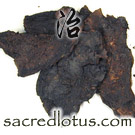 Sheng Di Huang6-12 gCool the Blood
Preparation & dosage
How is Qing Wei San prepared?
Qing Wei San ("Clear the Stomach Powder") — despite the "powder" in its name — is today most often prepared as a water decoction (tang) of Huang Lian, Sheng Ma, Mu Dan Pi, Sheng Di Huang and Dang Gui, taken cool for Stomach-fire toothache and gum problems.
In the original method the herbs were powdered and decocted as a draught. Sheng Ma both clears heat and guides the other herbs up to the face and gums the formula targets. Available as granules.
Source: Sacred Lotus sources & references (composition and preparation note) + Bensky & Barolet, Formulas & Strategies.
Taken as a decoction. Typical range: Huang Lian and Sheng Ma 3-6 g; Sheng Di Huang and Dang Gui 6-12 g; Mu Dan Pi 6-9 g. Originally ground to a powder, decocted, and taken cool. Reference only, not a prescription.
Safety — read before use
What are the cautions for Qing Wei San?
Qing Wei San is bitter and cold, so it suits excess Stomach fire, not deficiency. It is not appropriate for toothache or gum problems arising from Kidney/Stomach yin deficiency (empty fire) or from wind-cold. In people with Spleen/Stomach deficiency and cold, the cold herbs can injure Stomach yang and impair digestion.
- Not for deficiency (empty) fire: yin-deficient toothache is treated differently (see Notes).
- Spleen/Stomach cold or deficiency: use cautiously; bitter cold can weaken digestion.
- Pregnancy: use only under professional guidance — Mu Dan Pi and Dang Gui invigorate the blood.
Source: Bensky & Barolet, Formulas & Strategies (2nd ed.), cautions. Not a substitute for professional advice.
Originally Appeared In:
- Secrets from the Orchid Chamber (Lan Shi Mi Cang)
Notes:
How does Qing Wei San compare to related formulas, and how is it modified?
Qing Wei San treats excess Stomach fire; its key contrast is with formulas for Stomach heat complicated by deficiency.
- vs Yu Nu Jian: Yu Nu Jian is for Stomach heat plus Kidney yin deficiency (excess heat over a deficient base), so it adds fluid-enriching herbs; Qing Wei San addresses a purely excess Stomach fire pattern and drains more directly.
- vs Xie Huang San: Xie Huang San clears lingering/smoldering Spleen and Stomach heat (e.g. mouth ulcers, a dry mouth in children); Qing Wei San targets more acute, blazing Stomach fire reaching the teeth and gums.
Common modifications:
- For strong Stomach heat with marked thirst, add Shi Gao (gypsum) to reinforce the fire-clearing.
- For constipation with fire, add Da Huang to drain heat downward through the stool.
Source: Bensky & Barolet, Formulas & Strategies (2nd ed.), comparisons and modifications. Reference only.
Clinical Studies & Research:
Is there modern research on Qing Wei San?
Research is preclinical. In db/db mice, Qingwei San aided healing of oral ulcers in a stomach-heat model and modulated the TLR4/MyD88/NF-κB inflammatory pathway; other studies profile its chemistry and decoction process. Robust human trials are lacking.
Source: PubMed 34980192 (Chin Med, 2022); PubMed 33496098. Research context, not a therapeutic claim.
Sources & References
Compiled and edited by Thomas Dehli, Founder & Editor, Sacred Lotus Updated
The information here is referenced from numerous sources — teachers, practitioners, class notes from Five Branches University, the books below, and the published research literature, with citations given as resolvable PubMed identifiers. Where sources disagree, I have flagged the discrepancies directly. If facts couldn't be verified, I have left them out. How we source our content.
Reference information for students and practitioners — not medical advice. Consult a qualified practitioner. Terms of use.
Chinese Formulas Books & References
 https://amzn.to/4fYI3f8
 https://amzn.to/4j55NRA
 https://amzn.to/4gMROyv
 https://amzn.to/4h7msSK