
Radix Angelicae Dahuricae Angelica Root
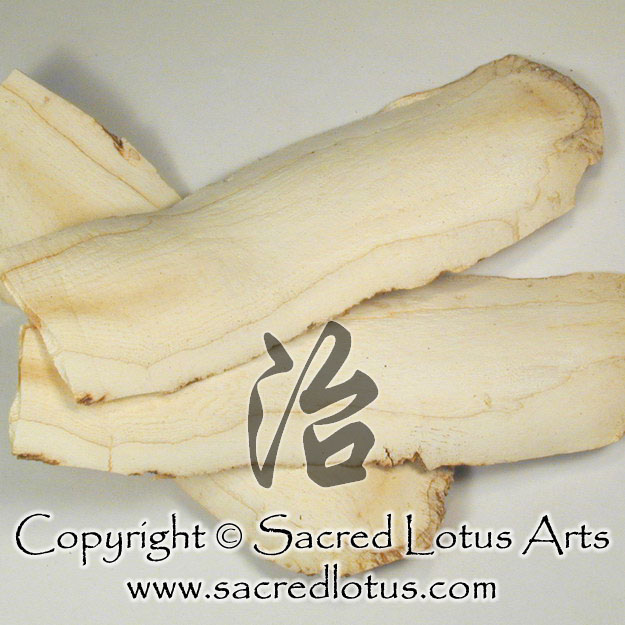
Materia Medica Data
- Temperature
- Warm
- Nature & Flavour
- Spicy, Warm
- Channels Entered
- LU, ST
- Latin (pharmaceutical)
- Radix Angelicae Dahuricae
- Chinese
- 白芷
- Tone Marks
- bái zhĭ
Chinese Herb Actions
What is Bai Zhi (Angelica Root) used for in Chinese medicine?
Bai Zhi is a warm, spicy, drying herb that releases exterior Wind-Cold, stops pain, and specifically opens the nasal passages — it is a classic choice for Yangming-channel headache (frontal/supraorbital), sinus congestion, and toothache, and is also used topically for early-stage sores and for damp discharge in the lower body.
Its main traditional actions:
- Releases the exterior and dispels Wind-Cold — for external Wind-Cold presentations, especially with a Yangming-channel headache pattern (forehead, supraorbital region) and sinus congestion.
- Stops pain — supraorbital pain, frontal headache, and toothache; its affinity for the face and sinuses is the herb’s signature trait among the exterior-releasing herbs.
- Opens the nasal passages — a first-choice herb for nasal congestion and sinus-type headache, traditionally paired with Cang Er Zi (Xanthium) and Xin Yi Hua.
- Reduces pus and swelling — used for early-stage surface sores/abscesses, helping reduce swelling and discharge pus.
- Dries dampness — also used for damp and discharge in the Lower Jiao (e.g., vaginal discharge).
Source: Sacred Lotus Sacred Lotus sources & references/legacy notes; Bensky, Materia Medica (3rd ed.); Chen & Chen, Chinese Herbal Medicine: Materia Medica. Traditional-use framing; not medical advice.
Chinese Herb Dosage
What is the typical dosage of Bai Zhi?
Roughly 3–9 grams in decoction, consistent with our recorded range and standard materia medica sources.
- Part used — the single root only, with side branches removed (per Sacred Lotus legacy note).
- Form — typically decocted with the other herbs in a formula; also used in topical powders for sores/swelling.
Source: Sacred Lotus (existing dosage record); Bensky, Materia Medica (3rd ed.). Reference only — not a prescription.
Chinese Herb Contraindications & Cautions
Are there cautions for Bai Zhi?
Bai Zhi is drying by nature and is traditionally avoided in Yin- or Blood-deficiency patterns, where its warming, drying quality could aggravate dryness or heat signs.
- Yin/Blood deficiency — not indicated; may worsen dryness.
- Traditional antagonism — traditional sources list Bai Zhi as antagonizing Xuan Fu Hua (Flos Inulae/Inula Flower); the two are traditionally not combined.
- Sun exposure (reference note) — Bai Zhi is rich in furanocoumarins (see Toxicity), which are photosensitizing; prolonged strong sun exposure after use is traditionally and pharmacologically worth avoiding.
Source: Sacred Lotus (existing cautions record); Bensky, Materia Medica (3rd ed.); furanocoumarin photosensitivity supported by research (below).
Chinese Herb Toxicity & Overdose
Low at standard decoction doses; not classified as a toxic or endangered herb in this reference. The main documented concern is not systemic toxicity but photosensitivity: Bai Zhi’s furanocoumarins (bergapten, xanthotoxin, imperatorin, and related compounds) are known photosensitizers, so strong sun/UV exposure is traditionally cautioned against after use.
Source: materia medica consensus (no toxic-herb designation in the Sacred Lotus); furanocoumarin/photosensitizer chemistry per Zhao et al., Front Pharmacol 2022 (PMID 35847034, DOI 10.3389/fphar.2022.896637). Reference note, not a safety guarantee.
Herb-Drug Interactions
No well-established clinical herb–drug interactions are documented, but Bai Zhi’s furanocoumarins (notably imperatorin and isoimperatorin) inhibit several cytochrome P450 enzymes (CYP1A2, 2C9, 2D6, 3A4) in laboratory and animal studies, which could theoretically slow the metabolism and raise blood levels of co-administered drugs cleared through these pathways. A rat study found Bai Zhi’s coumarin extract measurably increased plasma levels of ligustrazine (a Chuan Xiong-derived compound often combined with Bai Zhi for headache) by inhibiting its CYP450 metabolism — a preclinical finding, not a demonstrated clinical interaction. (Flagged for practitioner awareness with narrow-therapeutic-index medications and other photosensitizing drugs; not a confirmed clinical interaction.)
Source: metabolism-based synergy study, Molecules 2018 (PMID 29693578, DOI 10.3390/molecules23051004); CYP450 inhibition data per Zhao et al. review (PMID 35847034). Preclinical, practitioner-facing note.
Western / Biomedical Research
Chinese Herb Clinical Studies & Research
Provided as research context — a summary of published biomedical study, not a therapeutic or medical claim.
Is there modern research on Bai Zhi (Angelica dahurica)?
Yes — extensive preclinical and mechanistic research, but no controlled human clinical trials specific to Bai Zhi identified. Chemically, its roots contain 300+ compounds, chiefly coumarins (furanocoumarins) and volatile oils, which drive most of the pharmacology below.
- Anti-inflammatory (cell-based) — six coumarins isolated from Bai Zhi (bergapten, xanthotoxin, phellopterin, isoimperatorin, xanthotoxol, imperatorin) suppressed nitric oxide, IL-1β, IL-6, and TNF-α production in LPS-stimulated macrophages, with phellopterin and isoimperatorin acting via down-regulation of the NF-κB pathway. Cell-culture evidence, not clinical.
- Analgesic (animal model) — an oral Bai Zhi extract reduced mechanical hyperalgesia in mice with Complete Freund’s Adjuvant–induced chronic inflammatory pain, outperforming the comparator drug diclofenac in this model, via reduced TRPV1 channel activity/expression in sensory (dorsal root ganglion) neurons — consistent with the traditional pain-relieving use, but an animal model, not human proof.
- Headache/migraine (network pharmacology + animal) — a network-pharmacology study of the classic Bai Zhi + Chuan Xiong herb pair mapped 28 bioactive compounds onto 50 shared targets involved in neurotransmission, inflammation, and immune regulation, proposing mechanisms for the pair’s traditional anti-headache use; a related rat study found Bai Zhi’s coumarins potentiate co-administered ligustrazine (a Chuan Xiong constituent) by inhibiting its metabolism, improving migraine-model outcomes (reduced head-scratching, altered CGRP/nitric oxide/endothelin markers). Computational and animal evidence.
- Skin-whitening (in vitro, cosmetic science) — two Bai Zhi coumarins, isoimperatorin and imperatorin, inhibited tyrosinase (the melanin-producing enzyme) at the mRNA level in melanoma cells, supporting Bai Zhi’s long traditional cosmetic use as a facial-whitening herb. In vitro, not a clinical skin-lightening claim.
Overall: mechanistic and animal/cell evidence broadly supports the traditional pain-relieving, anti-inflammatory, sinus-opening, and whitening uses, but controlled human clinical trials of Bai Zhi itself are lacking — treat all findings as preclinical context.
Sources: PMID 35847034, DOI 10.3389/fphar.2022.896637 (phytochemistry/pharmacology review); PMID 39185311, PMC 11341442, DOI 10.3389/fphar.2024.1396001 (anti-inflammatory coumarins, NF-κB); PMID 35656472, PMC 9152374, DOI 10.1155/2022/4684830 (TRPV1 analgesic mouse model); PMID 36079577, PMC 9460128, DOI 10.3390/plants11172196 (migraine network pharmacology, herb pair); PMID 29693578, PMC 6102536, DOI 10.3390/molecules23051004 (coumarin–ligustrazine metabolic synergy, rat migraine model); PMID 16676120 (skin-whitening, tyrosinase inhibition). Research context, not a therapeutic claim.
Chinese Herb Notes
Is Bai Zhi the same herb as Dang Gui or Du Huo (all called “Angelica”)?
No — “Angelica” is an English umbrella name for three unrelated Chinese herbs with very different actions. Bai Zhi, Dang Gui, and Du Huo are all in the Angelica genus botanically, but in Chinese medicine they belong to different herb categories and are not interchangeable.
- Bai Zhi (Angelica dahurica, this herb) — Lung/Stomach channels; a spicy, warm, drying exterior-releasing/pain-relieving herb for Wind-Cold, Yangming headache, and sinus congestion.
- Dang Gui (Angelica sinensis, “Chinese Angelica Root,” slug dang-gui-chinese-angelica-root) — Heart/Liver/Spleen channels; a sweet, spicy, bitter, warm blood tonic that invigorates blood and moistens the intestines. It is a Blood-tonifying herb, not an exterior-releasing one.
- Du Huo (Angelica pubescens, “Pubescent Angelica Root,” slug du-huo-pubescent-angelica-root) — Kidney/Bladder channels; a bitter, spicy, warm herb that dispels Wind-Damp, mainly for lower-body/lower-back and leg Bi (painful obstruction) patterns.
What are Bai Zhi’s key formula combinations?
Bai Zhi’s core partnership is with other Wind-dispelling, sinus- and headache-focused herbs, reflected in the Sacred Lotus formula database (herb–formula links, verified by Sacred Lotus join):
- Cang Er Zi San (Xanthium Powder) — with Cang Er Zi, Xin Yi Hua, and Bo He for nasal congestion/sinus-type headache from Wind invasion — the classic sinus-opening pairing.
- Chuan Xiong Cha Tiao San (Ligusticum Chuanxiong Powder to be Taken with Green Tea) — with Chuan Xiong and other Wind-dispelling herbs for external Wind headache.
- Jiu Wei Qiang Huo Tang (Nine-Herb Decoction with Notopterygium) — for external Wind-Cold-Damp with headache and body aches.
- Chai Ge Jie Ji Tang (Bupleurum and Kudzu Decoction to Release the Muscle Layer) — for Wind-Cold beginning to transform into interior heat.
- Huo Xiang Zheng Qi San (Agastache Powder to Rectify the Qi) and Wu Ji San (Five Accumulation Powder) — for external Cold with internal Cold-Damp/digestive disturbance.
- Xian Fang Huo Ming Yin (Sublime Formula for Sustaining Life) — for early-stage toxic sores/abscesses, drawing on Bai Zhi’s pus-reducing action.
- Yu Zhen San (True Jade Powder) — a Wind-extinguishing formula for tetanus-type presentations (jaw rigidity/spasm following wounds).
Source: Sacred Lotus ingredient links (herb_id 25, 8 linked formulas); herb identity fields (channels/properties) for the Dang Gui and Du Huo comparison; Bensky, Materia Medica (3rd ed.).
Sources & References
Compiled and edited by Thomas Dehli, Founder & Editor, Sacred Lotus Updated
The information here is referenced from numerous sources — teachers, practitioners, class notes from Five Branches University, the books below, and the published research literature, with citations given as resolvable PubMed identifiers. Where sources disagree, I have flagged the discrepancies directly. If facts couldn't be verified, I have left them out. How we source our content.
Reference information for students and practitioners — not medical advice. Consult a qualified practitioner. Terms of use.
Chinese Herbs Books & References
 https://amzn.to/3WfB3DK
 https://amzn.to/3DR1VUh
 https://amzn.to/42aMz73
 https://amzn.to/3PuD4bt