
Rhizoma Atractylodis Black Atractylodes Rhizone
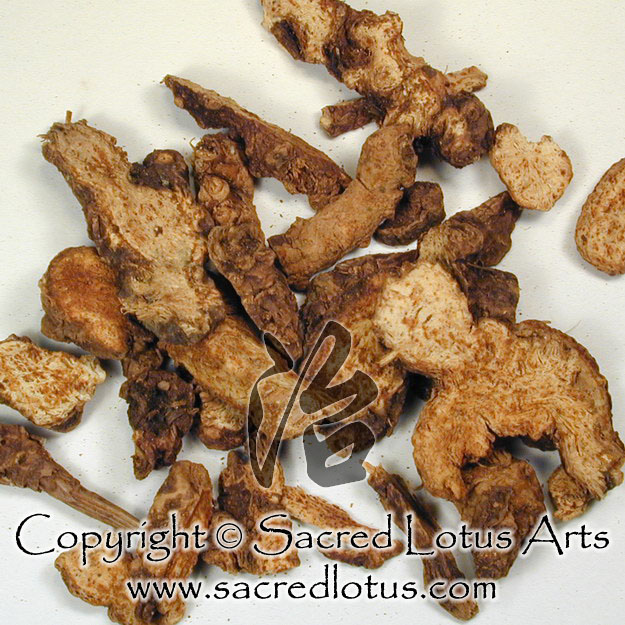
Materia Medica Data
- Temperature
- Warm
- Nature & Flavour
- Spicy, Bitter, Warm, Aromatic
- Channels Entered
- SP, ST
- Latin (pharmaceutical)
- Rhizoma Atractylodis
- Chinese
- 苍术
- Tone Marks
- cāng zhú
Chinese Herb Actions
What is Cang Zhu used for in Chinese medicine?
Cang Zhu (Atractylodes lancea rhizome) is a pungent, bitter, warm, aromatic herb that vigorously dries Dampness and strengthens the Spleen — the traditional first choice for Damp obstruction of the Middle Jiao (poor appetite, distension, loose stool) — and, distinctively among the damp-drying herbs, can also release the exterior in Wind-Damp presentations.
Its main traditional actions:
- Dries Damp and strengthens the Spleen — for Damp obstruction or accumulation in the Middle Jiao with low appetite, abdominal and epigastric distension and fullness, diarrhea or loose stool, nausea and vomiting, a heavy sensation in the body, and a thick, greasy tongue coating.
- Dispels Wind-Damp, induces sweating, and releases the exterior — for Wind-Damp exterior disorders with headaches, body aches, fever, chills, blocked nasal passages, and an absence of sweating.
- Dries Dampness in the Lower Jiao — combined with appropriate heat-clearing herbs, used for Damp-Heat conditions such as Damp Leg Qi, aching and swollen joints, and vaginal discharge.
- Improves the eyes — for night blindness or diminished vision.
Source: legacy Sacred Lotus materia medica notes, reviewed against Bensky, Barolet et al., Chinese Herbal Medicine: Materia Medica (3rd ed.). Traditional-use framing; not medical advice.
Chinese Herb Dosage
What is the typical dosage of Cang Zhu?
Commonly 5–10 g in decoction — the Sacred Lotus reference range. Standard materia medica sources (e.g., Bensky) cite a slightly lower and overlapping 3–9 g, so 5–10 g sits at the upper end of the widely cited range rather than conflicting with it; both reflect the same herb used at typical clinical strength.
Source: legacy Sacred Lotus dosage note; cross-checked against standard materia medica ranges. Reference only — not a prescription.
Chinese Herb Contraindications & Cautions
Are there cautions for Cang Zhu?
Use with caution in Yin-deficient heat, and in cases of spontaneous or excess sweating due to Wei-qi deficiency — the legacy Sacred Lotus caution, preserved here. Cang Zhu is a strongly drying, warming, aromatic herb; that same drying, dispersing action can aggravate Yin-deficient heat (further depleting fluids) and is not well suited to patients already prone to excess sweating from weak Wei (defensive) qi.
Source: legacy Sacred Lotus caution note, consistent with standard materia medica cautions for strongly drying/aromatic Damp-resolving herbs.
Chinese Herb Toxicity & Overdose
Low, based on the evidence available. Animal toxicology work summarized in pharmacology reviews and a small human Phase I trial both describe a favorable short-term safety profile for standardized Atractylodes lancea extract, with good tolerability and no dose-limiting toxicity at studied doses; long-term human safety data remain limited, and the herb's strongly drying/aromatic nature is the basis of its traditional cautions (above) rather than a documented toxic reaction.
Source: PMID 32987126 (Atractylodis Rhizoma review, phytochemistry/pharmacology/toxicology); PMID 34195029, PMC 8240349 (Phase I human safety/pharmacokinetic trial). Reference note, not a safety guarantee.
Herb-Drug Interactions
May interact with anti-diabetic medication — the legacy Sacred Lotus caution, preserved here. Preclinical research supports a plausible mechanism: in streptozotocin-induced diabetic rats, ethanolic Atractylodes lancea extract significantly lowered plasma glucose and triglycerides over 14 days, i.e., the herb itself has hypoglycemic activity. Combining a hypoglycemic herb with prescription anti-diabetic drugs could theoretically compound blood-glucose-lowering effects, so monitoring/practitioner awareness is reasonable. This is a precautionary, mechanism-based flag rather than a documented clinical drug interaction in humans. (Flagged for practitioner confirmation.)
Source: legacy Sacred Lotus caution note; DOI 10.9799/ksfan.2020.33.5.544 (diabetic-rat glucose/lipid study, preclinical).
Western / Biomedical Research
Chinese Herb Clinical Studies & Research
Provided as research context — a summary of published biomedical study, not a therapeutic or medical claim.
Is there modern research on Cang Zhu (Atractylodes lancea)?
Yes — an active preclinical literature plus one small human Phase I safety trial, with clinical efficacy evidence still limited. Chemically, Cang Zhu's rhizome is rich in volatile oil (roughly 3.5–7% of the dried rhizome), with atractylodin, β-eudesmol, atractylon, and hinesol as major constituents.
- Pharmacology review — comprehensive reviews summarize documented anti-inflammatory, antimicrobial, antipyretic, gastrointestinal, and central-nervous-system activities for Atractylodes lancea and its constituents; preclinical/laboratory evidence overall.
- Anti-inflammatory / anti-gastritis (preclinical) — an ethanolic rhizome extract reduced inflammatory injury in a rat gastritis model, associated with inhibition of the Akt/IκBα/NF-κB signaling pathway.
- Gastrointestinal motility (preclinical) — a rhizome extract and its constituent β-eudesmol enhanced gastric and small-intestinal motility in mice, via dopamine D2- and 5-HT3-receptor inhibition — offering a mechanistic rationale for the herb's traditional use in digestive complaints.
- Human safety (Phase I trial) — a randomized, placebo-controlled Phase I trial in 48 healthy Thai adults (1,000 mg standardized extract, single dose and 21-day dosing) found the extract well tolerated with rapid but low systemic absorption of atractylodin and no accumulation over 21 days. Small, short-duration safety/PK study — not an efficacy trial.
- Glucose/lipid metabolism (preclinical) — in streptozotocin-induced diabetic rats, extract administration significantly lowered plasma glucose and triglycerides versus untreated controls; animal-model evidence (see cautions above).
Human clinical-efficacy evidence remains limited; most support to date is preclinical (cell/animal) or a single small human safety study.
Sources: PMID 25066389 (DOI 10.1016/S1995-7645(14)60069-9, pharmacology review); PMID 32987126, PMC 7521906 (DOI 10.1016/j.jep.2020.113415, comprehensive review incl. toxicology); PMID 33991638 (DOI 10.1016/j.jep.2021.114183, anti-inflammatory/gastritis, rat); PMID 22374082 (DOI 10.1016/j.jep.2012.02.031, GI motility, mice); PMID 34195029, PMC 8240349 (DOI 10.1016/j.jtcme.2021.02.002, Phase I human safety/PK trial); DOI 10.9799/ksfan.2020.33.5.544 (diabetic-rat glucose/lipid study). Research context, not a therapeutic claim.
Chinese Herb Notes
What is the difference between Cang Zhu and Bai Zhu?
Cang Zhu (Atractylodes lancea) and Bai Zhu (Atractylodes macrocephala, Rhizoma Atractylodis Macrocephalae) are related but distinct herbs: Cang Zhu vigorously dries Dampness and can release the exterior, while Bai Zhu gently tonifies Spleen qi and does not release the exterior. Both are aromatic, warm herbs entering the Spleen and Stomach, and both are traditionally said to strengthen the Spleen — but by different mechanisms and for different pattern types.
- Cang Zhu — more pungent and stronger-drying; treats Damp excess (obstruction/accumulation) rather than tonifying; additionally dispels Wind-Damp and releases the exterior, and dries Damp-Heat in the Lower Jiao — functions Bai Zhu does not have.
- Bai Zhu — sweeter and milder; the primary Spleen-qi tonic for deficiency (fatigue, poor appetite, loose stool from weakness); dries Dampness more gently and does not release the exterior.
Classical teaching summarizes it as: “To supplement the Spleen, use Bai Zhu; to mobilize the Spleen, use Cang Zhu.” The two are frequently combined when a patient has both underlying Spleen-qi weakness and active Dampness.
Common combinations: Cang Zhu appears in numerous classical formulas in the Sacred Lotus database, including Ping Wei San (Calm the Stomach Powder — the classic Damp-in-the-Middle-Jiao formula, with Hou Po and Chen Pi), Er Miao San (Two Marvel Powder — with Huang Bai, for Damp-Heat), Jiu Wei Qiang Huo Tang (Nine-Herb Decoction with Notopterygium — Wind-Cold-Damp exterior release), Wan Dai Tang (End Discharge Decoction — vaginal discharge), Yue Ju Wan (Escape Restraint Pill — the six-stagnations formula), Wu Ji San (Five Accumulation Powder), and Xiao Feng San (Eliminate Wind Powder). (Traditional formula context, not treatment advice.)
Source: Sacred Lotus formula links; differentiation per Bensky, Barolet et al., Chinese Herbal Medicine: Materia Medica (3rd ed.), cross-checked against standard comparative TCM references.
Sources & References
Compiled and edited by Thomas Dehli, Founder & Editor, Sacred Lotus Updated
The information here is referenced from numerous sources — teachers, practitioners, class notes from Five Branches University, the books below, and the published research literature, with citations given as resolvable PubMed identifiers. Where sources disagree, I have flagged the discrepancies directly. If facts couldn't be verified, I have left them out. How we source our content.
Reference information for students and practitioners — not medical advice. Consult a qualified practitioner. Terms of use.
Chinese Herbs Books & References
 https://amzn.to/3WfB3DK
 https://amzn.to/3DR1VUh
 https://amzn.to/42aMz73
 https://amzn.to/3PuD4bt