
Ping Wei San
Calm the Stomach Powder
- Category
- Formulas that Expel Dampness
- Subcategory
- Formulas that Transform Damp Turbidity
- Ingredients
- 6 herbs
Actions
What does Ping Wei San do?
Ping Wei San dries dampness and strengthens the Spleen, moves qi in the middle burner to relieve fullness and distention, and harmonizes the Stomach so its qi descends normally. It is the foundational formula in the Chinese herbal repertoire for damp encumbering the Spleen and Stomach — a Song-dynasty formula (Tai Ping Hui Min He Ji Ju Fang, the Formulary of the Peaceful Benevolent Dispensary) that later authors treat as the template for the entire “aromatic transformation of dampness” category.
- Dries dampness: Cang Zhu’s acrid, bitter, warm nature strongly dries damp that has accumulated in the middle burner and clogged the Spleen’s ability to move fluids.
- Moves qi to relieve distention: Hou Po and Chen Pi work as a pair to break up qi stagnation, on the classical principle that “when qi moves, dampness transforms” (qi xing ze shi hua) — moving stuck qi is itself part of how the formula clears damp.
- Harmonizes the Stomach and directs qi downward: the combination settles nausea, belching, and acid regurgitation that come from damp obstructing the Stomach’s normal downward movement.
- Protects the Middle while drying: Sheng Jiang, Da Zao, and Zhi Gan Cao support Spleen–Stomach qi and temper the harshness of Cang Zhu and Hou Po so the formula does not dry the Middle to excess.
Source: Sacred Lotus sources & references (composition); Tai Ping Hui Min He Ji Ju Fang; Bensky & Barolet, Formulas & Strategies. Traditional-use framing; not medical advice.
Indications
What is Ping Wei San used for?
Ping Wei San treats damp stagnation (encumbrance) of the Spleen and Stomach — the excess-type pattern in which dampness has settled in the middle burner and blocked normal digestion and qi movement, distinct from a Spleen-qi-deficiency pattern with only mild dampness.
- Epigastric and abdominal distention or fullness, often worse after eating, with a feeling of stuffiness rather than sharp pain.
- Poor appetite and no interest in or taste for food.
- Nausea, vomiting, belching, or acid regurgitation from Stomach qi failing to descend.
- Loose stools or sluggish, poorly formed digestion.
- Generalized heaviness of the body and limbs, lethargy, and a tendency to feel drowsy or want to lie down after meals.
- A sweet or sticky, pasty taste in the mouth, sometimes with excess salivation.
- Tongue and pulse (per Sacred Lotus sources & references): a swollen tongue with teeth marks and a thick, white, greasy coat; a slippery pulse, sometimes slow.
Source: Sacred Lotus sources & references on pattern/tongue/pulse + Bensky & Barolet, Formulas & Strategies; Chen & Chen, Chinese Medical Herbology and Pharmacology. Traditional pattern description, not a diagnosis.
Western Uses:
What conditions is Ping Wei San used for in modern practice?
Ping Wei San dries damp-cold stagnation in the middle burner (epigastric fullness, heaviness, nausea, poor appetite, loose stools), so it is referenced for damp-type digestive complaints: acute and chronic gastroenteritis, functional gastric neurosis, peptic ulcer disease, and infantile indigestion (the DB also lists it as used to "induce labour," a practitioner-supervised context only — see below).
It is chosen for the damp-cold-stagnation pattern, not for a diagnosis. Peptic ulcer disease needs medical treatment (including H. pylori testing); persistent digestive symptoms in an infant need assessment; and anything to do with labour or pregnancy must be under qualified medical supervision. Traditional-use correlates only, not a treatment claim.
Source: Sacred Lotus sources & references (pattern) + Bensky & Barolet, Formulas & Strategies; biomedical correlates as reference only. Not medical advice.
Ingredients
6 substances in Ping Wei San — each links to its full herb monograph.
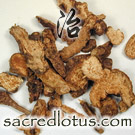 Cang Zhu12-15 gAromatic Herbs that Transform and Dissolve Dampness
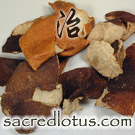 Chen Pi9-12 gRegulate the Qi
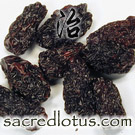 Da Zao3 piecesTonify Qi
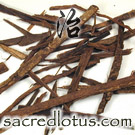 Hou Po9-12 gAromatic Herbs that Transform and Dissolve Dampness
 Sheng Jiang3 gWarm, Spicy Herbs that Release the Exterior
 Zhi Gan Cao3-6 gTonify Qi
Preparation & dosage
How is Ping Wei San prepared?
Classically Ping Wei San is a powder (san) — the four core herbs ground coarse and simmered briefly with fresh ginger and jujube, then the liquid strained off and taken warm; in modern practice it is most often decocted directly as a tang (decoction) using the same six ingredients. The name itself (“san”, powder) reflects its original form in the Song-dynasty formulary, though the working method — herbs coarsely ground, then boiled with ginger and jujube added at the time of cooking — is essentially the decoction technique used today.
- Cang Zhu processing: traditionally soaked in rice-washing water and/or bran- or wok-fried before use, a step meant to moderate its strong, harsh dryness so it acts more gently on the Middle.
- Zhi Gan Cao: honey-fried (zhi), per Sacred Lotus sources & references, rather than used raw — standard practice to enhance its harmonizing, Spleen-supporting action.
- Sheng Jiang: used fresh/uncooked (per Sacred Lotus sources & references), added at the time of decoction rather than pre-processed with the other herbs.
- Da Zao: whole jujube pieces (per Sacred Lotus sources & references: 3 pieces), simmered together with the rest.
Source: Tai Ping Hui Min He Ji Ju Fang (original powder form and preparation instructions), as summarized in Bensky & Barolet, Formulas & Strategies; live Sacred Lotus sources & references (herb processing and amounts). Reference only, not a prescription.
Safety — read before use
What are the cautions for Ping Wei San?
Ping Wei San is a drying, warming formula for excess damp stagnation and is inappropriate where the underlying problem is Spleen–Stomach qi or yin deficiency without significant dampness, or where damp has already transformed into heat or dryness. Its acrid, bitter, warm herbs (Cang Zhu, Hou Po, Chen Pi) are chosen for their strength in drying and moving; used against the wrong pattern, that same strength can injure fluids or aggravate heat.
- Avoid or modify in Stomach/Spleen yin deficiency and in patterns with signs of dryness or heat — a dry mouth, thirst, a red tongue with little or no coating, or a rapid pulse indicate the pattern has shifted away from the damp-cold presentation this formula is designed for.
- Avoid or modify in damp-heat (as opposed to damp-cold) stagnation, since the formula’s warm herbs can add fuel to underlying heat.
- Pregnancy: contains Hou Po and Cang Zhu, both strongly qi- and damp-moving; use only under professional guidance.
- Not intended for prolonged standalone use: once the damp-stagnation pattern resolves, the formula is typically stopped or modified, since its drying herbs can deplete fluids and injure Spleen qi if continued after the dampness has cleared.
Source: Bensky & Barolet, Formulas & Strategies (cautions for dampness-drying, qi-moving formulas); Chen & Chen, Chinese Medical Herbology and Pharmacology. Traditional-use framing; not medical advice.
Originally Appeared In:
- Imperial Grace Formulary of the Tai Ping Era (Tai Ping Hui Min He Ji Ju Fang)
Notes:
How does Ping Wei San compare with Wei Ling Tang, Bu Huan Jin Zheng Qi San, and Chai Ping Tang?
Ping Wei San’s four-herb core (Cang Zhu, Hou Po, Chen Pi, Zhi Gan Cao) is the base that a whole family of combination formulas builds on, each adding a different herb group to extend the same damp-stagnation strategy toward a related pattern. The formula’s classical source is the Tai Ping Hui Min He Ji Ju Fang (Formulary of the Peaceful Benevolent Dispensary), an official Song-dynasty (1107 CE) government formulary.
- Wei Ling Tang — Ping Wei San combined with Wu Ling San (Ze Xie, Zhu Ling, Fu Ling, Bai Zhu, Gui Zhi). Adding Wu Ling San’s diuretic, yang-transforming herbs extends Ping Wei San’s dampness-drying action with active fluid drainage, making it the better choice when damp stagnation presents with more pronounced diarrhea, scanty urination, or edema alongside the epigastric fullness.
- Bu Huan Jin Zheng Qi San (“Not Even Gold Can Buy This” Powder) — Ping Wei San plus Huo Xiang and Ban Xia. The added aromatic, phlegm-transforming herbs strengthen the formula’s ability to resolve turbid damp with a concurrent exterior wind-cold or summer-damp component, historically used for early-stage vomiting-and-diarrhea disorders with chills, fever, and a stifling sensation in the chest and epigastrium.
- Chai Ping Tang — Ping Wei San combined with Xiao Chai Hu Tang (Chai Hu, Huang Qin, Ban Xia, Ren Shen, Sheng Jiang, Da Zao, Zhi Gan Cao). This pairs Ping Wei San’s damp-drying, qi-moving action with Xiao Chai Hu Tang’s ability to harmonize the Shaoyang, indicated when damp stagnation in the Spleen and Stomach coincides with Shaoyang signs such as alternating chills and fever, a bitter taste, or chest-and-rib-side fullness.
Well-known modifications: Mu Xiang and Sha Ren are commonly added (forming Xiang Sha Ping Wei San) to strengthen qi movement and relieve pain when qi stagnation is prominent; Shen Qu, Mai Ya, and/or Shan Zha are added when food stagnation accompanies the damp pattern.
Source: Tai Ping Hui Min He Ji Ju Fang (classical source and formula lineage); Bensky & Barolet, Formulas & Strategies (combination formulas and modifications); Chen & Chen, Chinese Medical Herbology and Pharmacology.
Clinical Studies & Research:
Is there modern research on Ping Wei San?
Yes — Ping Wei San (Pyeongwi-san in Korean Traditional Medicine) is one of the most widely used formulas for digestive complaints in modern East Asian clinical practice, and current research spans population-level prescribing data, preclinical gut-microbiota mechanism studies, and early in-vitro/in-silico work.
- Clinical prescribing patterns (population study, Korea): a nationwide analysis of nearly 19.4 million Korean national health insurance claims for functional dyspepsia (2010–2019) found Pyeongwi-san (Ping Wei San) was the single most frequently prescribed herbal medicine, accounting for 31.12% of prescriptions, most often for elderly patients (PMID 35132326).
- Clinical/pharmacological overview (English-language): an early review written for U.S. pharmacists described Ping Wei San as a traditional Chinese remedy commonly used for gastritis, reflux, ulcers, and enteritis, and outlined the terminology and TCM framework needed to counsel patients using it (PMID 11215844).
- Ulcerative colitis, gut microbiota (preclinical, mouse): in a dextran-sulfate-sodium colitis model, Ping Wei San reduced weight loss, improved stool consistency, lowered pro-inflammatory cytokines IL-17A and IFN-γ, strengthened intestinal barrier protein (occludin) expression, and shifted gut microbiota composition (reduced Bacteroidetes, increased Firmicutes) — the authors concluded the formula’s anti-colitis effect works substantially through rebalancing intestinal bacteria (PMID 32114163).
- Gastroprotection / anti-H.-pylori (in vitro, comparative): a comparative study of three Korean herbal formulas for functional dyspepsia found Pyeongwi-san improved inflammatory and gastric-mucosa-protective gene expression, though a companion formula showed stronger direct anti-H.-pylori activity in the same experiment (PMID 38891033).
- Network pharmacology (in silico): computational screening of Pyeongwi-san’s constituent compounds against inflammatory bowel disease targets identified 26 candidate proteins and pathways (including TNF signaling and tight-junction integrity), with two compounds — β-eudesmol and a bisabolane sesquiterpenoid — showing strong predicted binding in molecular docking (PMID 37759722).
- Gut–brain axis (preclinical, mouse): a modified Ping-wei-san-based decoction (Ping Wei San plus additional herbs, not the plain six-herb formula) improved motor and emotional behavior and restored gut microbiota balance in a rotenone-induced Parkinson’s disease model, with multiomics analysis pointing to dopamine-signaling and gut-microbiome pathways (PMID 36687704).
Sources: PubMed 35132326; PubMed 11215844; PubMed 32114163; PubMed 38891033; PubMed 37759722; PubMed 36687704. Research context, not a therapeutic claim; most mechanistic evidence is preclinical (animal/in-vitro/in-silico), with direct clinical-trial evidence for Ping Wei San itself still limited.
Sources & References
Compiled and edited by Thomas Dehli, Founder & Editor, Sacred Lotus Updated
The information here is referenced from numerous sources — teachers, practitioners, class notes from Five Branches University, the books below, and the published research literature, with citations given as resolvable PubMed identifiers. Where sources disagree, I have flagged the discrepancies directly. If facts couldn't be verified, I have left them out. How we source our content.
Reference information for students and practitioners — not medical advice. Consult a qualified practitioner. Terms of use.
Chinese Formulas Books & References
 https://amzn.to/4fYI3f8
 https://amzn.to/4j55NRA
 https://amzn.to/4gMROyv
 https://amzn.to/4h7msSK