
Ding Xiang Shi Di Tang
Clove and Persimmon Calyx Decoction
- Category
- Formulas that Regulate the Qi
- Subcategory
- Formulas that Direct Rebellious Qi Downward
- Ingredients
- 4 herbs
Actions
What does Ding Xiang Shi Di Tang do?
Ding Xiang Shi Di Tang (Clove and Persimmon Calyx Decoction) warms the Stomach, augments Stomach qi, and directs rebellious qi downward to stop hiccup. It is built around one of the best-known herb pairs in the Chinese materia medica — Ding Xiang (Clove) and Shi Di (Persimmon Calyx) — used together specifically for hiccup, belching, or vomiting arising from Cold in a deficient Stomach.
The four ingredients divide by role:
- Chief: Ding Xiang and Shi Di act as a paired chief — Ding Xiang is acrid and warm, dispelling Cold from the Stomach and driving qi downward; Shi Di is bitter, astringent, and specific for anchoring rebellious qi and arresting hiccup. Neither achieves the descending, anti-hiccup effect as reliably alone.
- Deputy: Ren Shen tonifies Stomach and Source qi, addressing the underlying deficiency that lets qi rebel upward in the first place.
- Assistant: Sheng Jiang reinforces the warming and descending action of the chief pair and settles accompanying nausea.
Published sources agree that Ding Xiang and Shi Di form the chief pair, but disagree on the finer deputy/assistant split between Ren Shen and Sheng Jiang — some references list Ren Shen as deputy and Sheng Jiang as assistant, others the reverse, and at least one lists Ding Xiang itself as envoy rather than chief. The role assignment above follows the majority of cross-checked sources and the formula's own name (its two title herbs as chief); it could not be confirmed against the primary Bensky & Barolet text directly.
Source: Sacred Lotus sources & references + Bensky & Barolet, Formulas & Strategies, cross-checked against other published formula references for the chief/deputy/assistant analysis (Sacred Lotus role flags were unset). Traditional-use framing; not medical advice.
Indications
What is Ding Xiang Shi Di Tang used for?
Ding Xiang Shi Di Tang treats persistent hiccup, belching, or vomiting caused by Cold from Stomach deficiency. This is the classic presentation of rebellious Stomach qi — qi that should descend instead rises — driven by a Stomach that is both cold and too weak to hold its normal downward direction.
Its classic clinical presentation:
- Core signs: hiccup, belching, or vomiting with a stifling sensation in the epigastrium and focal distention in the chest.
- Underlying pattern: Cold from Stomach deficiency — the hiccup is persistent rather than acute, and worsens with cold food or fatigue.
Tongue and pulse: the tongue is pale with a white coating; the pulse is submerged (deep) and slow.
Source: Sacred Lotus sources & references on pattern/tongue/pulse + Bensky & Barolet, Formulas & Strategies. Traditional-use framing; not medical advice.
Western Uses:
What is Ding Xiang Shi Di Tang used for in modern practice?
In modern practice this formula's Cold-deficiency hiccup pattern has traditionally been applied to persistent or intractable hiccup, post-surgical diaphragm spasm, chemotherapy-associated hiccup, and morning sickness — contexts where Western medicine recognizes hiccup (singultus) as a distinct, sometimes hard-to-treat symptom.
These biomedical correlates are offered as a reference to the formula's traditional use, not as a claim that it treats any disease. A related Kampo (Japanese herbal medicine) formula built on the same persimmon-calyx herb, known as Shitei-to, has been studied in Japan specifically for chemotherapy-associated hiccup (see research); direct modern research on the four-herb Chinese formula itself remains limited. Any use for a diagnosed condition belongs with a qualified practitioner and appropriate medical care.
Source: traditional-use correlates summarized from Bensky & Barolet, Formulas & Strategies; reference only, not a treatment claim.
Ingredients
4 substances in Ding Xiang Shi Di Tang — each links to its full herb monograph.
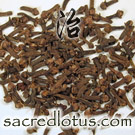 Ding Xiang6 gWarm the Interior and Expel Cold
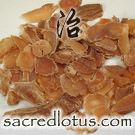 Ren Shen3-6 gTonify Qi
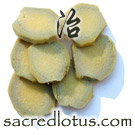 Sheng Jiang6-9 gWarm, Spicy Herbs that Release the Exterior
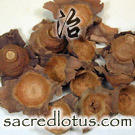 Shi Di6-9 gRegulate the Qi
Preparation & dosage
How is Ding Xiang Shi Di Tang prepared?
Ding Xiang Shi Di Tang is prepared as a decoction (tang) — the four herbs are simmered together in water, strained, and the resulting liquid is drunk warm.
- Method: simmer the herbs in water until reduced, then strain; take warm rather than cold or hot.
- Timing: traditionally taken between meals, in divided doses through the day, with more frequent small sips if hiccup is severe.
- Course: used acutely and reassessed once the hiccup resolves, rather than continued as a long-term formula.
Source: Bensky & Barolet, Formulas & Strategies (standard decoction preparation for this formula class). Traditional-use framing; not medical advice.
Decoction. Reference relative amounts (per Sacred Lotus sources & references): Ding Xiang 6 g; Shi Di 6-9 g; Ren Shen 3-6 g; Sheng Jiang 6-9 g. Dang Shen is sometimes substituted for Ren Shen. Reference only; not a prescription.
Safety — read before use
What are the cautions for Ding Xiang Shi Di Tang?
Ding Xiang Shi Di Tang is a warming formula for Cold-deficiency hiccup, so it is unsuitable for hiccup caused by Heat. Heat-type hiccup presents with loud, forceful hiccups, bad breath, thirst for cold drinks, a red tongue with yellow coating, and a rapid pulse — the opposite of this formula's pale tongue and slow, submerged pulse.
- Avoid or modify where Liver qi stagnation has transformed into Fire, or where Yin-deficiency Fire is driving the rebellious qi, since Ding Xiang's warmth would aggravate Heat.
- Use with caution in severe qi or yang collapse, or in marked post-illness/postpartum yin deficiency, where the warming, drying herbs need careful balancing.
- Acute-use formula: traditionally taken for a short course (days, not weeks) and reassessed once the hiccup resolves rather than continued long-term.
Source: Bensky & Barolet, Formulas & Strategies (Cold vs. Heat hiccup differentiation and cautions for warming formulas). Traditional-use framing; not medical advice.
Originally Appeared In:
- Pattern, Cause, Pulse, and Treatment (Zheng Yin Mai Zhi)
Notes:
How is Ding Xiang Shi Di Tang different from related Stomach-qi-descending formulas?
The differentiating question is Cold vs. Heat and how much qi deficiency is present. Several formulas direct rebellious Stomach qi downward for hiccup or vomiting, but they target different underlying patterns.
- vs Ju Pi Zhu Ru Tang: that formula treats hiccup from Stomach deficiency leaning toward Heat (dry mouth, restlessness, a slightly red tongue) and shares Ren Shen and Sheng Jiang but replaces Ding Xiang and Shi Di with Zhu Ru to clear mild Heat; choose Ding Xiang Shi Di Tang when the pattern is clearly Cold rather than Heat.
- vs Wu Zhu Yu Tang: also warms and descends, but targets Liver-Stomach Cold with vertex headache and drooling rather than a Stomach-only deficiency-Cold hiccup.
- vs Xuan Fu Dai Zhe Tang: addresses rebellious Stomach qi complicated by phlegm obstruction and uses heavy, settling minerals; better suited when fullness and phlegm dominate over simple Cold-deficiency.
Formula history: the Ding Xiang–Shi Di herb pair originated as a simpler two-herb formula and was later expanded with Ren Shen and Sheng Jiang to address concurrent qi deficiency, giving the four-herb version used today; the source text is Zheng Yin Mai Zhi (Symptom, Cause, Pulse and Treatment), compiled in the Ming dynasty and published in 1706.
Source: Bensky & Barolet, Formulas & Strategies (comparative formula analysis and source-text attribution).
Clinical Studies & Research:
Is there modern research on Ding Xiang Shi Di Tang?
Direct modern research on the four-herb Chinese formula itself is limited, but a related Kampo (Japanese herbal medicine) formula built on the same persimmon-calyx herb, known as Shitei-to, has several published Japanese studies on hiccup. A 2025 scoping review of hiccup interventions catalogued multiple retrospective/observational Shitei-to studies, and one of the underlying studies (in chemotherapy inpatients) reported the treatment effective in 82% of patients (45 of 55) with no related adverse events. Because Shitei-to's exact herb list was not confirmed in these sources, it is best read as evidence for the shared persimmon-calyx/hiccup approach rather than a direct trial of this specific four-herb formula.
- Hiccup in cancer/chemotherapy patients (Japan, retrospective): shitei extract was effective in 82.0% of chemotherapy patients with hiccup (45 of 55), with no reported adverse events (PMID 31296823).
- Scoping review context: a 2025 scoping review of hiccup interventions in adults catalogued this and several other Japanese retrospective studies of Shitei-to alongside Western pharmacologic approaches (DOI 10.1089/pmr.2024.0109; PMC 12040553).
Sources: PubMed 31296823; PMC 12040553 (DOI 10.1089/pmr.2024.0109). Small, published Chinese clinical observations of the exact four-herb formula exist but were not found indexed with a resolvable PMID/DOI and are therefore omitted. Research context, not a therapeutic claim.
Sources & References
Compiled and edited by Thomas Dehli, Founder & Editor, Sacred Lotus Updated
The information here is referenced from numerous sources — teachers, practitioners, class notes from Five Branches University, the books below, and the published research literature, with citations given as resolvable PubMed identifiers. Where sources disagree, I have flagged the discrepancies directly. If facts couldn't be verified, I have left them out. How we source our content.
Reference information for students and practitioners — not medical advice. Consult a qualified practitioner. Terms of use.
Chinese Formulas Books & References
 https://amzn.to/4fYI3f8
 https://amzn.to/4j55NRA
 https://amzn.to/4gMROyv
 https://amzn.to/4h7msSK