
Radix Codonopsitis Pilosulae Codonopsis Root
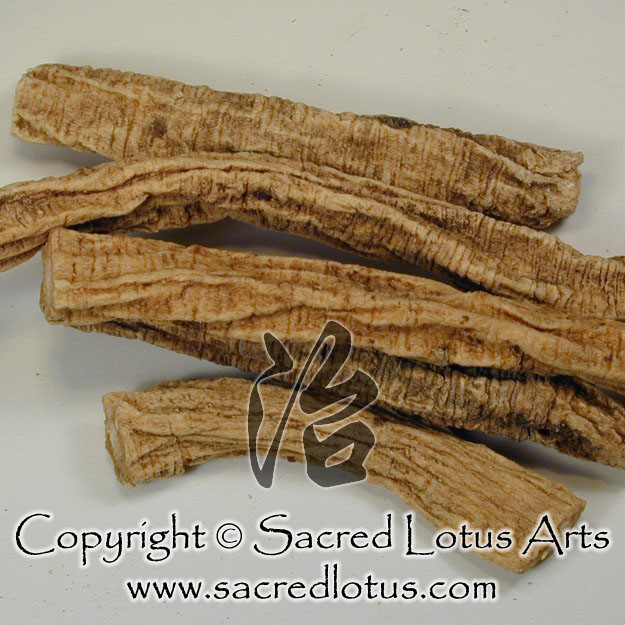
Materia Medica Data
- Category
- Herbs that Tonify Qi
- Temperature
- Neutral
- Nature & Flavour
- Sweet, Neutral
- Channels Entered
- LU, SP
- Latin (pharmaceutical)
- Radix Codonopsitis Pilosulae
- Chinese
- 党参
- Tone Marks
- dăng shēn
- Translation
- Group Root
Chinese Herb Actions
What is Dang Shen used for in Chinese medicine?
Dang Shen (Codonopsis Root) is traditionally used to tonify the Spleen and Lung qi — for qi-deficiency patterns showing poor appetite, fatigue, loose stools, weak limbs, chronic cough, shortness of breath, and a weak voice. It also generates fluids where there is thirst and gently supports the blood, and it serves as an economical stand-in for Ren Shen (ginseng) in deficiency patterns that are not qi or yang collapse.
Its main traditional actions:
- Tonifies Spleen & Stomach qi — poor appetite, fatigue, loose stools, a pale complexion.
- Tonifies Lung qi — chronic cough, shortness of breath, a weak voice.
- Generates fluids and supports the blood — where qi deficiency is joined by thirst or mild blood deficiency.
- A gentle substitute for Ren Shen — used in larger doses where ginseng would otherwise be indicated (non-collapse patterns).
Source: owner’s Five Branches notes, reviewed against Bensky, Materia Medica (3rd ed.). Traditional-use framing; not medical advice.
Chinese Herb Dosage
What is the typical dosage of Dang Shen?
9–30 g in decoction. Up to 30–60 g when used as a higher-dose, economical substitute for Ren Shen in deficiency (not collapse) patterns.
Source: owner’s Five Branches notes; standard materia medica ranges. Reference only — not a prescription.
Chinese Herb Contraindications & Cautions
Are there cautions or contraindications for Dang Shen?
Dang Shen is generally very well tolerated. Use it with care in excess or heat patterns, or fullness, that lack an underlying deficiency. Per the classical Eighteen Incompatibilities, it is traditionally not combined with Li Lu (Veratrum).
Source: owner’s Five Branches notes; classical incompatibility lists.
Chinese Herb Toxicity & Overdose
Low. No significant toxicity is reported at normal therapeutic doses; Codonopsis is regarded as a safe, food-grade tonic.
Source: materia medica consensus; no toxicity signal in the reviewed research.
Herb-Drug Interactions
No well-established clinical herb–drug interactions are documented. Given the immunomodulatory activity seen in laboratory research (below), practitioner caution is reasonable alongside immunosuppressant therapy. (Flagged for practitioner confirmation — absence of documented interactions is not proof of safety.)
Western / Biomedical Research
Chinese Herb Clinical Studies & Research
Provided as research context — a summary of published biomedical study, not a therapeutic or medical claim.
Is there modern research on Codonopsis (Dang Shen)?
Yes, but it is largely preclinical. The most-studied constituents are Codonopsis polysaccharides (CPPs), which show immunomodulatory activity in vitro and in animal models — modulating macrophage, NK-cell and T/B-lymphocyte function and cytokine secretion. In immunosuppressed mice, CPPs raised IgG and cytokine (IL-2, IL-10, IFN-γ) levels and supported intestinal mucosal immunity and gut microbiota. Human clinical evidence remains limited.
Sources: PubMed 9304404 (immunomodulatory polysaccharide preparation); PMC 6100181 (immunity & gut microbiota, immunosuppressed mice); PMC 12497736 (review of Codonopsis polysaccharides). Research context, not a therapeutic claim.
Chinese Herb Notes
How is Dang Shen different from Ren Shen (ginseng)?
Dang Shen is the gentler, more economical Lung/Spleen qi tonic; Ren Shen is reserved for qi or yang collapse. Dang Shen is favored for everyday Lung and Spleen qi deficiency and is used in larger doses; Ren Shen tonifies the Source (Yuan) qi, acts more strongly, and is considerably more costly. The two are combined when stronger tonification is wanted.
It also differs from its close neighbors:
- vs Tai Zi Shen — Tai Zi Shen is gentler and more moistening; favored when there is ascending Liver yang.
- vs Bai Zhu — Bai Zhu is more strengthening and drying to the Spleen; favored when qi deficiency produces dampness or water-metabolism problems.
- vs Huang Qi — Huang Qi better warms and raises qi and aids water metabolism, and is preferred alongside blood tonics to build blood.
Common combinations: with Bai Zhu and Fu Ling (the Si Jun Zi Tang framework) to strengthen the Spleen; with Huang Qi to raise and augment qi; with Dang Gui and blood tonics for concurrent qi-and-blood deficiency.
Source: owner’s Five Branches notes (differentiation set & combinations).
This herb is incompatible with:
- Li Lu (Radix Et Rhizoma Veratri)
Sources & References
Compiled and edited by Thomas Dehli, Founder & Editor, Sacred Lotus Updated
The information here is referenced from numerous sources — teachers, practitioners, class notes from Five Branches University, the books below, and the published research literature, with citations given as resolvable PubMed identifiers. Where sources disagree, I have flagged the discrepancies directly. If facts couldn't be verified, I have left them out. How we source our content.
Reference information for students and practitioners — not medical advice. Consult a qualified practitioner. Terms of use.
Chinese Herbs Books & References
 https://amzn.to/3WfB3DK
 https://amzn.to/3DR1VUh
 https://amzn.to/42aMz73
 https://amzn.to/3PuD4bt