
Radix Dioscoreae Oppositae Chinese Yam Rhizome, Dioscorea
Also known as Huai Shan Yao, Huai Shan
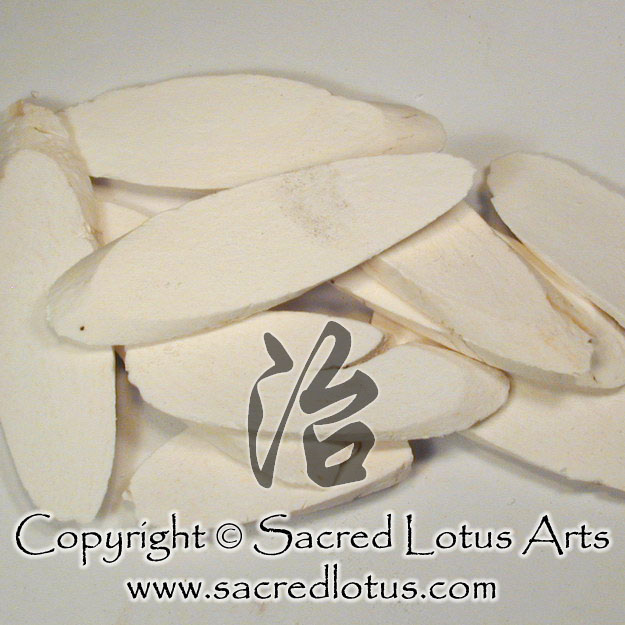
Materia Medica Data
- Category
- Herbs that Tonify Qi
- Temperature
- Neutral
- Nature & Flavour
- Sweet, Neutral
- Channels Entered
- KI, LU, SP
- Latin (pharmaceutical)
- Radix Dioscoreae Oppositae
- Chinese
- 山药
- Tone Marks
- shān yao
- Also Known As
- Huai Shan Yao, Huai Shan
- Translation
- Mountain Herb, Mountain Medicine
Chinese Herb Actions
What is Shan Yao (Chinese yam) used for in Chinese medicine?
Shan Yao is a gentle herb that tonifies the Qi and Yin of the Spleen, Lung, and Kidney together — unlike drier Qi tonics, it nourishes fluids as it strengthens, so it is prized for treating deficiency in more than one organ at once and can be taken alone in large doses when a single, safe tonic is wanted.
Its main traditional actions:
- Tonifies the Qi and Yin of the Spleen and Stomach — for deficiency with lack of appetite and energy, loose stools, spontaneous sweating, abdominal distention after eating, and a pale tongue; can be used alone in large doses for this purpose.
- Tonifies the Qi and Yin of the Lung — for Lung Qi-and-Yin deficiency with chronic coughing and wheezing; when Yin deficiency is pronounced, there may be little or no sputum, or small amounts of sticky sputum.
- Tonifies Yin — nourishing, slightly astringent, and not drying, it is considered effective for Xiao Ke (wasting-and-thirsting disorder, the traditional pattern most associated with diabetes-like presentations) and can be used alone in large quantities for this purpose.
- Tonifies Kidney Qi and Yin and stabilizes (secures) the essence — for Kidney deficiency with spermatorrhea, urinary frequency, and vaginal discharge (leukorrhea).
Source: existing Sacred Lotus content, reviewed against Bensky-style materia medica consensus (Herbs that Tonify Qi). Traditional-use framing; not medical advice.
Chinese Herb Dosage
What is the typical dosage of Shan Yao?
Roughly 9–30 g in standard decoction, prepared from the sliced dried rhizome. When used alone as the primary herb for pronounced deficiency or Xiao Ke (wasting-and-thirsting), materia medica sources describe much larger single-herb doses, on the order of 60–250 g per day. As a powder, about 3–10 g is typical.
Two processed forms are distinguished in practice: raw (unprocessed) Shan Yao, favored for nourishing Yin and benefiting the Lung and Kidney (including essence-related complaints), and bran/dry-fried (chǎo) Shan Yao, favored for strengthening the Spleen and Stomach and reducing its tendency to looseness of stool, at some cost to its Yin-nourishing strength.
Source: materia medica consensus (Bensky-style dosage ranges); processed-form distinction cross-checked against contemporary Chinese pharmacy references. Reference only — not a prescription.
Chinese Herb Contraindications & Cautions
Are there cautions for Shan Yao?
Shan Yao should not be used alone where there is an accumulation of dampness with abdominal fullness — as with other Spleen tonics, its nourishing, slightly moistening nature is not suited to excess/damp-turbid presentations without appropriate combination. It is otherwise considered a gentle, well-tolerated herb.
- Diabetes/blood-glucose context (reference note) — because Shan Yao has documented hypoglycemic activity in laboratory research (below) and is traditionally used at high single-herb doses for Xiao Ke, anyone on glucose-lowering medication should use it under professional guidance and monitor blood glucose rather than self-adjusting doses.
Source: existing Sacred Lotus content; materia medica consensus on Spleen-tonic/dampness cautions; research context below.
Chinese Herb Toxicity & Overdose
Low. Shan Yao is a food-grade dietary staple (Chinese yam) with a long history of use as both food and medicine, and no significant toxicity is reported at normal therapeutic doses. A separate, well-documented issue is contact dermatitis (“yam itch”) from handling and peeling the raw, fresh tuber — skin and mucosal irritation attributed to calcium-oxalate crystals in the fresh plant — which is a food-preparation concern rather than a property of the dried, sliced medicinal herb used in decoctions.
Source: materia medica consensus (dietary safety); horticultural/food-safety references on fresh-tuber contact dermatitis. Reference note, not a safety guarantee.
Herb-Drug Interactions
May interact with anti-diabetic (glucose-lowering) medications. This flag is preserved from existing Sacred Lotus content and is consistent with preclinical research (below) showing polysaccharide fractions of Chinese yam lower blood glucose in diabetic animal models; no formal human drug-interaction study has been done, so this is a precautionary, practitioner-confirmation flag rather than a demonstrated clinical interaction. (Flagged for practitioner confirmation.)
Western / Biomedical Research
Chinese Herb Clinical Studies & Research
Provided as research context — a summary of published biomedical study, not a therapeutic or medical claim.
Is there modern research on Shan Yao / Chinese yam (Dioscorea opposita)?
Yes — a 2025 systematic review found mostly preclinical support plus a small amount of human data, with blood-glucose and gut-health effects the best-studied areas. The review covered 27 studies (2 human trials, 25 animal experiments) on Dioscoreae Rhizoma and gastrointestinal/metabolic function.
- Human data (limited, n = 2 studies) — one study in 92 patients with type 2 diabetes after colorectal cancer surgery reported faster wound healing and fewer infections with yam supplementation versus controls; a second, small study (10 obese participants) found increased beneficial gut bacteria (e.g. Bifidobacterium) after a yam-based functional snack. Both are small, preliminary studies, not large controlled trials.
- Blood glucose (preclinical, animal) — a polysaccharide isolated from Chinese yam root (DOTP-80) showed dose-dependent hypoglycemic activity, improved glucose disposal, and raised antioxidant (SOD) enzyme activity in alloxan-induced diabetic mice and rats, without stimulating insulin secretion in healthy animals.
- Blood glucose and lipids (preclinical, animal, 2026) — polysaccharides from Chinese yam and its peel improved blood glucose and lipid profiles and favorably shifted gut microbiota in a high-fat-diet-plus-streptozotocin mouse model of type 2 diabetes, with the peel-derived polysaccharide outperforming the whole-root extract.
- Gut barrier / microbiota (systematic review, mixed human + animal) — across the reviewed studies, yam intake was associated with improved intestinal barrier markers (e.g. tight-junction proteins), increased short-chain-fatty-acid-producing bacteria, and reduced inflammatory cytokines in colitis and gastric-lesion models; the review authors note a lack of high-quality human studies and heterogeneity in plant part, extraction method, and dose across studies.
Overall, human clinical evidence remains limited (small, early studies); most support for blood-glucose and gut effects is preclinical.
Note: Research literature increasingly uses Dioscorea polystachya Decne. as the accepted name for the species long called Dioscorea opposita Thunb. (with D. batatas as an older synonym); all refer to the same Shan Yao / Chinese yam. Sacred Lotus Latin (Radix Dioscoreae Oppositae) is left unchanged pending owner confirmation.
Sources: PMID 41010469, DOI 10.3390/nu17182943 (systematic review, Nutrients, 2025); PMID 25809611, DOI 10.3390/ijms16036391 (antihyperglycemic polysaccharide, animal study, 2015); PMID 41344459, DOI 10.1016/j.ijbiomac.2025.149445 (yam & peel polysaccharides in diabetic mice, 2026). Research context, not a therapeutic claim.
Chinese Herb Notes
How is Shan Yao different from other Qi and Yin tonics, and what does it combine with?
Shan Yao's defining feature is that it tonifies Qi and Yin together without being warming/drying or cloying — most Qi tonics (Ren Shen, Huang Qi, Bai Zhu) are more warming and can dry dampness, while Shan Yao stays neutral and moistening, making it safe to use even where Yin deficiency is also present.
- vs Bai Zhu — both treat Spleen-deficiency diarrhea, but Bai Zhu actively dries dampness while Shan Yao does not, so Shan Yao suits cases with concurrent Yin deficiency where drying herbs are less appropriate.
- vs Ren Shen / Huang Qi — these raise and strongly tonify Qi (or Yang), whereas Shan Yao is gentler and dual-purpose (Qi and Yin), often used alongside rather than instead of them.
- vs dedicated essence-securing astringents (e.g. Qian Shi, Fu Pen Zi) — Shan Yao secures essence as a secondary action of its Kidney tonification, rather than as a pure astringent.
Common formula combinations (per Sacred Lotus formula database): Shen Ling Bai Zhu San and Jian Pi Wan (Spleen Qi deficiency with diarrhea); Liu Wei Di Huang Wan and Zuo Gui Yin (Kidney/Liver Yin); Jin Gui Shen Qi Wan and You Gui Wan (Kidney Yang, paired with Yin within the same formula); Tu Si Zi Wan and Suo Quan Wan (urinary frequency, enuresis); Wan Dai Tang and Yi Huang Tang (vaginal discharge); and Yu Ye Tang (Xiao Ke, wasting-and-thirsting). (Traditional formula context, not treatment advice.)
Is “Chinese yam” the same thing as “wild yam” supplements?
No — they are different species used for different purposes. Shan Yao (Chinese yam) is Dioscorea opposita/polystachya, a food-grade Qi-and-Yin tonic used in TCM formulas as above. Western “wild yam” supplements marketed for menopause/“natural progesterone” support are typically Dioscorea villosa, and the diosgenin they contain is not converted into progesterone by the human body (that conversion requires a laboratory process). The two should not be assumed interchangeable.
Source: existing Sacred Lotus content (differentiation & combinations); Sacred Lotus formula links; species/claim distinction cross-checked against botanical and pharmacology references.
Sources & References
Compiled and edited by Thomas Dehli, Founder & Editor, Sacred Lotus Updated
The information here is referenced from numerous sources — teachers, practitioners, class notes from Five Branches University, the books below, and the published research literature, with citations given as resolvable PubMed identifiers. Where sources disagree, I have flagged the discrepancies directly. If facts couldn't be verified, I have left them out. How we source our content.
Reference information for students and practitioners — not medical advice. Consult a qualified practitioner. Terms of use.
Chinese Herbs Books & References
 https://amzn.to/3WfB3DK
 https://amzn.to/3DR1VUh
 https://amzn.to/42aMz73
 https://amzn.to/3PuD4bt