
Zhi Zhu Wan
Immature Bitter Orange and Atractylodes Macrocephala Pill
- Category
- Formulas that Reduce Food Stagnation
- Subcategory
- Formulas that Reduce Food Stagnation
- Ingredients
- 2 herbs
Actions
What does Zhi Zhu Wan do?
Zhi Zhu Wan strengthens the Spleen and Stomach while gently moving accumulated food and qi stagnation. It is one of the classic small formulas of the Spleen–Stomach school — just two herbs, but their 2:1 ratio was deliberately reversed from an earlier decoction so that tonifying the Spleen, not purging stagnation, leads.
The two ingredients divide by role:
- Chief: Bai Zhu, dosed roughly double Zhi Shi, tonifies Spleen qi, dries dampness, and restores the Spleen’s ability to transform and transport food — addressing the root deficiency.
- Deputy: Zhi Shi breaks qi stagnation, disperses focal distension, and guides out accumulated food — addressing the branch (the stagnation left behind by a weak Spleen).
Bai Zhu’s gentle, upward-lifting tonification balances Zhi Shi’s downward-moving, dispersing action, so the formula reduces stagnation without further weakening a Spleen that is already deficient.
Source: Sacred Lotus sources & references + Bensky & Barolet, Formulas & Strategies (chief/deputy analysis; role flags were unset in our records and are derived here from this text). Traditional-use framing; not medical advice.
Indications
What is Zhi Zhu Wan used for?
Zhi Zhu Wan treats mild food/qi stagnation that arises from underlying Spleen qi deficiency — not stagnation from simple overeating in an otherwise strong digestion. It is the classic choice when a weak Spleen cannot move food efficiently, so food lingers and causes distension, rather than when stagnation itself is the primary problem.
Its classic clinical presentation:
- Epigastric focal distension (a sensation of fullness below the sternum, often worse after eating) without significant pain.
- Spleen-deficiency signs: poor appetite, fatigue, and a tendency toward loose stools.
- Common context: convalescence, chronic illness, or an elderly or otherwise weak patient whose digestion cannot keep pace with food intake.
Tongue and pulse: a white tongue coating with a deficient (weak) pulse — consistent with underlying deficiency rather than pure excess.
Source: Sacred Lotus sources & references on pattern/tongue/pulse + Bensky & Barolet, Formulas & Strategies. Traditional-use framing; not medical advice.
Western Uses:
What is Zhi Zhu Wan used for in modern practice?
In modern practice Zhi Zhu Wan and its Bai Zhu–Zhi Shi pairing are referenced for functional dyspepsia — persistent post-meal fullness, early satiety, and epigastric discomfort without a structural cause on endoscopy. This lines up with the formula’s traditional target of a weak Spleen struggling to move food.
These biomedical correlates are offered as a reference to the formula’s traditional use, not as a claim that it treats any diagnosed disease. Contemporary study is mostly network-pharmacology and animal work on the mechanism (see research); any use for a diagnosed digestive condition belongs with a qualified practitioner.
Source: traditional-use correlate summarized from Bensky & Barolet, Formulas & Strategies, cross-checked against the functional-dyspepsia research literature (see research); reference only, not a treatment claim.
Ingredients
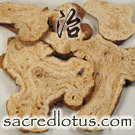
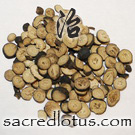
2 substances in Zhi Zhu Wan — each links to its full herb monograph.
Preparation & dosage
How is Zhi Zhu Wan prepared?
Classically Zhi Zhu Wan is a pill (wan), not a decoction: Bai Zhu and Zhi Shi are ground to a fine powder and formed into pills using rice that has been cooked wrapped in fresh He Ye (lotus leaf), then traditionally taken with warm rice-water or warm water. The lotus-leaf rice binder is a deliberate part of the design — the leaf’s light, upward-clearing quality complements Bai Zhu’s Spleen-lifting action.
In modern practice the same two herbs, in roughly the same 2:1 Bai Zhu-to-Zhi Shi ratio, are also commonly prepared as a decoction or taken as a granule/powder for convenience; the pill form is the historical original.
Source: Bensky & Barolet, Formulas & Strategies (traditional pill preparation with lotus-leaf rice). Traditional-use framing; not medical advice.
Traditionally a pill: Bai Zhu and Zhi Shi powdered and formed into pills with lotus-leaf-cooked rice, taken with warm water. Reference relative amounts (also prepared as a decoction in modern practice): Bai Zhu 12–18 g; Zhi Shi 6–9 g (roughly 2:1 Bai Zhu to Zhi Shi). Reference only.
Safety — read before use
What are the cautions for Zhi Zhu Wan?
Zhi Zhu Wan is a mild, deficiency-based formula and is not intended for pure excess stagnation or heat patterns. Where food stagnation is severe and the underlying digestion is otherwise strong (no fatigue or loose stools), a stronger reducing formula is generally chosen instead so the stagnation is cleared more directly.
- Not for Spleen–Stomach deficiency-cold or yin-deficiency patterns without accompanying qi stagnation — the formula is built around moving stagnation, not pure warming or nourishing.
- Zhi Shi is a strong qi-breaking, downward-moving substance; it is used cautiously, and generally avoided, in pregnancy.
- Not for excess heat or damp-heat food stagnation — those patterns call for formulas that also clear heat (see notes).
Source: Bensky & Barolet, Formulas & Strategies (cautions for qi-breaking, food-moving formulas; general caution profile of Zhi Shi). Traditional-use framing; not medical advice.
Originally Appeared In:
- Clarifying Doubts About Injury from Internal and External Causes (Nei Wai Shang Bian Huo Lun)
Notes:
How is Zhi Zhu Wan different from Bao He Wan and Zhi Shi Dao Zhi Wan?
Zhi Zhu Wan is built for stagnation caused by a weak Spleen; Bao He Wan is built for stagnation caused by simple overeating in a strong digestion. Bao He Wan uses a larger, more aggressive set of digestants (Shan Zha, Shen Qu, Lai Fu Zi and others) with no Spleen tonic, so it clears stagnation harder and faster — appropriate when there is no underlying deficiency.
- vs Bao He Wan: choose Zhi Zhu Wan when fatigue, poor appetite, or loose stools accompany the distension (deficiency present); choose Bao He Wan when digestion is otherwise robust and stagnation is the whole problem.
- vs Zhi Shi Dao Zhi Wan: Zhi Shi Dao Zhi Wan expands the same Zhi Shi–Bai Zhu core with heat-clearing and dampness-draining herbs (e.g., Huang Lian, Huang Qin, Fu Ling, Ze Xie) for damp-heat food stagnation with diarrhea and burning — a hotter, damper presentation than plain Zhi Zhu Wan treats.
Historical note: the formula is recorded, in a version with Bai Zhu dosed double Zhi Shi, in the Spleen–Stomach-school literature associated with Li Dongyuan (Jin dynasty) — a deliberate reversal from an earlier, more purgative ratio, shifting the strategy toward tonifying the Spleen with only gentle elimination of stagnation.
Source: Bensky & Barolet, Formulas & Strategies (formula-family comparisons and historical attribution).
Clinical Studies & Research:
Is there modern research on Zhi Zhu Wan?
Yes, though direct clinical-trial evidence on the classic two-herb formula itself is limited — most study is network pharmacology, with larger clinical evidence available for a related modern patent-medicine derivative. A system-pharmacology analysis of Zhi-zhu Wan (Zhi Shi + Bai Zhu) identified dozens of active components acting through inflammation, gastrointestinal-motility, and related signaling pathways relevant to functional dyspepsia, consistent with the formula’s traditional Spleen-strengthening, stagnation-moving action.
- Mechanism (preclinical/computational): system-pharmacology and network analysis of Zhi-zhu Wan for functional dyspepsia found synergistic, multi-pathway activity (calcium, cAMP, and NF-κB signaling) rather than a single active compound (PMID 30127739).
- Related derivative (clinical, for context): Zhizhu Kuanzhong Capsule — a modern four-herb patent formula built on the same Zhi Shi–Bai Zhu pairing plus two additional herbs, not identical to classic Zhi Zhu Wan — showed a better clinical effective rate than conventional care alone across 23 randomized trials (n=2,496; OR 3.32), though most included trials were of poor methodological quality (PMID 30159646).
Sources: PubMed 30127739; PubMed 30159646. Research context, not a therapeutic claim; direct trial evidence on the classic two-herb formula remains limited.
Sources & References
Compiled and edited by Thomas Dehli, Founder & Editor, Sacred Lotus Updated
The information here is referenced from numerous sources — teachers, practitioners, class notes from Five Branches University, the books below, and the published research literature, with citations given as resolvable PubMed identifiers. Where sources disagree, I have flagged the discrepancies directly. If facts couldn't be verified, I have left them out. How we source our content.
Reference information for students and practitioners — not medical advice. Consult a qualified practitioner. Terms of use.
Chinese Formulas Books & References
 https://amzn.to/4fYI3f8
 https://amzn.to/4j55NRA
 https://amzn.to/4gMROyv
 https://amzn.to/4h7msSK