
Tong Xie Yao Fang
Important Formula for Painful Diarrhea
- Category
- Formulas that Harmonize
- Ingredients
- 4 herbs
Actions
What does Tong Xie Yao Fang do?
Tong Xie Yao Fang harmonizes the Liver and Spleen, softening an overactive Liver while strengthening a deficient Spleen to stop painful diarrhea. It is the classic formula for a “Wood-overacting-on-Earth” pattern, in which Liver qi stagnation invades a Spleen too weak to hold its ground, producing recurrent cramping pain and loose stool rather than pure deficiency or pure stagnation alone.
Its four herbs divide by function:
- Bai Zhu (dry-fried): tonifies Spleen qi and dries dampness, rebuilding the transporting/transforming function a besieged Spleen has lost.
- Bai Shao (dry-fried): softens and calms the Liver, restrains its excess, nourishes Blood, and — paired with Bai Zhu — relieves the cramping abdominal pain.
- Chen Pi (dry-fried): regulates qi and dries dampness in the middle burner, keeping Bai Shao’s sour, slightly astringent nature from stagnating and helping the Spleen resume normal movement.
- Fang Feng: a wind-releasing herb repurposed here to course stagnant Liver qi and lift clear yang, working with Bai Zhu to dry dampness and check diarrhea — its inclusion in a digestive formula is explained further below.
Source: Sacred Lotus sources & references (composition) + Bensky & Barolet, Formulas & Strategies; Chen & Chen, Chinese Medical Herbology and Pharmacology.
Indications
What is Tong Xie Yao Fang used for?
Tong Xie Yao Fang treats painful diarrhea from Liver qi overacting on a deficient Spleen — cramping abdominal pain and loose, watery stool that recur in bouts, often triggered or worsened by stress, frustration, or anger, with the pain characteristically easing (though not always fully resolving) once the stool has passed.
- Recurrent bouts of abdominal pain with diarrhea, worse with emotional upset.
- Borborygmus (audible intestinal rumbling) accompanying the pain.
- A sensation of distension or fullness in the chest and flanks (Liver qi stagnation signs).
- Irritability or a tendency to sigh, alongside generally weak digestion.
- Pattern commonly correlated with diarrhea-predominant irritable bowel syndrome in contemporary practice.
Source: Sacred Lotus sources & references (pattern/tongue/pulse) + Bensky & Barolet, Formulas & Strategies.
Ingredients
4 substances in Tong Xie Yao Fang — each links to its full herb monograph.
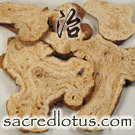 Bai Zhu9-12 gDry-FriedTonify Qi
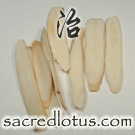 Bai Shao6-24 gDry-FriedTonify Blood
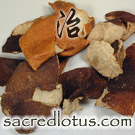 Chen Pi4.5-9 gDry-FriedRegulate the Qi
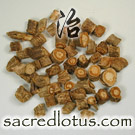 Fang Feng3-6 gWarm, Spicy Herbs that Release the Exterior
Preparation & dosage
How is Tong Xie Yao Fang prepared?
Tong Xie Yao Fang is prepared as a water decoction, with three of its four herbs dry-fried (stir-fried without liquid) before decocting. Bai Zhu, Bai Shao, and Chen Pi are each dry-fried: for Bai Zhu this deepens its Spleen-tonifying, drying action; for Bai Shao it tempers its cooling, sour nature so it softens the Liver without further burdening a weak Spleen; for Chen Pi it strengthens its warming, qi-regulating effect. Fang Feng is used raw (unprocessed) to preserve its dispersing quality.
Reference relative amounts: Bai Zhu 9–12 g, Bai Shao 6–24 g, Chen Pi 4.5–9 g, Fang Feng 3–6 g — decocted together in water and taken warm, typically in divided doses.
Source: Sacred Lotus sources & references (processing/amounts) + Bensky & Barolet, Formulas & Strategies.
Safety — read before use
What are the cautions for Tong Xie Yao Fang?
Tong Xie Yao Fang is designed for a specific Liver-overacting-on-Spleen pattern and is not a general-purpose remedy for diarrhea. It is not appropriate for diarrhea driven by damp-heat (foul-smelling stool, burning sensation, yellow tongue coat), by food stagnation (marked distension and belching relieved by vomiting or purging), or by pure Spleen-qi deficiency without a Liver component (fatigue-predominant loose stool with no cramping or emotional trigger) — those patterns call for different formulas.
- Fever, blood or mucus in the stool, or signs of infection point away from a simple Liver-Spleen pattern and warrant proper medical evaluation rather than this formula alone.
- Persistent or recurrent diarrhea of any kind should be assessed by a qualified practitioner to rule out underlying digestive disease.
- None of the four ingredients are restricted or toxic herbs; the caution here is one of pattern-matching, not ingredient safety.
Source: Bensky & Barolet, Formulas & Strategies (pattern differentiation and cautions).
Originally Appeared In:
- Collected Treatises of Jing Yue (Jing Yue Quan Shu)
Notes:
How does Tong Xie Yao Fang differ from Shen Ling Bai Zhu San and Ge Gen Qin Lian Tang?
Tong Xie Yao Fang is chosen specifically when Liver qi stagnation is driving a Spleen-deficient diarrhea — the emotional trigger and cramping pain are the giveaway. Without those signs, other diarrhea formulas fit better.
- vs Shen Ling Bai Zhu San: that formula tonifies Spleen qi and drains dampness for chronic loose stool from deficiency alone, without the pain, Liver involvement, or stress trigger.
- vs Ge Gen Qin Lian Tang: that formula clears damp-heat from the intestines for diarrhea with a burning sensation and foul odor — a heat pattern, not the Liver-Spleen disharmony this formula addresses.
- vs Si Ni San / Xiao Yao San: these free constrained Liver qi more broadly (chest/flank distension, irritability) but are not built around Bai Zhu and Bai Shao’s specific action on diarrhea and cramping.
Classical source: the formula is traditionally attributed to the Yuan-dynasty physician Zhu Danxi, and is recorded under this name in the Ming-dynasty formulary Yi Fang Kao (Investigation of Medical Formulas) by Wu Kun. Common modifications: increase Fang Feng for more pronounced spasmodic pain; add Fu Ling if dampness is prominent; add Mu Xiang for stronger qi-stagnation symptoms. Contemporary research on modified versions (e.g., an added-ingredient variant referred to in the literature as Xin-Jia-Tong-Xie-Yao-Fang) reflects this same modifying tradition.
Source: Bensky & Barolet, Formulas & Strategies (classical source, modifications, differentiation); Chen & Chen, Chinese Medical Herbology and Pharmacology.
Clinical Studies & Research:
Is there modern research on Tong Xie Yao Fang?
Yes — a cluster of rodent studies on diarrhea-predominant irritable bowel syndrome (IBS-D), the modern condition most often correlated with this classical pattern. The research is preclinical (rat models), consistently finding that the formula normalizes bowel frequency and colonic transit, and proposing several overlapping mechanisms rather than a single pathway.
- Neurotransmitter regulation: reduced colonic and hypothalamic serotonin (5-HT) and substance P alongside improved stool frequency in IBS-D rats (PMID 25914462); a related study linked the 5-HT effect to gut-microbiota modulation (PMID 30323765).
- Intestinal barrier repair: upregulated tight-junction proteins (occludin, ZO-1) and suppressed NF-κB/Notch signalling, improving intestinal permeability in IBS-D rats (PMID 31775739).
- Cell-stress and microbiome pathways: effects via the GCN2/PERK-eIF2α-ATF4 stress-signalling pathway (PMID 36194974) and via bile-acid-metabolizing gut microbiota (PMID 38677571).
Sources: PMID 25914462; PMID 30323765; PMID 31775739; PMID 36194974; PMID 38677571. Preclinical research context; not a therapeutic claim, and human clinical-trial evidence for this specific formula remains limited.
Sources & References
Compiled and edited by Thomas Dehli, Founder & Editor, Sacred Lotus Updated
The information here is referenced from numerous sources — teachers, practitioners, class notes from Five Branches University, the books below, and the published research literature, with citations given as resolvable PubMed identifiers. Where sources disagree, I have flagged the discrepancies directly. If facts couldn't be verified, I have left them out. How we source our content.
Reference information for students and practitioners — not medical advice. Consult a qualified practitioner. Terms of use.
Chinese Formulas Books & References
 https://amzn.to/4fYI3f8
 https://amzn.to/4j55NRA
 https://amzn.to/4gMROyv
 https://amzn.to/4h7msSK