
Li Zhong Wan
Regulate the Middle Pill
- Category
- Formulas that Warm Interior Cold
- Subcategory
- Formulas that Warm the Middle and Dispel Cold
- Ingredients
- 4 herbs
Actions
What does Li Zhong Wan do?
Li Zhong Wan (Regulate the Middle Pill) warms the Middle Jiao (Spleen and Stomach) yang and dispels interior cold, restoring the Spleen’s ability to transform and transport food and fluids. “Regulating the Middle” means simultaneously warming away cold and tonifying the qi that has weakened along with it — the two problems arise together in this pattern and the formula addresses both at once.
How the four ingredients work together:
- Chief — Gan Jiang (dried ginger rhizome, 9 g): acrid and hot, it warms the Spleen and Stomach yang directly and expels interior cold. Bensky & Barolet note this role calls for the dried rhizome (Gan Jiang), not fresh ginger (Sheng Jiang): dried ginger’s action is deeper, drier, and more sustained on the interior, whereas fresh ginger acts more superficially and dispersingly — useful for releasing the exterior or stopping vomiting, but too mild and outward-moving to anchor and rebuild Middle-Jiao yang the way this formula requires.
- Deputy — Ren Shen (Radix Ginseng, 9 g): tonifies the source qi and strengthens the Spleen and Stomach, rebuilding the qi that interior cold has depleted.
- Deputy — Bai Zhu (Rhizoma Atractylodis Macrocephalae, 9 g): strengthens the Spleen and dries dampness, complementing Ren Shen and helping the Spleen resume normal transformation and transportation.
- Envoy — Zhi Gan Cao (honey-fried Radix Glycyrrhizae, 9 g): tonifies Middle qi and harmonizes the other three herbs.
Source: Sacred Lotus sources & references (composition: Gan Jiang, Ren Shen, Bai Zhu, Zhi Gan Cao, 9 g each); Bensky & Barolet, Chinese Herbal Medicine: Formulas & Strategies (chief-herb rationale, dried vs fresh ginger). Traditional-use framing; not medical advice.
Indications
What is Li Zhong Wan used for?
It is used for Spleen–Stomach (Middle Jiao) yang deficiency with interior cold — watery diarrhea, poor appetite, and cold abdominal pain that eases with warmth and pressure, in a person who tends to feel cold and tired.
- Watery diarrhea, often with undigested food visible in the stool.
- Poor appetite and general indigestion.
- Nausea and vomiting, worse with cold food or drink.
- Abdominal or epigastric pain that is relieved by warmth and pressure.
- Lack of thirst, or preference for warm drinks in small amounts.
- Fatigue and generally low energy.
Source: live Sacred Lotus sources & references (indications: watery diarrhea, undigested food in stool, indigestion, nausea, vomiting, lack of thirst, abdominal pain relieved by warmth, poor appetite, fatigue; pattern: Middle Jiao (SP, ST) Yang deficiency with cold; tongue: pale with white coat; pulse: deep, slow, and weak). Traditional pattern description, not a diagnosis.
Western Uses:
What conditions is Li Zhong Wan used for in modern practice?
Li Zhong Wan warms Spleen-and-Stomach yang and dispels middle-burner cold (cold epigastric pain, vomiting, watery diarrhoea, poor appetite, cold limbs), so it is referenced for cold-type digestive and deficiency conditions: acute and chronic gastroenteritis, gastro-duodenal ulcers, irritable bowel syndrome, gastric dilation (gastrectasis), gastric prolapse (gastroptosis), chronic colitis, cholera, vomiting, anaemia, chronic bronchitis, oral herpes, and functional uterine bleeding.
It is chosen for the middle-burner-cold pattern, not for a diagnosis. Cholera is a severe, rapidly dehydrating infection needing urgent medical care; ulcers require treatment (including H. pylori testing); and persistent vomiting or diarrhoea needs assessment. Traditional-use correlates only, not a treatment claim.
Source: Sacred Lotus sources & references (pattern) + Bensky & Barolet, Formulas & Strategies; biomedical correlates as reference only. Not medical advice.
Ingredients
4 substances in Li Zhong Wan — each links to its full herb monograph.
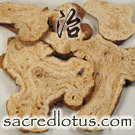 Bai Zhu9 gTonify Qi
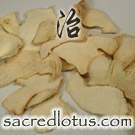 Gan Jiang9 gWarm the Interior and Expel Cold
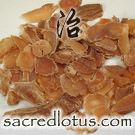 Ren Shen9 gTonify Qi
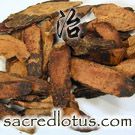 Zhi Gan Cao9 gTonify Qi
Preparation & dosage
How is Li Zhong Wan prepared?
Classically a pill (wan): the four herbs are ground to a fine powder and formed into pills with honey, taken in roughly 9 g doses two to three times a day. The name “Li Zhong Wan” specifically refers to this pill form from the Shang Han Lun.
- Decoction form: the same four herbs, at similar gram amounts, can also be simmered as a decoction — in the Shang Han Lun this decoction form of the identical formula is separately named Ren Shen Tang (Ginseng Decoction).
- Dang Shen substitution: in all but acute presentations, the milder and less costly Dang Shen (Codonopsis) is commonly substituted for Ren Shen.
Source: live Sacred Lotus sources & references (pill preparation, dosing, Dang Shen substitution note); Shang Han Lun (pill form named Li Zhong Wan; decoction form named Ren Shen Tang). Reference only, not a prescription.
Safety — read before use
What are the cautions for Li Zhong Wan?
Because the formula is warm and drying, it is unsuitable whenever heat rather than cold is the problem. It should not be used in Yin deficiency with heat signs, and it is not appropriate when an external pathogen (an unresolved exterior condition) is present, since warming and tonifying can lock a pathogen in.
- Heat and damp-heat — avoid in heat-type or damp-heat diarrhea/vomiting; the formula’s warming, drying nature would aggravate heat.
- Ren Shen — per the classical Eighteen Incompatibilities, ginseng-type herbs are traditionally not combined with Li Lu (Veratrum).
- Licorice (Zhi Gan Cao) — per the same Eighteen Incompatibilities, not traditionally combined with Gan Sui, Da Ji, Yuan Hua, or Hai Zao.
Source: live Sacred Lotus sources & references (warm/drying nature; avoid in Yin deficiency with heat; avoid with external pathogens present); classical Eighteen Incompatibilities lists. Reference only.
Originally Appeared In:
- On Cold Damage (Shang Han Lun)
Notes:
How does Li Zhong Wan compare with related and confusable formulas?
Li Zhong Wan sits at the milder, Middle-Jiao end of a family of warming formulas built from Gan Jiang, Ren Shen, and Zhi Gan Cao — related formulas add or subtract herbs to shift the target from ordinary qi deficiency, to concurrent exterior illness, to true Yang collapse.
- vs Si Jun Zi Tang (Four Gentlemen Decoction) — Si Jun Zi Tang (Ren Shen, Bai Zhu, Fu Ling, Zhi Gan Cao) tonifies Spleen–Stomach qi for plain qi deficiency (fatigue, poor appetite, loose stools) without cold signs. Li Zhong Wan swaps out Fu Ling’s damp-draining action for Gan Jiang’s yang-warming action, making it the choice when qi deficiency is compounded by interior cold — cold pain relieved by warmth, watery diarrhea, and a cold-leaning presentation that Si Jun Zi Tang alone does not address.
- vs Si Ni Tang (Frigid Extremities Decoction) — Si Ni Tang (Gan Jiang, Fu Zi, Zhi Gan Cao) treats a far more severe presentation: true, devastated Yang collapse (Shaoyin-stage) with profuse cold sweating, limbs cold to the elbows and knees, and a faint pulse on the verge of expiring. It relies on Fu Zi (aconite) to urgently rescue devastated yang at the root. Li Zhong Wan, by contrast, treats the milder, more chronic pattern of Middle-Jiao (Spleen–Stomach) yang deficiency — digestive cold and deficiency without imminent collapse — and uses Ren Shen and Bai Zhu to tonify Spleen qi rather than Fu Zi to rescue Yang.
- Fu Zi Li Zhong Wan (Aconite Regulate the Middle Pill) — Li Zhong Wan plus Fu Zi (prepared aconite), used when Middle-Jiao yang deficiency cold is more pronounced (more marked cold limbs and lassitude) but has not progressed to the full Shaoyin collapse that Si Ni Tang addresses; a bridge formula between the two.
- Gui Zhi Ren Shen Tang (Cinnamon Twig and Ginseng Decoction) — from the Shang Han Lun, this is the decoction form of Li Zhong Wan (Ren Shen Tang) plus Gui Zhi, used when repeated incorrect purgation has left a lingering, unresolved exterior (persistent low fever, chills) together with the underlying Spleen-yang deficiency diarrhea that Li Zhong Wan alone treats — Gui Zhi releases the lingering exterior while the Ren Shen Tang base warms and tonifies the interior.
Source: Shang Han Lun (classical source text; pill/decoction naming, Gui Zhi Ren Shen Tang clause); Bensky & Barolet, Chinese Herbal Medicine: Formulas & Strategies (comparative analysis, Si Ni Tang, Si Jun Zi Tang, Fu Zi Li Zhong Wan). Comparative reference only.
Clinical Studies & Research:
Is there modern research on Li Zhong Wan?
Modern laboratory research on this formula (studied under the name “Lizhong Decoction,” LZD) has focused on mouse models of ulcerative colitis rather than clinical trials in people. This is preclinical, mechanistic work — it explores biological pathways, not evidence that the formula treats a diagnosed disease in humans.
In a dextran-sodium-sulfate (DSS)-induced colitis mouse model, Lizhong Decoction improved colon lesions and colon length and reduced weight loss, alongside lowered inflammatory markers (including TNF-α, IL-1β, IL-6) and increased tight-junction proteins (zonula occludens-1, occludin, claudin-1), consistent with reduced gut inflammation and a strengthened intestinal barrier in that model. A related study in the same DSS mouse model found the decoction shifted plasma and urine metabolic markers linked to bile-acid, amino-acid, and lipid metabolism back toward normal, suggesting a metabolic route for its effect in that model.
Sources: PMID 32360800 (J Ethnopharmacol, 2020, DSS-induced colitis mouse model, inflammatory markers and gut-barrier proteins); PMID 34586559 (Chin J Integr Med, 2022, DSS-induced colitis mouse model, plasma/urine metabolomics). Preclinical research context only, not a therapeutic claim.
Sources & References
Compiled and edited by Thomas Dehli, Founder & Editor, Sacred Lotus Updated
The information here is referenced from numerous sources — teachers, practitioners, class notes from Five Branches University, the books below, and the published research literature, with citations given as resolvable PubMed identifiers. Where sources disagree, I have flagged the discrepancies directly. If facts couldn't be verified, I have left them out. How we source our content.
Reference information for students and practitioners — not medical advice. Consult a qualified practitioner. Terms of use.
Chinese Formulas Books & References
 https://amzn.to/4fYI3f8
 https://amzn.to/4j55NRA
 https://amzn.to/4gMROyv
 https://amzn.to/4h7msSK