
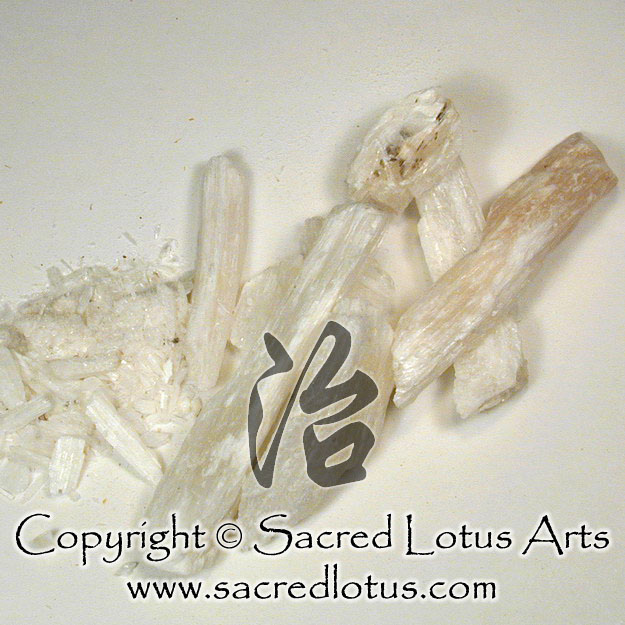
Materia Medica Data
- Category
- Herbs that Drain Fire
- Temperature
- Very Cold
- Nature & Flavour
- Sweet, Spicy, Very Cold
- Channels Entered
- LU, ST
- Latin (pharmaceutical)
- Gypsum Fibrosum
- Chinese
- 石膏
- Tone Marks
- shí gāo
- Translation
- Stone Paste
Chinese Herb Actions
What is Shi Gao used for in Chinese medicine?
Shi Gao (gypsum, calcium sulfate) is the classic herb for clearing blazing heat at the Qi level — the stage of febrile disease marked by the traditional "four bigs": big fever, big thirst, big sweating, and a big (flooding) pulse, together with a red tongue and yellow coating. Sweet, acrid, and very cold, it enters the Lung and Stomach channels.
Its main traditional actions:
- Clears heat at the Qi level — high fever, intense thirst, profuse sweating, a flooding/big pulse, and red tongue with yellow coating; the archetypal indication is the "four bigs" pattern treated by Bai Hu Tang (White Tiger Decoction).
- Clears heat from the Lung — cough or wheezing with thick yellow phlegm from Lung heat.
- Clears Stomach fire — inflamed, painful gums, toothache, and thirst from Stomach-fire flaring upward.
- Topical use (calcined form) for burns, sores, and eczema — applied externally, distinct from its internal Qi-level-heat use (see notes on raw vs. calcined below).
Source: Sacred Lotus sources & references, cross-referenced against multiple online sources and materia medica consensus (Bensky, Materia Medica, 3rd ed.; Chen & Chen, Chinese Herbal Medicine: Materia Medica). Traditional-use framing; not medical advice.
Chinese Herb Dosage
What is the typical dosage of Shi Gao?
Roughly 9–30 g in decoction, occasionally up to 90 g for very high fever — consistent with the Sacred Lotus reference range and standard materia medica. As a hard mineral, raw Shi Gao is traditionally crushed and pre-cooked (simmered) for about 20–30 minutes before the other herbs are added, so its heat-clearing constituents fully enter the decoction.
Source: Sacred Lotus sources & references; cross-referenced against multiple online sources and standard materia medica ranges. Reference only — not a prescription.
Chinese Herb Contraindications & Cautions
Are there cautions for Shi Gao?
Shi Gao is very cold and is used with caution in Yang-deficiency or Spleen/Stomach-cold patients, and in Yin-deficiency heat where its coldness could injure the Stomach. The Sacred Lotus reference specifically flags caution in patients with a weak stomach, a weak (not flooding) pulse, Yang deficiency, or Yin-deficiency heat — all patterns where this herb's intensely cold, draining nature is not well matched to the underlying deficiency and could aggravate digestion or further deplete Yang.
Source: Sacred Lotus sources & references; cross-referenced against multiple online sources and materia medica consensus. Reference only, not a substitute for individualized practitioner guidance.
Chinese Herb Toxicity & Overdose
Low at standard therapeutic decoction doses; not intended for prolonged unsupervised high-dose internal use. As a mineral (calcium sulfate), Shi Gao is generally regarded as having low toxicity in the doses used in decoctions, though, as with other mineral substances, professional guidance is advised for extended courses or higher doses, and the calcined form is a topical-only preparation and is not the form taken internally.
Source: Sacred Lotus sources & references; materia medica consensus. Reference note, not a safety guarantee.
Herb-Drug Interactions
May interact with anti-diabetic medications, per the Sacred Lotus reference; patients on glucose-lowering drugs should have this combination reviewed by a qualified practitioner. No other well-established clinical herb–drug interactions are documented in the materia medica literature reviewed. (Flagged for practitioner confirmation.)
Western / Biomedical Research
Chinese Herb Clinical Studies & Research
Provided as research context — a summary of published biomedical study, not a therapeutic or medical claim.
Is there modern research on Shi Gao (Gypsum fibrosum)?
Yes, though evidence is largely preclinical (animal and laboratory) rather than human clinical trials of Shi Gao alone — most modern research studies Shi Gao within its classical formulas rather than as an isolated substance.
- Antipyretic mechanism (formula-level) — a 2024 rabbit-model study of Qingwanzi Pills, a classical formula containing Gypsum fibrosum and Indigo naturalis, found the formula's fever-reducing effect was linked to lowered TNF-α, IL-6, IL-1β, and calcium levels in serum, with serum metabolomics identifying 27 biomarkers across four metabolic pathways associated with the antipyretic effect.
- Ma Xing Shi Gan Tang, antibacterial mechanism — a 2021 study found this Gypsum-containing formula inhibited a key virulence factor (pneumolysin) of Streptococcus pneumoniae in lung-cell and mouse models, without affecting bacterial growth directly, supporting a plausible mechanism for its traditional use in Lung-heat cough and pneumonia-type presentations.
These findings support biological plausibility for Shi Gao-containing formulas' heat-clearing, antipyretic, and antibacterial traditional uses at the animal/laboratory level; they are not clinical-trial evidence for Shi Gao alone in humans.
Sources: PMID 38759325 (Qingwanzi Pills antipyretic mechanism, rabbit model); PMID 33892068 (Ma Xing Shi Gan Tang vs. pneumolysin, S. pneumoniae models). Research context, not a therapeutic claim.
Chinese Herb Notes
What is the difference between raw and calcined (fired) Shi Gao?
Raw Shi Gao and calcined (fired/“duan”) Shi Gao are prepared very differently and are NOT interchangeable — raw gypsum is the form decocted and taken internally to clear Qi-level heat; calcined gypsum, made by heating raw gypsum until it loses its water of crystallization, is traditionally reserved for EXTERNAL use only, ground into a powder and applied topically to draw out dampness, promote healing, and stop discharge in weeping sores, eczema, and burns. This raw-internal / calcined-external distinction is one of the most important practical points to know before using this herb, since the two forms are chemically different and are not substituted for each other.
Key formula — Bai Hu Tang (White Tiger Decoction): Shi Gao is the chief herb, paired with Zhi Mu, Zhi Gan Cao, and Geng Mi (rice) for the classic Qi-level "four bigs" pattern. Shi Gao also appears in numerous derivative and related formulas:
- Ma Xing Shi Gan Tang — with Ma Huang, Xing Ren, and Gan Cao, for Lung heat with cough/wheezing.
- Zhu Ye Shi Gao Tang and Qing Zao Jiu Fei Tang — Qi-level or Lung-dryness heat with residual Qi/Yin deficiency.
- Xie Huang San and Qing Wen Bai Du Yin — draining Stomach/Spleen fire and severe epidemic heat-toxin, respectively.
- Yu Nu Jian — Stomach-fire with concurrent Kidney-Yin deficiency (toothache, dry mouth).
- Zi Xue Dan, Fang Feng Tong Sheng San, Chai Ge Jie Ji Tang, and Xiao Feng San — broader heat-clearing/wind-heat formulas that include Shi Gao alongside other herbs. (Traditional formula context, not treatment advice.)
Source: Sacred Lotus sources & references (formula links, raw/calcined note); cross-referenced against multiple online sources and materia medica consensus.
Sources & References
Compiled and edited by Thomas Dehli, Founder & Editor, Sacred Lotus Updated
The information here is referenced from numerous sources — teachers, practitioners, class notes from Five Branches University, the books below, and the published research literature, with citations given as resolvable PubMed identifiers. Where sources disagree, I have flagged the discrepancies directly. If facts couldn't be verified, I have left them out. How we source our content.
Reference information for students and practitioners — not medical advice. Consult a qualified practitioner. Terms of use.
Chinese Herbs Books & References
 https://amzn.to/3WfB3DK
 https://amzn.to/3DR1VUh
 https://amzn.to/42aMz73
 https://amzn.to/3PuD4bt