
Resina Olibani Frankincense Resin
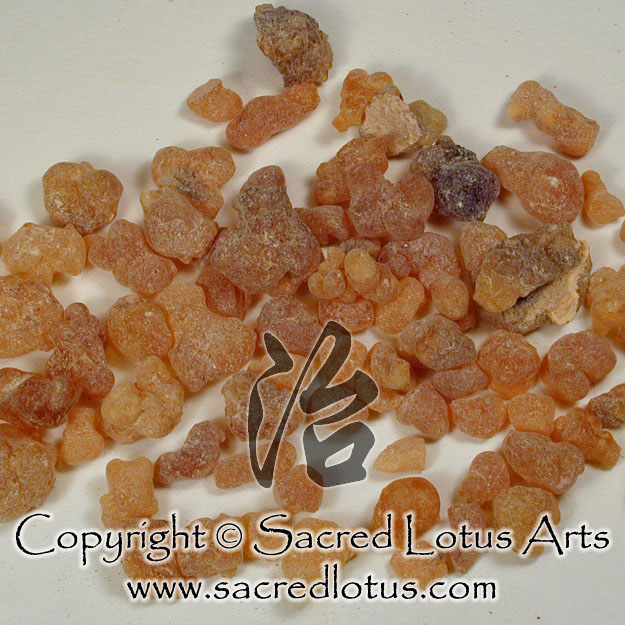
Materia Medica Data
- Temperature
- Warm
- Nature & Flavour
- Spicy, Bitter, Warm
- Channels Entered
- HT, LIV, SP
- Latin (pharmaceutical)
- Resina Olibani
- Chinese
- 乳香
- Tone Marks
- rŭ xiāng
- Translation
- Fragrant Milk
Chinese Herb Actions
What is Ru Xiang used for in Chinese medicine?
Ru Xiang (frankincense resin, Boswellia) moves Blood and Qi, relieves pain, and relaxes the sinews — and, applied externally as a powder, reduces swelling and promotes tissue healing. It is almost always thought of alongside its classic partner Mo Yao (myrrh), the two together forming one of the most enduring pain-relieving pairs in Chinese medicine.
Its main traditional actions:
- Moves Blood and Qi, relieves pain — for amenorrhea, dysmenorrhea, stomach and epigastric pain, traumatic injury pain, carbuncles and sores, and chest or abdominal pain; also for Wind-Damp painful obstruction (Bi-syndrome) with rigidity and spasm.
- Reduces swelling and generates flesh (externally) — as a topical powder, for reducing swelling, relieving pain, promoting healing of skin lesions, ulcers, sores, carbuncles, and traumatic injuries, and for pain/redness/swelling of the gums, mouth, and throat.
Source: Sacred Lotus sources & references, cross-referenced against multiple online sources and Bensky, Materia Medica (3rd ed.).
Chinese Herb Dosage
What is the typical dosage of Ru Xiang?
Commonly 3–9 g in decoction, with some materia medica sources giving a slightly wider 3–10 g range. It is traditionally used topically as a powder for external applications as well as internally in decoction or pill form.
Source: Sacred Lotus sources & references (Bensky; Chen & Chen). Reference only — not a prescription.
Chinese Herb Combinations:
- Dang Gui (Radix Angelicae Sinensis)
- Mo Yao (Resina Myrrhae)
- Ru Xiang (Resina Olibani)
- Zi Ran Tong (Pyritum)
Combined Indications:
- Strains and Fractures
Chinese Herb Contraindications & Cautions
Are there cautions for Ru Xiang?
Ru Xiang is contraindicated in pregnancy because of its blood-invigorating action, and it is not recommended for patients with sensitive stomachs, since it may cause nausea or vomiting. It is traditionally reserved for cases with a genuine Blood-stasis pattern (not for pain without stasis) and is not intended for long-term use.
Source: Sacred Lotus sources & references (Bensky; Chen & Chen materia medica cautions).
Chinese Herb Toxicity & Overdose
- None Noted
Western / Biomedical Research
Chinese Herb Clinical Studies & Research
Provided as research context — a summary of published biomedical study, not a therapeutic or medical claim.
Is there modern research on Ru Xiang (Boswellia) and boswellic acids?
Yes — a substantial pharmacology literature exists, but it concerns standardized Boswellia extracts concentrated for boswellic acids (notably AKBA), not the crude resin used in traditional decoction. This is an important distinction: most published anti-inflammatory pharmacokinetic and clinical work uses purified, standardized extracts with defined boswellic-acid content (as set out in pharmacopeial monographs), which is chemically and dosimetrically different from simmering raw Ru Xiang resin in a decoction alongside other herbs.
- Standardized-extract pharmacology (comprehensive review) — a widely cited review of in vitro, preclinical, pharmacokinetic, and clinical data on Boswellia serrata extract describes boswellic acids (KBA, AKBA) as pharmacopeial quality markers and summarizes animal studies and pilot clinical trials in inflammatory disease, while also cautioning that measured plasma concentrations of these acids are often far below levels shown to be bioactive in vitro — meaning mechanism and clinical effect are not yet fully reconciled even for the standardized extract.
- Frankincense–myrrh combination (animal, preclinical) — a study comparing individual myrrh and frankincense water extracts against a combined extract found the combination produced stronger anti-inflammatory and analgesic effects in mouse pain/edema models than either resin alone, offering preclinical support for the traditional Ru Xiang–Mo Yao pairing. Animal model only, not clinical proof, and again using extracts rather than crude decocted resin.
- Clinical trials of standardized extract — small clinical trials of Boswellia serrata extract have been reported in inflammatory conditions such as collagenous/chronic colitis and radiation-associated brain edema, using defined pharmaceutical-grade extracts rather than the traditional resin.
Because nearly all boswellic-acid inflammation research uses standardized, concentrated extracts, it should not be read as direct evidence for the crude resin as traditionally decocted; the traditional-use and modern-extract research literatures describe related but distinct preparations.
Sources: PMID 21553931 (comprehensive review, standardized extract pharmacology/pharmacokinetics, Clinical Pharmacokinetics); PMID 22178177 (combined myrrh/frankincense extract, mouse pain/inflammation models, Journal of Ethnopharmacology); PMID 11488449 and PMID 17764013 (small clinical trials, standardized extract, chronic/collagenous colitis); PMID 21287538 (standardized extract, radiation-associated cerebral edema). Research context, not a therapeutic claim.
Chinese Herb Notes
Why is Ru Xiang paired with Mo Yao?
Ru Xiang (frankincense) and Mo Yao (myrrh) are the classic paired herbs for blood-stasis pain — both invigorate Blood and relieve pain, and are traditionally combined for a wide range of painful conditions including amenorrhea, dysmenorrhea, stomach and epigastric pain, traumatic injury, carbuncles, sores, swellings, and chest/abdominal pain, as well as Wind-Damp obstruction with rigidity and spasm. Combining the two is considered more effective than using either resin alone for stasis-type pain.
Sacred Lotus’s own formula records show the pair recurring across numerous classical prescriptions, including Xian Fang Huo Ming Yin, Juan Bi Tang, Qi Li San, Die Da Wan (traumatic injury), Huo Luo Xiao Ling Dan, Zhen Ling Dan, Xiao Huo Luo Dan, and Su He Xiang Wan. (Traditional formula context, not treatment advice.)
Source: Sacred Lotus sources & references (formula cross-links); cross-referenced against multiple online sources; PMID 22178177 (combined myrrh/frankincense extract, animal pain/inflammation models).
Sources & References
Compiled and edited by Thomas Dehli, Founder & Editor, Sacred Lotus Updated
The information here is referenced from numerous sources — teachers, practitioners, class notes from Five Branches University, the books below, and the published research literature, with citations given as resolvable PubMed identifiers. Where sources disagree, I have flagged the discrepancies directly. If facts couldn't be verified, I have left them out. How we source our content.
Reference information for students and practitioners — not medical advice. Consult a qualified practitioner. Terms of use.
Chinese Herbs Books & References
 https://amzn.to/3WfB3DK
 https://amzn.to/3DR1VUh
 https://amzn.to/42aMz73
 https://amzn.to/3PuD4bt