
Rhizoma Sparganii Bur Reed Rhizome
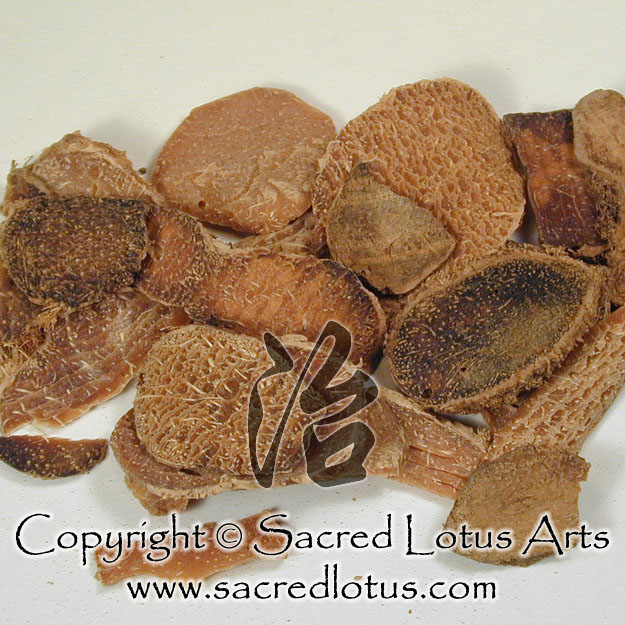
Materia Medica Data
- Temperature
- Neutral
- Nature & Flavour
- Bitter, Spicy, Neutral
- Channels Entered
- LIV, SP
- Latin (pharmaceutical)
- Rhizoma Sparganii
- Chinese
- 三棱
- Tone Marks
- sān léng
- Translation
- Three Edges
Chinese Herb Actions
What is San Leng used for in Chinese medicine?
San Leng is one of the strongest blood-breaking herbs in the materia medica, reserved for severe blood stasis with palpable masses and fixed, stabbing pain — amenorrhea, dysmenorrhea, postpartum abdominal pain and abdominal masses. Bitter, spicy and neutral, it enters the Liver and Spleen channels and moves qi as well as blood.
- Breaks blood stasis, moves qi, relieves pain — reserved for severe, stubborn stasis with palpable abdominal masses; also amenorrhea, dysmenorrhea and postpartum abdominal pain.
- Dissolves accumulations — food stagnation and qi stagnation producing severe abdominal pain and distention.
Its neutral temperature is part of what defines it: unlike most strong blood-movers it is neither warming nor cooling, so the pattern’s thermal nature is set by the herbs it is combined with. Reference reviews describe it as a gynaecological herb used for dysmenorrhea, abdominal masses, stasis-type amenorrhea and abdominal distension. PMID 33181282.
Source: Sacred Lotus sources & references (Bensky, Materia Medica, 3rd ed.; Chen & Chen); PMID 33181282; cross-referenced against multiple online sources. Traditional-use framing; not medical advice.
Chinese Herb Dosage
What is the dosage of San Leng, and what does vinegar-processing change?
Roughly 3–10 g in decoction — our references give 3–9 g (Bensky) and 3–10 g (Chen & Chen). The part used is the peeled, dried rhizome. Because it is a breaking rather than merely invigorating herb, it is normally used in short courses and combined with qi- and blood-supporting herbs rather than given alone over long periods.
- Standard range — 3–9 g (Bensky); 3–10 g (Chen & Chen). The two overlap; this is a rounding difference, not a real conflict.
- Vinegar-processed San Leng (cu zhi) — the vinegar-prepared form is the one most used when the intent is to enter the Liver blood level and relieve stasis pain. Two processed products of this herb are recognised in the Chinese Pharmacopoeia and are described in the review literature as having better pharmacological effects than the crude herb. PMID 33181282; PMID 35718497.
Source: Sacred Lotus sources & references (Bensky; Chen & Chen); processing from PMID 33181282 and PMID 35718497. Reference only — not a prescription.
Chinese Herb Contraindications & Cautions
Are there cautions for San Leng, especially in pregnancy?
San Leng is contraindicated in pregnancy — the strongest caution on this herb. It has been associated with teratogenic (birth-defect) effects in the reference literature, and a strong blood-breaking action is inherently unsuitable in pregnancy regardless. Modern review work likewise records reproductive toxicity for this herb. PMID 33181282.
- Pregnancy — do not use. Reported teratogenic effects; blood-breaking action is a direct risk. This caution is shared with its usual partner herb, E Zhu.
- Hypermenorrhea / excessive menstrual bleeding — do not use.
- Qi and blood deficiency, or no genuine accumulation — not appropriate; San Leng is draining and breaking by nature and can weaken an already deficient patient.
- Bleeding disorders and anticoagulant therapy — practitioner caution is reasonable given documented antithrombotic and antiplatelet activity in preclinical work. PMID 33181282; PMID 36327879.
- Not a long-course herb — used in short courses, usually with qi- and blood-supporting herbs alongside.
Source: Sacred Lotus sources & references (Bensky; Chen & Chen); PMID 33181282; PMID 36327879; cross-referenced against multiple online sources. Neutral reference information, not usage instructions.
Chinese Herb Toxicity & Overdose
The principal documented concern is reproductive toxicity, which is the basis of the absolute pregnancy contraindication. A comprehensive review of Sparganii Rhizoma covering traditional application, processing, phytochemistry, pharmacology and toxicity explicitly records that the herb has reproductive toxicity, and notes that its toxicological profile still requires more detailed research. PMID 33181282.
Outside of pregnancy, no significant systemic toxicity is established at standard decoction doses in the sources reviewed; the practical limits are its draining, blood-breaking nature and its antithrombotic activity rather than organ toxicity.
Source: PMID 33181282; Sacred Lotus sources & references (Bensky; Chen & Chen). Reference note, not a safety guarantee.
Herb-Drug Interactions
No well-established clinical herb–drug interactions are documented for San Leng in the literature reviewed. Preclinical work does report antithrombotic activity for the herb and antiplatelet-aggregation activity for phenylpropanoids isolated from it, so practitioner awareness is reasonable for patients on anticoagulant or antiplatelet therapy, or approaching surgery. PMID 33181282; PMID 36327879. This is precautionary reasoning from pharmacology, not a demonstrated clinical interaction. (Flagged for practitioner confirmation.)
Western / Biomedical Research
Chinese Herb Clinical Studies & Research
Provided as research context — a summary of published biomedical study, not a therapeutic or medical claim.
Is there modern research on San Leng (Sparganii Rhizoma)?
Yes — a substantial preclinical literature, much of it studying San Leng together with E Zhu as a named herb pair, plus one comprehensive review covering the whole herb. No human clinical trials of San Leng as a single herb were identified in the literature reviewed.
- Comprehensive review — approximately 180 compounds have been identified from Sparganii Rhizoma, including phenylpropanoids, flavonoids, anthraquinones, organic acids, alkaloids, steroids, volatile oils and diarylheptanoids. Reported activities of the crude extracts and isolated constituents include anti-tumour, antithrombotic, estrogen-antagonistic, anti-inflammatory, analgesic, antioxidant and anti-organ-fibrosis effects; reproductive toxicity is also recorded. PMID 33181282.
- The herb pair, chemically — the essential oil of the Curcumae Rhizoma–Sparganii Rhizoma pair has been characterised for composition and antioxidant/anticancer activity in vitro. PMID 26343630; PMC 6332236. Linear diarylheptanoids from the pair and from each single herb have been studied for anti-tumour activity. PMID 31821851.
- Gynaecological models — components of Rhizoma Curcumae and Rhizoma Sparganii inhibited fibroblast activation in uterine leiomyoma models, a line of work that maps onto the herbs’ traditional use for abdominal masses. PMID 33732680; PMC 7957009. Osteoclast-formation effects of Sparganii Rhizoma have also been examined. PMID 35058781.
- Isolated constituents — phenylpropanoids from Sparganium stoloniferum with antiplatelet-aggregation activity. PMID 36327879.
- Processing — network-pharmacology work comparing crude and vinegar-processed Sparganii Rhizoma. PMID 35718497.
All of the above is cell, animal, chemical or computational work. It is research context, not a therapeutic claim, and it does not establish efficacy in people.
Sources: PMID 33181282; PMID 26343630 / PMC 6332236; PMID 31821851; PMID 33732680 / PMC 7957009; PMID 35058781; PMID 36327879; PMID 35718497.
Chinese Herb Notes
What is the difference between San Leng and E Zhu?
San Leng and E Zhu are the classic blood-breaking pair — almost always used together, and separated mainly by temperature and emphasis. Our own records place them in the same category with the same Liver and Spleen channels; the difference is that San Leng is neutral and leans toward breaking blood, while E Zhu is warm and leans toward breaking qi. Combined, they cover both the qi and blood aspects of a stubborn accumulation, and each is said to moderate the other.
- San Leng — Rhizoma Sparganii; bitter, spicy, neutral; Liver, Spleen. Emphasis on breaking blood stasis; the more purely stasis-directed of the two.
- E Zhu — Rhizoma Curcumae Zedoariae; bitter, spicy, warm; Liver, Spleen. Emphasis on breaking qi stagnation and dispersing accumulation, with added warmth for cold-type stagnation.
- Shared pregnancy contraindication — this is the safety point that matters most about the pair. Both are contraindicated in pregnancy in our records, and both carry reported teratogenic effects in the reference literature. Neither is a herb to encounter unexpectedly during pregnancy.
- Shared caution in hypermenorrhea and in deficiency — both are inappropriate where there is heavy bleeding, or where qi and blood are weak and there is no genuine accumulation to break.
- Recognised as a formal herb pair in research — the Sparganii Rhizoma–Curcumae Rhizoma combination is studied in the modern literature as a named “herbal couple,” including its combined essential oil chemistry and its linear diarylheptanoids. PMID 26343630; PMID 31821851.
Discrepancy noted: the classical aphorism contrasting the two herbs (that one “breaks the qi within the blood” and the other “breaks the blood within the qi”) is rendered in opposite directions by different sources, so we do not assert either direction here. The uncontested consensus — and what our own property records support — is that San Leng is neutral and more blood-directed while E Zhu is warm and more qi-directed.
Naming note: our records use the pharmaceutical Latin “Rhizoma Sparganii,” while the research literature usually writes “Sparganii Rhizoma” (botanical source Sparganium stoloniferum). Likewise our “Rhizoma Curcumae Zedoariae” for E Zhu appears in the literature as “Curcumae Rhizoma.” These are word-order and pharmacopoeial-style variants of the same materials, not different herbs.
Source: Sacred Lotus sources & references (Bensky; Chen & Chen) and our own E Zhu record; PMID 26343630; PMID 31821851; cross-referenced against multiple online sources.
This herb antagonizes or is antagonized by:
- Ya Xiao (Nitrum)
Sources & References
Compiled and edited by Thomas Dehli, Founder & Editor, Sacred Lotus Updated
The information here is referenced from numerous sources — teachers, practitioners, class notes from Five Branches University, the books below, and the published research literature, with citations given as resolvable PubMed identifiers. Where sources disagree, I have flagged the discrepancies directly. If facts couldn't be verified, I have left them out. How we source our content.
Reference information for students and practitioners — not medical advice. Consult a qualified practitioner. Terms of use.
Chinese Herbs Books & References
 https://amzn.to/3WfB3DK
 https://amzn.to/3DR1VUh
 https://amzn.to/42aMz73
 https://amzn.to/3PuD4bt