
Huo Luo Xiao Ling Dan
Fantastically Effective Pill to Invigorate the Collaterals
- Category
- Formulas that Invigorate the Blood
- Ingredients
- 4 herbs
Actions
What does Huo Luo Xiao Ling Dan do?
Huo Luo Xiao Ling Dan invigorates the blood, dispels stasis, and opens the collaterals to relieve pain. It is a compact four-herb formula built from two complementary pairs — one that nourishes and moves the blood, and one that drives that action specifically into the smaller collaterals (the peripheral vessels) where trauma and fixed pain settle.
The four ingredients divide by role:
- Chief pair: Dang Gui (nourishes blood while invigorating it) and Dan Shen (powerfully invigorates blood and dispels stasis) — together they address the root: stagnant, insufficiently moving blood.
- Assistant pair: Ru Xiang and Mo Yao, the classic frankincense-and-myrrh combination that moves qi alongside blood, penetrates the collaterals, reduces swelling, and stops pain — addressing the branch (the local pain and swelling itself).
Source: Sacred Lotus sources & references + Bensky & Barolet-style chief/deputy/assistant analysis, cross-checked against multiple published formula references. Traditional-use framing; not medical advice.
Indications
What is Huo Luo Xiao Ling Dan used for?
Huo Luo Xiao Ling Dan treats qi and blood stagnation obstructing the vessels or collaterals and causing pain. Its classic presentation is fixed, stabbing or boring pain — often worse at night or under pressure — that can appear almost anywhere: chest, abdomen, back, or limbs, frequently following traumatic injury.
Traditional applications include:
- Traumatic injury: bruising, swelling, and pain from sprains, strains, or blunt trauma.
- Fixed pain and masses: abdominal or flank masses (accumulations), and chronic pain patterns attributed to blood stasis in the collaterals.
- Sores and ulceration: slow-healing internal or external sores linked to stagnant blood.
Tongue and pulse: the tongue is dark (sometimes with static spots); the pulse is wiry.
Source: Sacred Lotus sources & references on pattern/tongue/pulse + Bensky & Barolet-style formula analysis, cross-checked against multiple published formula references. Traditional-use framing; not medical advice.
Western Uses:
What is Huo Luo Xiao Ling Dan used for in modern practice?
In modern practice Huo Luo Xiao Ling Dan is referenced for musculoskeletal pain and soft-tissue injury — sprains, strains, bruising, and post-trauma or post-surgical stiffness — and is discussed in the TCM literature as an adjunct approach alongside conventional care for inflammatory joint conditions such as rheumatoid arthritis, where laboratory research has explored its anti-inflammatory activity.
These biomedical correlates are offered as a reference to the formula’s traditional use, not as a claim that it treats any disease. The supporting research base is preclinical (animal and mechanistic studies; see research). Any use for a diagnosed condition belongs with a qualified practitioner and appropriate medical care.
Source: traditional-use correlates summarized from published TCM formula references and the preclinical literature cited under research; reference only, not a treatment claim.
Ingredients
4 substances in Huo Luo Xiao Ling Dan — each links to its full herb monograph.
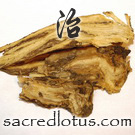 Dang Gui15 gTonify Blood
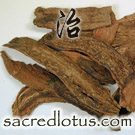 Dan Shen15 gInvigorate Blood and Remove Stagnation
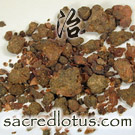 Mo Yao15 gInvigorate Blood and Remove Stagnation
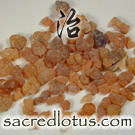 Ru Xiang15 gInvigorate Blood and Remove Stagnation
Preparation & dosage
How is Huo Luo Xiao Ling Dan prepared?
Traditionally prepared as a water decoction of the four herbs in equal amounts. Ru Xiang and Mo Yao are classically specified raw (unprocessed/unfried) rather than dry-fried, which is thought to preserve their resin content and collateral-penetrating action.
Source: Sacred Lotus sources & references + corroborated across multiple published TCM formula references.
Decoction. Reference relative amounts (equal parts): Dang Gui 15 g; Dan Shen 15 g; Ru Xiang (raw) 15 g; Mo Yao (raw) 15 g. Reference only.
Safety — read before use
What are the cautions for Huo Luo Xiao Ling Dan?
Huo Luo Xiao Ling Dan is contraindicated during pregnancy — its blood-invigorating herbs (Dang Gui, Dan Shen, Ru Xiang, Mo Yao) carry a recognized risk of stimulating uterine contraction. It is a moving, dispersing formula for stasis and excess, not a tonic, so it is not appropriate where there is no true blood-stasis pattern.
- Pregnancy: avoid.
- Bleeding risk: use cautiously with active hemorrhage, bleeding disorders, or alongside anticoagulant/antiplatelet medication (Dan Shen in particular has documented interaction potential with warfarin-type drugs).
- Digestive sensitivity: Ru Xiang and Mo Yao (resins, traditionally used raw/unprocessed) can irritate a sensitive stomach; reduce dose or discontinue if nausea or stomach upset occurs.
Source: cross-checked across multiple published TCM formula references (contraindications for blood-invigorating trauma formulas). Traditional-use framing; not medical advice.
Originally Appeared In:
- Records of Heart Felt Experiences in Medicine with References to the West (Yi Xue Zhong Zhong Can Xi Lu)
Notes:
Where does Huo Luo Xiao Ling Dan come from, and how is it typically used clinically?
Huo Luo Xiao Ling Dan was recorded by the physician Zhang Xichun in his early-20th-century text Yi Xue Zhong Zhong Can Xi Lu (“Records of Heart-Felt Experiences in Medicine with Reference to the West”), notable for its era for deliberately blending Chinese and Western medical thinking. Because it is only four herbs, practitioners often use it either as a simple, quickly-prepared decoction for acute blood-stasis pain, or fold its two herb pairs into a larger, more tailored prescription when stronger or more targeted blood-moving action is needed.
Source: formula source-text attribution corroborated across multiple published TCM formula references.
Clinical Studies & Research:
Is there modern research on Huo Luo Xiao Ling Dan?
Yes, but it is preclinical — animal-model and mechanistic studies of inflammatory arthritis, not human clinical trials. The best-studied line of research uses a rat adjuvant-arthritis (AA) model, a standard model for rheumatoid-arthritis-like joint inflammation, to examine the formula’s anti-inflammatory and bone-protective effects.
- Arthritis severity and cytokines: an extract of Huo Luo Xiao Ling Dan reduced arthritis severity and paw swelling in rats with adjuvant arthritis, with lower tissue levels of the inflammatory cytokines TNF-α and IL-1β and no observed adverse effects (Zhang et al., Journal of Ethnopharmacology, 2009; PMID 19100323).
- Bone protection: in the same rat model, the formula reduced osteoclast activity and bone/cartilage damage alongside lower levels of bone-resorption mediators (RANKL, MMP-2/9) (Nanjundaiah et al., Evidence-Based Complementary and Alternative Medicine, 2013; PMID 23762133).
- Mechanistic/metabolomic profiling: a metabonomics study reported that the formula normalized arachidonic-acid inflammatory metabolites (COX/LOX pathway) in arthritic rats, at a magnitude comparable to a conventional antirheumatic drug comparator (Wang et al., Journal of Ethnopharmacology, 2018; PMID 29474901).
Sources: PubMed 19100323; PubMed 23762133; PubMed 29474901. Research context, not a therapeutic claim; findings are from animal models, and direct human clinical trial evidence was not identified.
Sources & References
Compiled and edited by Thomas Dehli, Founder & Editor, Sacred Lotus Updated
The information here is referenced from numerous sources — teachers, practitioners, class notes from Five Branches University, the books below, and the published research literature, with citations given as resolvable PubMed identifiers. Where sources disagree, I have flagged the discrepancies directly. If facts couldn't be verified, I have left them out. How we source our content.
Reference information for students and practitioners — not medical advice. Consult a qualified practitioner. Terms of use.
Chinese Formulas Books & References
 https://amzn.to/4fYI3f8
 https://amzn.to/4j55NRA
 https://amzn.to/4gMROyv
 https://amzn.to/4h7msSK