

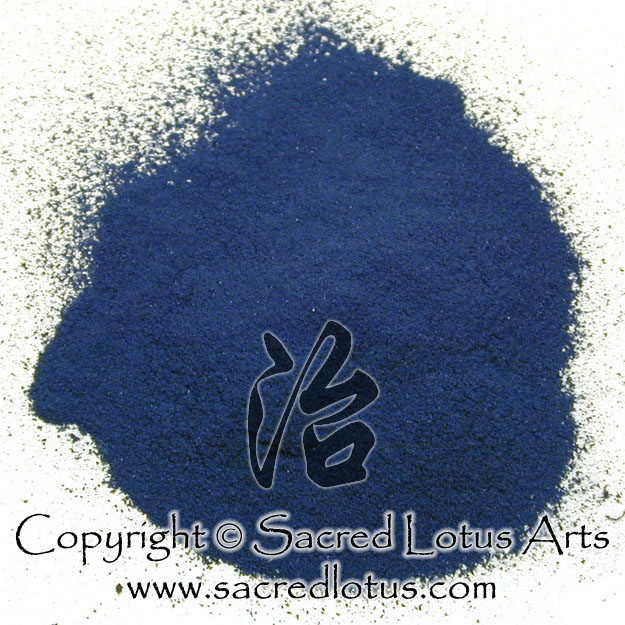
Materia Medica Data
- Temperature
- Cold
- Nature & Flavour
- Salty, Cold
- Channels Entered
- LIV, LU, ST
- Latin (pharmaceutical)
- Indigo Naturalis
- Chinese
- 青黛
- Tone Marks
- qīng dài
Chinese Herb Actions
What is Qing Dai (Indigo) used for in Chinese medicine?
Qing Dai (Indigo) is traditionally used to clear heat and resolve fire toxicity, cool the blood and reduce maculae, and clear Liver heat to stop convulsions. It is salty and cold, entering the Liver, Lung, and Stomach channels. It is used chiefly for heat-toxin patterns — skin lesions and infections, mumps, sore throat — and for heat in the blood. Because it is a poorly soluble indigo powder, it is used mostly topically and in small internal doses.
Its main traditional actions:
- Clears heat and resolves fire toxicity — heat-toxin skin lesions and infections, mumps, sore throat.
- Cools the blood and reduces maculae — warm-heat patterns with skin blotches or purpura, and reckless bleeding such as nosebleeds, coughing or vomiting of blood, and blood-streaked phlegm.
- Clears Liver heat and stops convulsions — childhood or febrile convulsions and spasms from heat generating Liver wind.
- Clears Lung heat — heat-type cough with chest pain and blood in the phlegm; it also drains Liver fire that invades the Lung.
Source: owner’s Five Branches notes (Clear Heat & Reduce Toxins category), reviewed against Bensky, Materia Medica (3rd ed.). Traditional-use framing; not medical advice.
Chinese Herb Dosage
What is the typical dosage of Qing Dai?
1.5–3 g internally, and applied topically as needed. Qing Dai is a fine indigo powder that does not dissolve in water, so it is not usually decocted — it is taken in pills or powders (or stirred into a strained decoction) and is frequently used topically. Internal use is kept to small doses.
Source: owner’s Five Branches notes (0.5–1 qián); standard materia medica ranges. Reference only — not a prescription.
Chinese Herb Contraindications & Cautions
Are there cautions or contraindications for Qing Dai?
Qing Dai is cold, so it is used with caution in cold patterns from Spleen and Stomach deficiency (weak digestion, cold epigastrium, loose stools) and is not appropriate where there is no genuine heat. Internal use should be limited to small doses.
Larger oral doses — as explored in modern indigo-naturalis research for inflammatory bowel disease — carry documented safety signals (pulmonary arterial hypertension, intussusception, and colitis with bowel-wall changes); see the Toxicity and Research sections. Oral indigo naturalis at those doses should only be used under qualified supervision. (Flagged for practitioner confirmation.)
Source: owner’s Five Branches notes; modern IBD safety signals from the biomedical literature (see Research). Not medical advice.
Chinese Herb Toxicity & Overdose
Low at traditional topical and small internal doses; but higher oral doses carry real, documented safety signals. As a topical agent and in small internal amounts, Qing Dai has a long record of safe use. However, the higher oral doses studied for inflammatory bowel disease have been linked to pulmonary arterial hypertension (generally reversible on stopping the herb), intussusception, and colitis with bowel-wall thickening in Japanese trials and a nationwide survey. This is stated plainly for reader safety.
Sources: PubMed 31102012 (Japanese nationwide survey of adverse events with indigo naturalis in ulcerative colitis); PubMed 37005323 (case of Qing-Dai–associated pulmonary arterial hypertension, improved after discontinuation); PubMed 29549501 (colitis with wall thickening during oral Qing-dai). Not a therapeutic claim.
Herb-Drug Interactions
No well-established clinical herb–drug interactions are documented for Qing Dai at traditional doses. Given the pulmonary and gastrointestinal safety signals reported with higher oral doses (see Toxicity), practitioner caution is warranted for internal use, especially in patients with cardiopulmonary conditions or on other IBD therapies. (Flagged for practitioner confirmation — absence of documented interactions is not proof of safety.)
Western / Biomedical Research
Chinese Herb Clinical Studies & Research
Provided as research context — a summary of published biomedical study, not a therapeutic or medical claim.
Is there modern research on Qing Dai (Indigo Naturalis)?
Yes — the two most-studied uses are topical indigo naturalis for psoriasis and oral indigo naturalis for ulcerative colitis, and both are reported honestly alongside a real safety caveat. Randomized trials of topical indigo-naturalis ointment and oil (Lindioil) show benefit for plaque and nail psoriasis, and the investigator-initiated INDIGO trial found oral indigo naturalis improved ulcerative colitis. However, oral use has been linked to pulmonary arterial hypertension and intussusception, so its risk-benefit is unsettled.
Sources: PubMed 28815560 and PubMed 25738921 (randomized trials of topical indigo naturalis / Lindioil for psoriasis and psoriatic nails); PubMed 33151988 (INDIGO trial, oral indigo naturalis in ulcerative colitis) and PubMed 31529220 (INDIGO post hoc, refractory patients); PubMed 38006941 (systematic review/meta-analysis for IBD); safety signals in PubMed 31102012 and PubMed 37005323. Research context, not a therapeutic claim.
Chinese Herb Notes
What is Qing Dai, and how does it compare with Da Qing Ye and Ban Lan Gen?
Qing Dai is the dried indigo powder (pharmaceutically Indigo Naturalis, also Indigo Pulverata Levis) prepared from the leaves of indigo-yielding plants such as Isatis, Baphicacanthus/Strobilanthes, and Polygonum tinctorium. Da Qing Ye (the leaf), Ban Lan Gen (the root), and Qing Dai can all derive from the same plant group and share the ability to cool heat in the blood and reduce skin blotches.
How the three differ in emphasis:
- Qing Dai — the processed indigo powder; strongest for cooling the blood to reduce maculae and for clearing Liver heat to stop convulsions, and it is the one used topically.
- Da Qing Ye — the leaf; strongly clears heat and resolves toxicity, favored for high fever and heat-toxin rashes.
- Ban Lan Gen — the root; emphasizes resolving toxicity for the throat and head.
Source: owner’s Five Branches notes (comparison of Da Qing Ye, Ban Lan Gen and Qing Dai from the same plant); standard materia medica for the botanical sources.
Sources & References
Compiled and edited by Thomas Dehli, Founder & Editor, Sacred Lotus Updated
The information here is referenced from numerous sources — teachers, practitioners, class notes from Five Branches University, the books below, and the published research literature, with citations given as resolvable PubMed identifiers. Where sources disagree, I have flagged the discrepancies directly. If facts couldn't be verified, I have left them out. How we source our content.
Reference information for students and practitioners — not medical advice. Consult a qualified practitioner. Terms of use.
Chinese Herbs Books & References
 https://amzn.to/3WfB3DK
 https://amzn.to/3DR1VUh
 https://amzn.to/42aMz73
 https://amzn.to/3PuD4bt