
Flos Lonicerae Japonicae Honeysuckle Flower or Lonicera
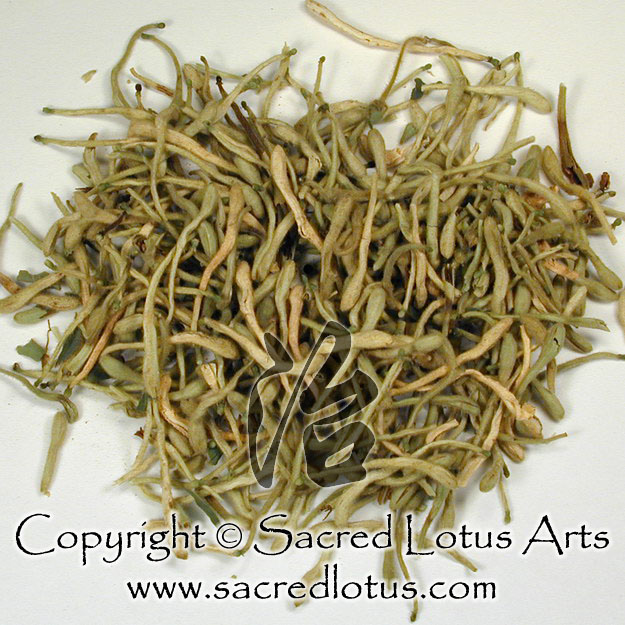
Materia Medica Data
- Temperature
- Cold
- Nature & Flavour
- Sweet, Cold
- Channels Entered
- LI, LU, ST
- Latin (pharmaceutical)
- Flos Lonicerae Japonicae
- Chinese
- 金银花
- Tone Marks
- jīn yín huā
- Translation
- Gold Silver Flower
Chinese Herb Actions
What is Jin Yin Hua used for in Chinese medicine?
Jin Yin Hua (honeysuckle flower) clears heat and relieves toxicity, and releases wind-heat from the exterior — it is one of the primary herbs for early-stage febrile disease, sore throat, and hot, toxic-type skin lesions such as boils and abscesses. It is sweet and very cold, entering the Lung, Stomach, and Large Intestine channels, and is prized for being effective yet gentle on the stomach compared to many other heat-clearing herbs.
Its main traditional actions:
- Clears heat and resolves toxicity — fever with any type of hot, painful, swollen boil, sore, or abscess, especially of the breast (mastitis), eyes, and throat; a first-choice herb for "heat-toxin" skin and soft-tissue lesions.
- Releases wind-heat from the exterior — early-stage common cold or warm-febrile disease with fever, sore throat, and headache; also used for Summerheat patterns.
- Clears damp-heat in the lower jiao — diarrhea, dysentery, intestinal abscess, or painful urination of a damp-heat type.
- Cools the blood in warm-disease patterns — in combination formulas, helps clear heat that has penetrated deeper (nutritive/blood level) stages of febrile disease.
Source: Sacred Lotus sources & references, cross-referenced against multiple online sources and materia medica consensus (Bensky, Materia Medica, 3rd ed.; Chen & Chen, Chinese Herbal Medicine: Materia Medica). Traditional-use framing; not medical advice.
Chinese Herb Dosage
What is the typical dosage of Jin Yin Hua?
Roughly 9–15 g in decoction, per standard materia medica ranges, consistent with the Sacred Lotus reference range. Larger doses (up to 30–60 g) are sometimes used in modern practice for severe heat-toxin conditions; the flower bud (unopened bud, harvested before it turns yellow) is the part used, and it can be added later in a decoction (not long-boiled) to preserve its lighter, more volatile heat-clearing action.
Source: Sacred Lotus sources & references; cross-referenced against multiple online sources and standard materia medica ranges. Reference only — not a prescription.
Chinese Herb Contraindications & Cautions
Are there cautions for Jin Yin Hua?
Jin Yin Hua is very cold in nature, so it is generally avoided in cases of diarrhea from Spleen/Stomach cold-deficiency, and is not recommended for sores or skin conditions that are already draining clear (non-heat-type, "yin" type) discharge, since it can further weaken digestive-system yang. As with other cold, heat-clearing herbs, prolonged high-dose use in someone without a genuine heat pattern is traditionally discouraged.
Source: Sacred Lotus sources & references; cross-referenced against multiple online sources and materia medica consensus. Reference only, not a substitute for individualized practitioner guidance.
Western / Biomedical Research
Chinese Herb Clinical Studies & Research
Provided as research context — a summary of published biomedical study, not a therapeutic or medical claim.
Is there modern research on Jin Yin Hua (Lonicera japonica)?
Yes — extensive preclinical research supports antibacterial, antiviral, and anti-inflammatory activity, though most human evidence comes from multi-herb formulas rather than Jin Yin Hua alone. Its principal studied constituents are chlorogenic acid and related phenolic acids, along with flavonoids and iridoids.
- Herb-pair pharmacology (Jin Yin Hua + Lian Qiao) — a 2015 review of the traditional Flos Lonicerae–Forsythiae fructus pairing summarizes laboratory evidence for antibacterial, antiviral, antitumor, anti-inflammatory, and antioxidant effects, and identifies chlorogenic acid (Jin Yin Hua) and forsythoside A (Lian Qiao) as key active compounds behind the pair's traditional heat-toxin–clearing use.
- Comparative phytochemistry review — a 2024 systematic review comparing Lonicerae japonicae flos (Jin Yin Hua) with the related Lonicerae flos (Shan Yin Hua) documents overlapping but distinct chemical profiles (337 vs. 242 isolated constituents) and shared anti-inflammatory, antiviral, antibacterial, antioxidant, and hepatoprotective activity in laboratory and animal studies, while noting these remain two officially distinct materials.
- Flower vs. stem vs. leaf — laboratory analysis found flowers, stems, and leaves share core anti-inflammatory bioactive compounds (with leaves highest in some phenolics), supporting related-but-distinct traditional use of the flower (Jin Yin Hua) and stem (Ren Dong Teng).
This is preclinical (laboratory/animal/chemical) evidence for the isolated plant and its compounds, not clinical-trial proof for Jin Yin Hua as a standalone treatment; well-known combination formulas containing it (e.g., Yin Qiao San) have separate, more extensive clinical literature.
Sources: PMID 26161134 (Flos Lonicerae–Forsythiae fructus herb-pair chemistry/pharmacology review); PMID 37972908 (comparative review, Lonicerae japonicae flos vs. Lonicerae flos); PMID 31597198 (chemical/bioactivity comparison of flower, stem, and leaf). Research context, not a therapeutic claim.
Chinese Herb Notes
How is Jin Yin Hua different from Lian Qiao, and from Ren Dong Teng (the stem)?
Jin Yin Hua and Lian Qiao (Forsythia) are the classic paired herbs for clearing heat-toxin and releasing wind-heat — almost always used together, most famously as the two chief herbs of Yin Qiao San (Honeysuckle and Forsythia Powder), the archetypal formula for early-stage wind-heat invasion (fever, sore throat, thirst). Jin Yin Hua leans slightly more toward clearing heat-toxin and damp-heat in the intestines; Lian Qiao is considered to have a stronger action at reducing swelling/nodules and is said to also lift heat from the Heart.
- Yin Qiao San — Jin Yin Hua + Lian Qiao as chief herbs, for wind-heat exterior invasion (fever, sore throat, thirst, mild cough).
- Yin Qiao Ma Bo San — the same pair combined with Ma Bo (puffball) for more severe sore throat.
- Si Miao Yong An Tang — combined with Xuan Shen and Dang Gui for heat-toxin affecting the lower limbs (a classic pattern resembling thromboangiitis/severe local infection).
- Xian Fang Huo Ming Yin and Wu Wei Xiao Du Yin — toxin-clearing formulas for abscesses and sores.
- Qing Ying Tang and Qing Luo Yin — deeper-level (nutritive-level) heat-clearing formulas that include Jin Yin Hua.
Ren Dong Teng (honeysuckle stem) comes from the same plant but is a distinct crude drug with its own traditional profile: alongside heat-clearing/toxin-resolving action, the stem is traditionally credited with dispelling wind-dampness from the channels and collaterals, making it additionally useful for hot, painful joint (Bi) syndrome — a use the flower is not typically indicated for. A 2020 chemical comparison found flowers, stems, and leaves of Lonicera japonica share overlapping compounds (hydroxycinnamic acids, flavonoids, iridoids) and anti-inflammatory activity, but leaves and stems differ quantitatively from the flower bud, supporting their traditional treatment as related but separate materials. (Traditional formula context, not treatment advice.)
Source: Sacred Lotus sources & references (formula links); cross-referenced against multiple online sources and materia medica consensus; PMID 31597198 (comparative phytochemistry of flower/stem/leaf).
Sources & References
Compiled and edited by Thomas Dehli, Founder & Editor, Sacred Lotus Updated
The information here is referenced from numerous sources — teachers, practitioners, class notes from Five Branches University, the books below, and the published research literature, with citations given as resolvable PubMed identifiers. Where sources disagree, I have flagged the discrepancies directly. If facts couldn't be verified, I have left them out. How we source our content.
Reference information for students and practitioners — not medical advice. Consult a qualified practitioner. Terms of use.
Chinese Herbs Books & References
 https://amzn.to/3WfB3DK
 https://amzn.to/3DR1VUh
 https://amzn.to/42aMz73
 https://amzn.to/3PuD4bt