

Herba cum Radice Houttuyniae Cordatae Houttuynia
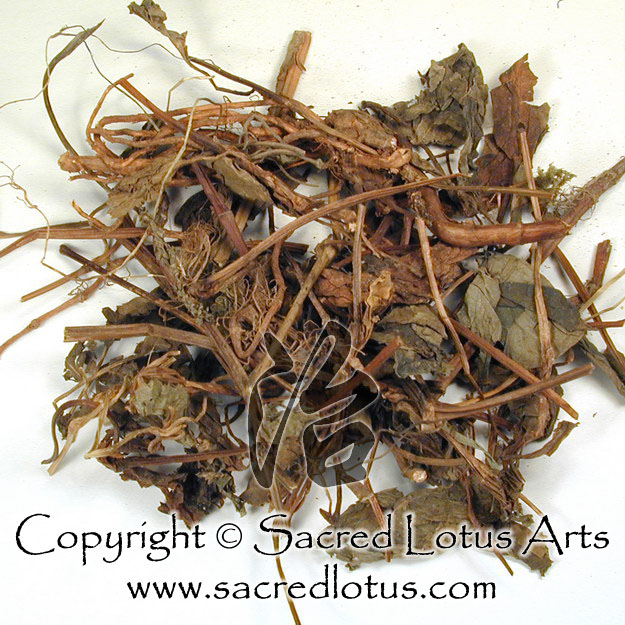
Materia Medica Data
- Temperature
- Cool
- Nature & Flavour
- Spicy, Cool
- Channels Entered
- LI, LU
- Latin (pharmaceutical)
- Herba cum Radice Houttuyniae Cordatae
- Chinese
- 鱼腥草
- Tone Marks
- yú xīng căo
- Translation
- Fishy Smelling Herb
Chinese Herb Actions
What is Yu Xing Cao used for in Chinese medicine?
Yu Xing Cao (Houttuynia) is an acrid, cool heat-clearing and toxin-eliminating herb, and it is the single most representative herb for Lung abscess (fei yong) — cough with thick, foul, yellow-green sputum, chest heat, and purulent conditions of the respiratory tract. Its acrid, dispersing quality lets it move outward and expel pus rather than simply cool from within.
Its main traditional actions:
- Clears heat and eliminates toxins in the Lung — the defining use, for Lung abscess and Lung heat presentations with thick yellow or green phlegm, including cough patterns described in modern terms as bronchitis or pneumonia.
- Expels pus and reduces abscesses — used both internally and topically for purulent sores, boils and carbuncles.
- Drains dampness and promotes urination — for damp-heat in the Large Intestine (dysenteric disorders, colitis-type presentations) and damp-heat urinary patterns.
Nature and channels as recorded here: spicy (acrid) and cool, entering the Lung and Large Intestine channels.
Source: Sacred Lotus sources & references, cross-referenced against multiple online sources (materia medica consensus). Traditional-use framing; not medical advice.
Chinese Herb Dosage
What is the dosage of Yu Xing Cao, and why should it not be cooked for long?
15–60 g, added late in the decoction — it must not be boiled for a long time. This is the single most important preparation rule for this herb, and there is a chemical reason for it: the active volatile constituent decanoyl acetaldehyde (houttuynin), which carries both the herb’s characteristic odour and much of its antimicrobial activity, is heat-labile and converts to 2-undecanone at high temperature. Prolonged boiling drives off and transforms exactly what is being sought.
- Part used — the aerial parts (leaves and stems); the material recorded here is the herb with root.
- Preparation — added near the end of cooking (a “late addition” herb), or steeped rather than boiled hard. The fresh herb is used at the higher end of the range and is traditionally preferred where available.
- External — the fresh herb is pounded and applied to purulent sores, or a decoction is used as a wash.
Source: Sacred Lotus sources & references (dose range and cooking instruction); the volatile chemistry behind the instruction from PMID 34539401 / PMC 8440972. Reference only — not a prescription.
Chinese Herb Contraindications & Cautions
Are there cautions for Yu Xing Cao?
Yu Xing Cao is cool and draining, so it is traditionally avoided in cold from deficiency and in yin-type sores — the pale, flat, non-inflamed, chronic lesions that need warming and tonifying rather than cooling and draining. Using a toxin-clearing cold herb on a yin-type sore works directly against the pattern.
- Cold from deficiency — not suited to weak, cold digestion or cold-pattern cough.
- Yin-type furuncles and sores — contraindicated; these call for the opposite treatment principle.
- Route matters — the serious adverse-reaction history attached to this plant belongs specifically to an injectable hospital preparation, not to the decocted herb or the food. See the toxicity section, which sets out that distinction precisely.
Source: Sacred Lotus sources & references (contraindications as recorded), cross-referenced against multiple online sources (materia medica cautions). Reference only, not a substitute for practitioner guidance.
Chinese Herb Toxicity & Overdose
Is Yu Xing Cao safe? What happened with Houttuynia injection?
The oral herb and the injectable preparation must be assessed separately, and conflating them is the single most common error made about this herb. Taken by mouth — as a decoction, a tea or a food — Houttuynia is described in the review literature as relatively safe in humans, and China’s National Health Commission listed it in 2013 among plants usable as both food and medicine. It is eaten as a vegetable in southwest China and Vietnam. No significant toxicity is reported at customary decoction doses, though reviewers note that high-dose toxicity has not been fully characterised and warrants further study.
The injectable is a different product with a different, serious safety record. Yuxingcao herbal injection (YHI) was an intravenous or intramuscular hospital pharmaceutical made from a Houttuynia extract — a modern manufactured dosage form, not a traditional preparation. What is documented:
- Regulatory action — severe adverse drug reactions occurred in four children during the first half of 2006, two of them fatal. In response, China’s State Food and Drug Administration halted hospital use of the injection in June 2006. Limited use was later permitted after a review of manufacturing and quality control.
- Scale of reporting — more than 5,000 adverse drug reactions were reported in association with the product between 1988 and 2006, including 222 classed as serious.
- Systematic review — a 2010 systematic review covering 1,232 reported adverse-reaction cases from 645 articles found that anaphylactic shock made up the majority (about 59%) of the most severe grade of cases, with onset in some instances within one minute of injection. Risk was 6.86-fold higher for the intravenous than the intramuscular route, and 8.8-fold higher when the injection was given together with macrolide antibiotics.
- Case reports — anaphylactic shock and lethal anaphylaxis from Houttuynia cordata injection were reported in the international allergy literature in 2009.
- Mechanism research — subsequent work has investigated the excipient polysorbate 80 (finding no anaphylactoid reactions in beagles when its concentration was controlled below about 0.25–0.30%) and MRGPRX2/Mrgprb2-mediated pathways as a route to non-IgE anaphylactoid reactions common to several Chinese herbal injections.
The distinction in plain terms. These events involved a manufactured extract delivered directly into the bloodstream or muscle, bypassing digestion entirely, with excipients and manufacturing variables of its own. They are not evidence about drinking a Houttuynia decoction or eating the plant, and they should not be presented as such. Equally, they are a real and serious documented history and should not be omitted. Anyone with a known allergy to the plant should of course avoid it in any form.
Sources: PMID 19559066 / PMC 7117048 (comments on serious anaphylaxis from Chinese herbal injections, including the June 2006 SFDA halt and case numbers, Regul Toxicol Pharmacol 2009); PMID 21349062 (systematic review of adverse events to Houttuynia injection, J Evid Based Med 2010); PMID 19210362 (anaphylactic shock and lethal anaphylaxis from Houttuynia cordata injection, Allergy 2009); PMID 21434352 (polysorbate 80 concentration study); PMID 35104575 (Mrgprb2 and anaphylactoid reactions, J Ethnopharmacol 2022); PMID 34539401 / PMC 8440972 (oral safety and food-and-medicine listing). Route-specific findings, recorded as neutral reference information — not medical advice.
Herb-Drug Interactions
Does Yu Xing Cao interact with medications?
No well-established clinical herb–drug interactions are documented for orally taken Yu Xing Cao. The one interaction finding in the literature is route-specific and belongs to the injectable preparation: the 2010 systematic review found that co-administering Houttuynia injection with macrolide antibiotics was associated with an 8.8-fold increase in adverse-reaction risk compared with the injection given alone, and other reviews note that concurrent penicillins and cephalosporins likewise raised allergic-reaction risk.
That finding concerns intravenous or intramuscular administration of a manufactured extract alongside intravenous antibiotics in a hospital setting. It has not been shown to apply to the decocted herb or to dietary use, and it is recorded here for completeness rather than as a warning about oral use. (Flagged for practitioner confirmation — absence of documented interactions for the oral herb is not proof of safety.)
Source: PMID 21349062 (macrolide co-administration risk with Houttuynia injection); PMID 34539401 / PMC 8440972 (co-administered antibiotic classes and allergic-reaction risk). Route-specific context only.
Western / Biomedical Research
Chinese Herb Clinical Studies & Research
Provided as research context — a summary of published biomedical study, not a therapeutic or medical claim.
Is there modern research on Yu Xing Cao (Houttuynia cordata)?
Yes — a large preclinical literature, several comprehensive reviews, and essentially no rigorous single-herb clinical trials. The plant’s chemistry is dominated by volatile oils (including the odour-bearing decanoyl acetaldehyde and its heat-conversion product 2-undecanone), flavonoids such as quercetin and quercitrin, alkaloids and polysaccharides. Reported laboratory activities cluster around the traditional indications: antimicrobial, antiviral, anti-inflammatory and immunomodulatory effects.
- Ethnopharmacological reviews — a 2021 review in a pharmacology journal and a 2024 comprehensive review covering traditional applications, phytochemistry, pharmacology and safety both consolidate this evidence and note that human data remains the weak point.
- Antiviral activity — extracts and isolated flavonoids have shown activity against respiratory viruses in cell-based assays, including influenza models where polysaccharides reduced intestinal injury and modulated microbiota in H1N1-infected mice. Cell and animal work only.
- Anti-inflammatory and gut effects — polysaccharides and extracts have been reported to alleviate colitis and modulate the intestinal microenvironment in rodent models, which parallels the traditional damp-heat Large Intestine use without demonstrating it clinically.
- Immunomodulation — laboratory studies report effects on innate immune mediators, including in oral mucosal models.
- Safety literature — the most clinically substantial human data associated with this plant is the adverse-event literature on the injectable preparation, summarised in the toxicity section. Notably, that is pharmacovigilance data, not efficacy data.
Laboratory and animal research is extensive; controlled human trials of the oral herb are lacking, and nothing above should be read as evidence that Yu Xing Cao treats any condition.
Sources: PMID 34539401 / PMC 8440972 (ethnopharmacological review, Front Pharmacol 2021); PMID 37956635 (comprehensive review of traditional applications, phytochemistry, pharmacology and safety, Phytomedicine 2024); PMID 36145299 (pharmacological effects review, Pharmaceuticals 2022); PMID 29605674 (anti-inflammatory and antioxidant review, J Ethnopharmacol 2018); PMID 26851778 (antiviral activity of extract and flavonoids); PMID 30910055 (polysaccharide effects in H1N1-infected mice); PMID 38077358 (inflammatory bowel disease model, Front Immunol 2023). Research context, not a therapeutic claim.
Chinese Herb Notes
Why is Yu Xing Cao called “fishy smelling herb,” and is it eaten as a food?
The name 鱼腹草 means literally “fish-smell herb,” and it is descriptive rather than poetic: the fresh plant genuinely smells strongly fishy. The odour comes from decanoyl acetaldehyde (houttuynin), a volatile aldehyde in the leaves; the published ethnopharmacological literature makes the connection explicitly, noting that this component “has a special fishy scent” and is the reason the herb carries that name in China. The same compound converts to 2-undecanone under high heat, which is why the smell changes markedly on cooking and why the herb is added late to a decoction.
Yes, it is also a food. Houttuynia is eaten as a fresh vegetable and herb across southwest China and in Vietnamese cooking, where the leaves are used raw in salads and as a table herb and the crisp rhizomes are eaten as a pickled or dressed vegetable. In 2013 China’s National Health Commission listed Houttuynia cordata among the plants usable as both food and medicine. People encountering it for the first time tend to find the taste polarising — some perceive it as fishy, some as metallic or coriander-like.
How it differs from its neighbours in the heat-and-toxin group:
- vs Jin Yin Hua and Lian Qiao — those two clear heat and toxins broadly and also release the exterior in early-stage wind-heat; Yu Xing Cao is far more specifically targeted at the Lung and at pus, and is not an exterior-releasing herb.
- vs Bai Tou Weng and Ma Chi Xian — those are directed at damp-heat in the Intestines (dysenteric disorders); Yu Xing Cao does share an intestinal damp-heat action but its centre of gravity is the Lung.
- Its distinguishing feature — among the toxin-clearing herbs, it is the one that both clears heat and actively expels pus from the Lung, which is why it is the signature herb for fei yong.
Common combinations: for Lung abscess it is frequently added to the classical Lung-abscess strategy built on Lu Gen, Yi Yi Ren, Dong Gua Ren and Tao Ren (the Wei Jing Tang pattern), and paired with Jie Geng to direct the action upward into the Lung and help expel pus. (Traditional combination context, not treatment advice.)
Source: Sacred Lotus sources & references (herb identity, translation “Fishy Smelling Herb,” Wei Jing Tang composition); odour chemistry and food-and-medicine listing from PMID 34539401 / PMC 8440972; culinary use cross-referenced against multiple online sources.
Sources & References
Compiled and edited by Thomas Dehli, Founder & Editor, Sacred Lotus Updated
The information here is referenced from numerous sources — teachers, practitioners, class notes from Five Branches University, the books below, and the published research literature, with citations given as resolvable PubMed identifiers. Where sources disagree, I have flagged the discrepancies directly. If facts couldn't be verified, I have left them out. How we source our content.
Reference information for students and practitioners — not medical advice. Consult a qualified practitioner. Terms of use.
Chinese Herbs Books & References
 https://amzn.to/3WfB3DK
 https://amzn.to/3DR1VUh
 https://amzn.to/42aMz73
 https://amzn.to/3PuD4bt