

Radix Pulsatillae Chinensis Chinese Anemone Root or Pulsatilla
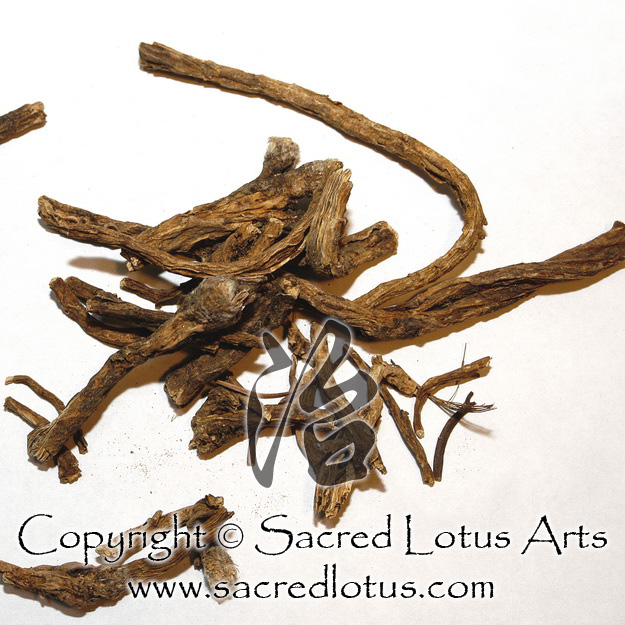
Materia Medica Data
- Temperature
- Cold
- Nature & Flavour
- Bitter, Cold
- Channels Entered
- LI, LIV, ST
- Latin (pharmaceutical)
- Radix Pulsatillae Chinensis
- Chinese
- 白头翁
- Tone Marks
- bái tóu wēng
- Translation
- Hoary headed geezer
Chinese Herb Actions
What is Bai Tou Weng used for in Chinese medicine?
Bai Tou Weng is the classical herb for damp-heat dysenteric disorders — bitter and cold, entering the Large Intestine, Liver and Stomach channels, it clears heat, resolves toxicity and cools the blood, and is used above all for diarrhoea and dysentery with heat signs, especially where there is blood or pus in the stool. It is one of the herbs that clear heat and eliminate toxins.
Its main traditional actions:
- Clears heat, resolves toxicity, and cools the blood to stop dysenteric disorders — damp-heat in the Stomach and Intestines presenting as diarrhoea or dysentery with abdominal pain, tenesmus, and blood or pus in the stool. Traditional sources associate it with both bacterial and amoebic dysentery presentations.
- Cools the blood and stops bleeding — nosebleed and bleeding haemorrhoids arising from heat in the blood.
- Used externally — as a wash or douche for damp-heat vaginal discharge and itching, including trichomonal vaginitis.
The name: bai tou weng translates roughly as “hoary-headed old man” — a description of the silvery, white-haired plumes that cover the plant's seed heads and the crown of the root.
Source: Sacred Lotus sources & references (herb identity, category, channel and action data), cross-referenced against multiple online sources and materia medica consensus. Traditional-use framing; not medical advice.
Chinese Herb Dosage
What is the typical dosage of Bai Tou Weng?
Roughly 6–15 g in decoction, consistent with standard materia medica ranges. The part used is the root of Pulsatilla chinensis, harvested and dried — the dried root is the medicinal material, not the fresh plant (see cautions). For external use it is prepared as a strong decoction and applied as a wash or sitz bath rather than taken internally.
- 6–15 g in decoction internally.
- Part used: dried root.
- External use: decocted and used topically as a wash.
Source: Sacred Lotus sources & references (existing dosage record); standard materia medica ranges. Reference only — not a prescription.
Chinese Herb Contraindications & Cautions
Are there cautions for Bai Tou Weng?
Contraindicated in chronic diarrhoea arising from Spleen and Stomach deficiency — Bai Tou Weng is bitter and cold and is aimed at heat and toxicity, so it is the wrong herb for cold, deficient, or long-standing loose stool, where it would further weaken digestion. Two further reference points sit alongside the traditional caution:
- Use the dried root, not the fresh plant — Bai Tou Weng belongs to the buttercup family (Ranunculaceae), whose members contain ranunculin, which converts on tissue damage to protoanemonin, a known irritant. Measured comparisons in this family show fresh material carrying far more protoanemonin than dried: in Ranunculus sceleratus, protoanemonin made up 9.49% of the fresh material versus 0.38% of the dried — a roughly 25-fold difference (PMID 31629027). Protoanemonin is also chemically unstable and degrades on storage (PMID 32497949). Medicinal Bai Tou Weng is the dried root, which is why this is a handling and identity note rather than a hazard of the prepared herb.
- Prolonged or high-dose use warrants supervision — long-term oral dosing of isolated Pulsatilla chinensis saponins produced time-dependent liver injury in rats (PMID 32575028). This is animal work on concentrated saponin fractions, not the decocted herb at normal doses, but it supports keeping Bai Tou Weng to short courses under a qualified practitioner rather than open-ended self-use.
- Pregnancy — professional supervision is appropriate; precautionary reference note.
Source: Sacred Lotus sources & references (traditional contraindication); PMID 31629027; PMID 32497949; PMID 32575028. Neutral reference facts, not usage instructions.
Chinese Herb Toxicity & Overdose
Low at normal doses of the dried, decocted root; two constituent-level facts are worth recording accurately.
- Protoanemonin (family-level, fresh material). Ranunculaceae plants contain ranunculin, which converts to the irritant protoanemonin when tissue is crushed or damaged. This has been directly quantified in related species — fresh Ranunculus sceleratus contained about 25 times more protoanemonin than dried material (PMID 31629027), and protoanemonin has been measured in Pulsatilla vulgaris flowers, where it also proved unstable over storage (PMID 32497949). We state this at the level the literature actually supports: it is a well-documented property of the family and of measured relatives, and drying substantially reduces it. We have not found quantification specific to dried Pulsatilla chinensis root, and do not assert one.
- Saponin hepatotoxicity (isolated fraction, animal). Long-term oral administration of P. chinensis saponins caused time-dependent liver damage in rats, mechanistically linked to disruption of ceramide/sphingomyelin balance, lipid-metabolism dysregulation and hepatocyte apoptosis (PMID 32575028). This concerns concentrated saponin fractions in animals, not the traditional decoction.
Sources: PMID 31629027; PMID 32497949; PMID 32575028. Reference notes, not a safety guarantee.
Herb-Drug Interactions
No well-established clinical herb–drug interactions are documented for Bai Tou Weng. The one area worth practitioner awareness is hepatic: given that isolated Pulsatilla chinensis saponins produced dose- and time-dependent liver injury in rats (PMID 32575028), concurrent use with hepatotoxic medications, or use in people with existing liver disease, is reasonably kept under professional supervision. This is precautionary extrapolation from animal data on an isolated fraction, not a demonstrated clinical interaction. (Flagged for practitioner confirmation.)
Source: PMID 32575028. Precautionary reference, not a documented clinical interaction.
Western / Biomedical Research
Chinese Herb Clinical Studies & Research
Provided as research context — a summary of published biomedical study, not a therapeutic or medical claim.
Is there modern research on Bai Tou Weng (Pulsatilla chinensis)?
Yes — a substantial preclinical literature centred on its triterpenoid saponins, with anemoside B4 as the most-studied compound and the accepted quality-control marker for the herb. Human clinical evidence remains limited; almost all of the work below is laboratory or animal research and none of it establishes a treatment.
- Anemoside B4 — the most abundant of the herb's triterpenoid saponins and its quality-control marker. A dedicated review covers its pharmacokinetics, tissue distribution and biological activity, and frames it as a candidate natural immunomodulatory agent for inflammatory conditions such as ulcerative colitis (PMID 32679180). Notably, that review sets this in the context of Pulsatilla Decoction — our Bai Tou Weng Tang — which has been used for bacterial dysenteric disorders for centuries and has more recently drawn interest for ulcerative colitis. That is a direct modern echo of the classical indication, but it is research interest, not clinical proof.
- Pulsatilla saponins generally — a review of their pharmacological activities and molecular mechanisms describes anti-inflammatory, antioxidant, antimicrobial and organ-protective effects, alongside apoptosis induction and inhibition of angiogenesis in cancer cell models (PMID 35606807).
- Anticancer research — a systematic review of P. chinensis in oncology reports mechanisms including inhibition of proliferation, induction of apoptosis and autophagy, cell-cycle and energy-metabolism effects, and anti-angiogenesis, via Notch, PI3K/AKT/mTOR and MEK/ERK signalling (PMID 35814470). Experimental research only; this is not a cancer treatment claim.
- The same saponins are the toxicity story — the constituent class responsible for most of the reported activity is also the one linked to liver injury in long-term rat dosing (PMID 32575028). Activity and toxicity here are not separate findings.
We found no randomized controlled trials or meta-analyses of Bai Tou Weng or Bai Tou Weng Tang indexed in PubMed at the time of writing; the human evidence base is not yet there.
Sources: PMID 32679180 (Pharmacological Research, 2020, anemoside B4 review); PMID 35606807 (Chinese Medicine, 2022, Pulsatilla saponins review); PMID 35814470 (Frontiers in Oncology, 2022, systematic review, preclinical/clinical anticancer research); PMID 32575028 (Phytomedicine, 2020, saponin-induced liver injury in rats); PMID 31629027 and PMID 32497949 (protoanemonin quantification in Ranunculaceae). Research context, not a therapeutic claim.
Chinese Herb Notes
Which formula is Bai Tou Weng best known for?
Bai Tou Weng Tang (Pulsatilla Decoction) — the formula is named after the herb, and Bai Tou Weng is its chief ingredient. Sacred Lotus's own formula data records it as a four-herb decoction for heat-toxin dysenteric disorders: Bai Tou Weng with Huang Lian, Huang Bai, and Qin Pi. Every herb in it is bitter and cold; the combination clears heat and toxicity from the Intestines while Qin Pi adds an astringent, diarrhoea-checking quality that keeps the formula from being purely draining.
- Bai Tou Weng — chief; clears heat, resolves toxicity, cools the blood in the Intestines.
- Huang Lian and Huang Bai — dry damp-heat in the middle and lower burners.
- Qin Pi — bitter, cold and astringent; stops the dysenteric discharge.
How is Bai Tou Weng different from other heat-clearing dysentery herbs?
Among the heat-clearing, toxin-resolving herbs, Bai Tou Weng is unusually specific: its reputation is built almost entirely on damp-heat dysenteric disorders rather than on general fire-toxin conditions like sores and abscesses. Compared with Huang Lian, which dries damp-heat broadly across the middle burner, Bai Tou Weng is directed at the Large Intestine and is favoured where the stool contains blood, because it also cools the blood. (Traditional formula and comparison context, not treatment advice.)
Source: Sacred Lotus sources & references (formula composition data for Bai Tou Weng Tang), cross-referenced against multiple online sources and materia medica consensus.
Sources & References
Compiled and edited by Thomas Dehli, Founder & Editor, Sacred Lotus Updated
The information here is referenced from numerous sources — teachers, practitioners, class notes from Five Branches University, the books below, and the published research literature, with citations given as resolvable PubMed identifiers. Where sources disagree, I have flagged the discrepancies directly. If facts couldn't be verified, I have left them out. How we source our content.
Reference information for students and practitioners — not medical advice. Consult a qualified practitioner. Terms of use.
Chinese Herbs Books & References
 https://amzn.to/3WfB3DK
 https://amzn.to/3DR1VUh
 https://amzn.to/42aMz73
 https://amzn.to/3PuD4bt