
Radix Polygalae Tenuifoliae Chinese Senega Root
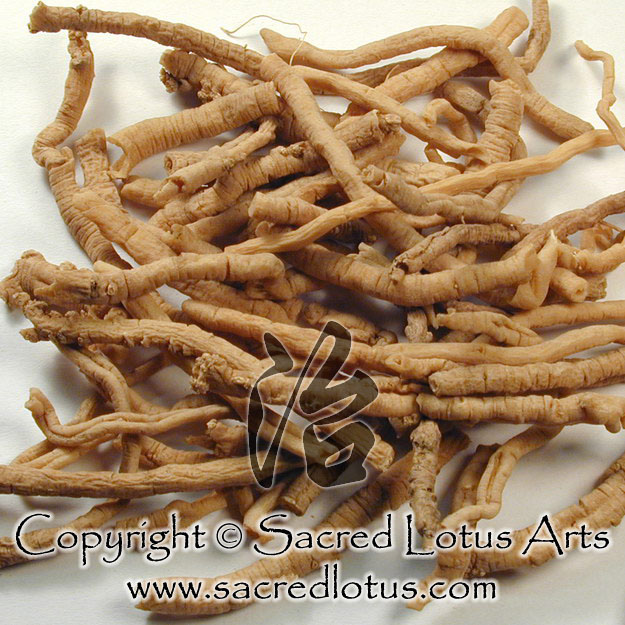
Materia Medica Data
- Temperature
- Slightly Warm
- Nature & Flavour
- Bitter, Spicy, Slightly Warm
- Channels Entered
- HT, LU, KI
- Latin (pharmaceutical)
- Radix Polygalae Tenuifoliae
- Chinese
- 元志
- Tone Marks
- yuán zhì
- Translation
- Profound Will
Chinese Herb Actions
What is Yuan Zhi used for in Chinese medicine?
Yuan Zhi (Chinese senega root / Polygala) is traditionally used to calm the spirit and quiet the Heart, expel phlegm, and open the orifices — and it is classically valued for improving the memory. It is used for insomnia, restlessness, and palpitations with anxiety, especially when tied to pent-up or constrained emotions, and for phlegm-type disorientation, forgetfulness, and cough with hard-to-expel phlegm.
Its main traditional actions:
- Calms the spirit and quiets the Heart — insomnia, palpitations with anxiety, restlessness and irritability, most effective where the cause is constrained, pent-up emotion; traditionally said to sharpen memory.
- Expels phlegm and opens the orifices — disorientation, confusion, forgetfulness, and seizure-type presentations attributed to phlegm clouding the Heart orifices.
- Expels phlegm from the Lung — cough with copious or difficult-to-expel phlegm.
- Reduces sores and abscesses — traditionally applied to swellings, sores, and mastitis (dissipates masses).
Source: owner’s Five Branches notes, reviewed against Bensky, Materia Medica (3rd ed.). Traditional-use framing; not medical advice.
Chinese Herb Dosage
What is the typical dosage of Yuan Zhi?
3–9 g in decoction. Yuan Zhi is usually used in processed (honey- or licorice-prepared) form, which softens its irritating quality to the throat and stomach.
Source: owner’s Five Branches notes; standard materia medica ranges. Reference only — not a prescription.
Chinese Herb Contraindications & Cautions
Are there cautions or contraindications for Yuan Zhi?
Yuan Zhi is warming and irritating, so it is used with care where there is heat or a raw digestive tract. Traditionally it is contraindicated or used cautiously in yin deficiency with heat signs, and in those with gastritis or peptic (stomach) ulcers, because it can irritate the throat and stomach lining. Processed forms and pairing with harmonizing herbs reduce this irritation.
Source: owner’s Five Branches notes (contraindications: yin deficiency with heat; stomach ulcers; gastritis).
Chinese Herb Toxicity & Overdose
Low at normal doses, but the saponins are irritating. Pharmacology reviews identify the triterpenoid saponins as the main irritant/toxic component; large or prolonged doses can irritate the throat and gastrointestinal tract and provoke nausea. Traditional processing (honey- or licorice-prepared) and combination with other herbs are used specifically to blunt this irritation.
Source: PubMed 38873413 (Polygalae Radix: metabolites, pharmacological activities and toxicology). Not medical advice.
Herb-Drug Interactions
No well-established clinical herb–drug interactions are documented. Given the known throat and gastrointestinal irritation from its saponins, practitioner caution is reasonable alongside other agents that irritate the stomach. (Flagged for practitioner confirmation — absence of documented interactions is not proof of safety.)
Western / Biomedical Research
Chinese Herb Clinical Studies & Research
Provided as research context — a summary of published biomedical study, not a therapeutic or medical claim.
Is there modern research on Yuan Zhi (Polygala) and memory or cognition?
Yes, but it is largely preclinical. Polygalae Radix (the root of Polygala tenuifolia) is one of the traditional “memory” herbs, and modern reviews catalog more than 160 constituents — chiefly triterpenoid saponins, xanthones, and oligosaccharide esters — with reported neuroprotective, antioxidant, and anti-inflammatory activity in laboratory and animal models. Its saponins (including tenuigenin, tenuifolin, and onjisaponin B) are being studied as candidate compounds for dementia.
- Mechanisms studied — in preclinical models the saponins reduce β-amyloid accumulation, modulate neurotransmitters, improve synaptic function, and limit neuronal apoptosis.
- Limitation — robust human clinical evidence is still limited; most findings are in vitro or in animals.
Sources: PubMed 38873413 (Polygalae Radix review, Front Pharmacol 2024); PubMed 39050746 (Polygala tenuifolia saponins for dementia, Front Pharmacol 2024). Research context, not a therapeutic claim.
Chinese Herb Notes
How does Yuan Zhi compare to other calm-spirit herbs, and what is it combined with?
Yuan Zhi is the calm-spirit herb that also resolves phlegm, so it is chosen when a disturbed spirit sits alongside phlegm, cough, or emotional constraint. Unlike the purely nourishing spirit-calmers, it is spicy, bitter, and dispersing, which is why it doubles as a phlegm and orifice-opening herb.
How it differs from close neighbors:
- vs Suan Zao Ren — Suan Zao Ren nourishes Heart yin and Liver blood for insomnia from deficiency; Yuan Zhi is better for insomnia and palpitations from pent-up emotion and also transforms phlegm.
- vs Bai Zi Ren — Bai Zi Ren is a moistening spirit-calmer best for Heart blood deficiency; Yuan Zhi is dispersing rather than nourishing.
- vs He Huan Pi — He Huan Pi is best for insomnia from qi constraint; Yuan Zhi additionally opens the orifices and resolves phlegm.
Common combinations: with Shi Chang Pu to open the orifices and support memory and mental clarity; with Suan Zao Ren and Bai Zi Ren to strengthen the calm-spirit effect; with Jie Geng to help expel phlegm.
Source: owner’s Five Branches notes and comparative-function tables (Bensky-derived differentiation set).
Sources & References
Compiled and edited by Thomas Dehli, Founder & Editor, Sacred Lotus Updated
The information here is referenced from numerous sources — teachers, practitioners, class notes from Five Branches University, the books below, and the published research literature, with citations given as resolvable PubMed identifiers. Where sources disagree, I have flagged the discrepancies directly. If facts couldn't be verified, I have left them out. How we source our content.
Reference information for students and practitioners — not medical advice. Consult a qualified practitioner. Terms of use.
Chinese Herbs Books & References
 https://amzn.to/3WfB3DK
 https://amzn.to/3DR1VUh
 https://amzn.to/42aMz73
 https://amzn.to/3PuD4bt