
Cortex Eucommiae Ulmoidis Eucommia Bark
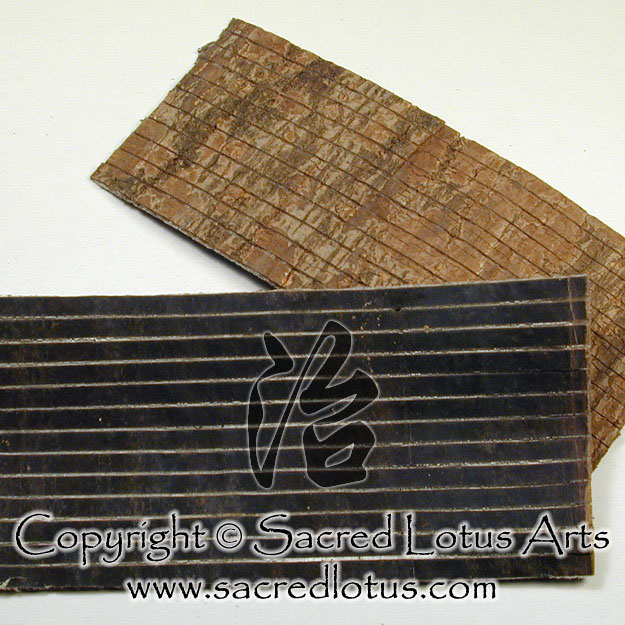
Materia Medica Data
- Category
- Herbs that Tonify Yang
- Temperature
- Warm
- Nature & Flavour
- Sweet, Slightly Spicy, Warm
- Channels Entered
- KI, LIV
- Latin (pharmaceutical)
- Cortex Eucommiae Ulmoidis
- Chinese
- 杜仲
- Tone Marks
- dù zhòng
Chinese Herb Actions
What is Du Zhong used for in Chinese medicine?
Du Zhong (Eucommia Bark) is traditionally used to tonify the Liver and Kidney and to strengthen the sinews and bones — its principal use, for Liver/Kidney-deficiency presentations of a sore, weak lower back and knees and weak legs. It is also traditionally used to steady an unsettled pregnancy, to warm and support Kidney yang, and to calm ascendant Liver yang.
Its main traditional actions:
- Tonifies the Liver and Kidney; strengthens the sinews and bones — sore, weak lower back and knees, weak legs.
- Traditionally used to “calm the fetus” — in Kidney-deficiency (“Cold Xu Kidney”) patterns of an unsettled pregnancy with bleeding or a restless fetus, classically paired with other fetus-calming herbs.
- Warms and supports Kidney yang — within Kidney-yang-deficiency (“yang xu”) presentations that older texts describe in terms of impotence and a cold, weak lower body.
- Calms ascendant Liver yang — where Liver/Kidney deficiency lets Liver yang rise, described as dizziness, blurred vision, and light-headedness. (A TCM pattern label, not a biomedical diagnosis.)
Source: owner’s Five Branches notes, reviewed against Bensky, Materia Medica (3rd ed.). Traditional-use framing; not medical advice.
Chinese Herb Dosage
What is the typical dosage of Du Zhong?
Roughly 6–15 g in decoction — the owner’s notes give 3–5 qián, which at the common modern conversion (~3 g per qián) is about 6–15 g, consistent with standard materia medica ranges. Du Zhong is used either raw (Du Zhong) or dry-fried / salt-fried (Chǎo Du Zhong), the fried form being the usual choice to strengthen the Kidney-tonifying, back-strengthening action.
Source: owner’s Five Branches notes; standard materia medica ranges. Reference only — not a prescription.
Chinese Herb Contraindications & Cautions
Are there cautions for Du Zhong?
Du Zhong is warm and, like the Tonify-Yang herbs as a class, can injure yin — the chapter caution is to avoid these herbs in fire from yin deficiency (yin-xu heat). The notes flag Du Zhong specifically: use it carefully in yin-deficiency / ascendant-yang pictures, and combine it with other herbs rather than using it alone in those cases. It is traditionally regarded as gentle and well tolerated within its indicated deficiency patterns, and is best used under a qualified practitioner, particularly in pregnancy.
Note: The classical “calm the fetus” use in pregnancy is a traditional indication but a clinical context — flagged for practitioner oversight rather than self-use.
Source: owner’s Five Branches notes; blood/yang-tonic chapter cautions.
Chinese Herb Toxicity & Overdose
Low. Eucommia bark is regarded as a safe, well-tolerated tonic; the reviewed literature reports no major adverse effects at studied doses and provides no formal human toxicity threshold.
Note: Absence of reported toxicity is not the same as an established safety ceiling — no formal human toxicity threshold has been set in the reviewed research.
Source: materia medica consensus; reviewed research (below) reports no toxicity signal but sets no human threshold.
Herb-Drug Interactions
No well-established clinical herb–drug interactions are documented. Because preclinical research reports blood-pressure-lowering activity (below), a theoretical caution is reasonable alongside antihypertensive medication — this is precautionary, not a demonstrated clinical interaction. (Flagged for practitioner confirmation.)
Western / Biomedical Research
Chinese Herb Clinical Studies & Research
Provided as research context — a summary of published biomedical study, not a therapeutic or medical claim.
Is there modern research on Eucommia (Du Zhong)?
Yes, but it is largely preclinical. Characterized constituents of Eucommia ulmoides include lignans (notably pinoresinol diglucoside), iridoids (aucubin, geniposidic acid, asperuloside), phenolics (chlorogenic acid, caffeic acid, rutin, quercetin), flavonoids, and polysaccharides. A comprehensive review catalogues antihypertensive, antioxidant, anti-inflammatory, and bone-protective activities but notes the evidence is largely from cell and animal models, with human clinical data limited.
- Pinoresinol diglucoside is the marker compound specified for Eucommia bark in the Chinese Pharmacopoeia (2020 ed., minimum content 0.10%), and reviews associate it with the antihypertensive activity seen in animal studies.
- Blood pressure (animal) — in spontaneously hypertensive rats, a Eucommia (male-flower) aqueous extract lowered blood pressure and modulated the renal ACE2 / angiotensin-(1–7) axis; an animal mechanistic study, not evidence of a clinical antihypertensive effect.
- Bone-protective (animal) — improved bone mineral density and trabecular microarchitecture via BMP/SMAD, Wnt/β-catenin, and OPG/RANKL signalling in animal models of osteoporosis.
Human clinical evidence remains limited; most support is laboratory and animal research.
Sources: PMID 27042191, PMC 4793136 (health-promoting properties review); PMC 12845223 (bioactive compounds review, Chinese Pharmacopoeia marker detail); PMC 7210558 (male-flower extract in spontaneously hypertensive rats, animal study); PMC 12868233 (osteoprotective scoping review, preclinical). Research context, not a therapeutic claim.
Chinese Herb Notes
How is Du Zhong different from Xu Duan?
Both tonify the Liver and Kidney, ease lower-back pain, and calm a restless fetus, but Du Zhong is favored for primarily deficiency (xu) pictures. Xu Duan is used more when low-back pain combines wind-damp with Kidney deficiency, and Xu Duan additionally invigorates blood and helps heal injuries “without causing stagnation.”
- vs Xu Duan — Du Zhong for deficiency-dominant back/knee weakness; Xu Duan for wind-damp with Kidney deficiency, plus blood-invigorating and injury-healing action.
- Within the Tonify-Yang group — Bensky’s summary places Du Zhong among the yang tonics said to also nourish yin (alongside Dong Chong Xia Cao), i.e. less drying than harsher yang tonics such as Xian Mao or Yin Yang Huo.
Common combinations: with Xu Duan for a weak, painful lower back and to steady an unsettled pregnancy; with Hu Tao Ren, Bu Gu Zhi, and Gou Ji for Kidney-deficiency weakness of the lower back and knees. It also features in well-known classical formulas including Du Huo Ji Sheng Tang (wind-damp with Liver/Kidney deficiency, low-back pain), You Gui Wan (Kidney yang), Zan Yu Dan (fertility), and Tian Ma Gou Teng Yin (rising Liver yang). (Traditional formula context, not treatment advice.)
Source: owner’s Five Branches notes (differentiation & combinations); Sacred Lotus formula links.
Sources & References
Compiled and edited by Thomas Dehli, Founder & Editor, Sacred Lotus Updated
The information here is referenced from numerous sources — teachers, practitioners, class notes from Five Branches University, the books below, and the published research literature, with citations given as resolvable PubMed identifiers. Where sources disagree, I have flagged the discrepancies directly. If facts couldn't be verified, I have left them out. How we source our content.
Reference information for students and practitioners — not medical advice. Consult a qualified practitioner. Terms of use.
Chinese Herbs Books & References
 https://amzn.to/3WfB3DK
 https://amzn.to/3DR1VUh
 https://amzn.to/42aMz73
 https://amzn.to/3PuD4bt