
Gelatinum Cornu Cervi Deer Horn Gelatin
Also known as Bai Jiao
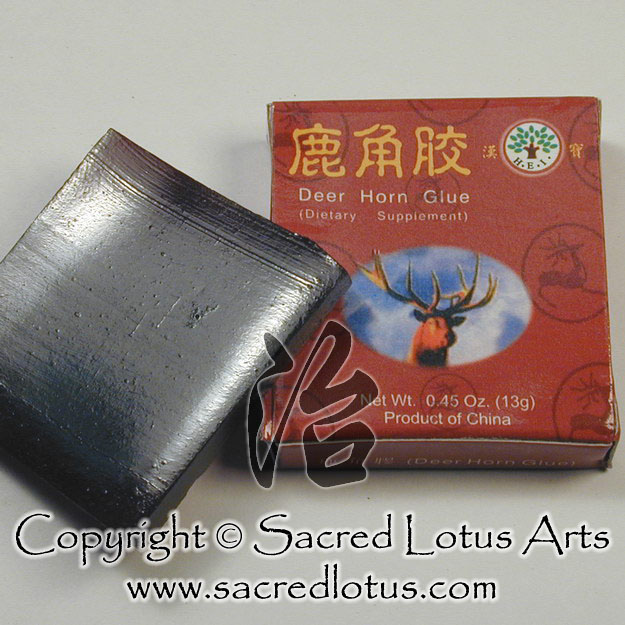
Materia Medica Data
- Category
- Herbs that Tonify Yang
- Temperature
- Warm
- Nature & Flavour
- Sweet, Salty, Warm
- Channels Entered
- LIV, KI
- Latin (pharmaceutical)
- Gelatinum Cornu Cervi
- Chinese
- 鹿角胶
- Tone Marks
- lù jiăo jiāo
- Also Known As
- Bai Jiao
- Translation
- Deer Horn Gelatin
Chinese Herb Actions
What is Lu Jiao Jiao used for in Chinese medicine?
Lu Jiao Jiao (deer antler gelatin) traditionally tonifies Kidney yang, augments essence and blood, and stops bleeding — most notably deficient-cold uterine bleeding — for patterns of jing-blood depletion with a sore, weak low back, dizziness, and fatigue. It is milder and more moistening than the raw antler forms above it in the deer-antler family (see comparison below).
Its main traditional actions:
- Tonifies Kidney yang — cold, weak low back and knees, and general Kidney-yang deficiency; gentler than Lu Rong or Lu Jiao.
- Augments essence and blood — jing-blood depletion with dizziness, tinnitus, and profound fatigue.
- Stops bleeding, especially deficient-cold uterine bleeding — chronic or heavy uterine bleeding and abnormal vaginal discharge arising from Kidney-yang/Chong-Ren deficiency and cold.
- More blood- and yin-nourishing than Lu Rong or Lu Jiao — as a rendered gelatin (glue) rather than raw antler, it carries a more moistening, blood-tonifying quality alongside its warming, yang-tonic action.
Source: this site’s own identity record (Sweet, Salty, Warm; Liver & Kidney channels); materia medica consensus (Bensky, Chinese Herbal Medicine: Materia Medica, 3rd ed.), cross-referenced against multiple online sources. Traditional-use framing; not medical advice.
Chinese Herb Dosage
What is the typical dosage of Lu Jiao Jiao, and how is it prepared?
Commonly about 3 g taken up to three times daily (roughly 9 g/day), within a published range of about 4–12 g/day. As a rendered gelatin, Lu Jiao Jiao is not decocted together with the other herbs — it is melted/dissolved into the strained, hot decoction or into warm rice or millet wine, or taken as a prepared pill or powder.
Source: standard materia medica ranges, cross-referenced against secondary summaries (Bensky-derived references and multiple online sources). Reference only — not a prescription.
Chinese Herb Contraindications & Cautions
Are there cautions for Lu Jiao Jiao?
Lu Jiao Jiao is warm and yang-tonifying, so it is contraindicated in yin-deficiency patterns with heat or effulgent (excess) fire — where it would be expected to aggravate night sweats, hot flashes, dry mouth, or agitation. Because it treats deficient-cold bleeding specifically, it is not indicated for heat-type or excess bleeding patterns. As with other strongly tonifying substances, it is best used under a qualified practitioner, particularly during pregnancy.
- Dietary/ethical (reference note) — Lu Jiao Jiao is an animal-derived product (deer antler gelatin) and is not suitable for vegetarians or vegans; the animal source should be disclosed.
- Sourcing/species (reference note) — it is rendered from the hardened, mature antler of farmed Cervus elaphus (red deer) or Cervus nippon (sika deer), typically antler that has been sawn off or naturally shed; this site’s own record flags this entry for endangered-species/sourcing sensitivity, and species/CITES status are worth confirming with the supplier at purchase.
Source: materia medica consensus (yin-deficiency-fire contraindication, cross-referenced against multiple online sources and secondary Bensky-derived summaries); this site’s own identity record flag; sourcing per herbalogical/authentication research (below). Animal-source and sourcing points are neutral reference disclosures.
Chinese Herb Toxicity & Overdose
Low. Lu Jiao Jiao is an animal-derived gelatin with a long history of dietary and medicinal use, and no significant intrinsic toxicity is reported at normal doses. The main real-world concerns are not intrinsic toxicity but (a) inappropriate use in heat/yin-deficiency-fire patterns, given its warming, yang-tonifying nature, (b) product authenticity (species substitution is a documented quality-control issue for deer-antler gelatins), and (c) allergen potential for those sensitive to gelatin/collagen.
Source: materia medica consensus; deer-antler-gelatin authentication research (below). Reference note, not a safety guarantee.
Herb-Drug Interactions
No well-established clinical herb–drug interactions are documented. Given its traditional hemostatic and blood-tonic use, practitioner awareness is reasonable for patients on anticoagulant or other bleeding-affecting therapy — this is precautionary, not a demonstrated clinical interaction. (Flagged for practitioner confirmation.)
Western / Biomedical Research
Chinese Herb Clinical Studies & Research
Provided as research context — a summary of published biomedical study, not a therapeutic or medical claim.
Is there modern research on Lu Jiao Jiao (Colla Cornus Cervi)?
Yes — mostly preclinical and case-report evidence, with no controlled human trials identified. Colla Cornus Cervi (Cervi Cornus Colla) is an aqueous extract made by boiling and condensing the ossified antler of Cervus nippon or Cervus elaphus down into a solid glue.
- Human case reports (hematologic) — a case-report series of two patients with otherwise-intractable anemia (acquired aplastic anemia; virus-associated anemia with thrombocytopenia) added Placenta Hominis (4 g/day) and Cervi Cornus Colla (3 g/day) to conventional therapy; both showed sustained improvement in hemoglobin and platelet counts over months. Preliminary case-report evidence, not a controlled trial.
- Tissue-engineering / skin models (preclinical) — two related lab studies found that adding Cervi cornus Colla to engineered human skin equivalents (with hyaluronic acid) increased epidermal thickness, basement-membrane protein expression, and markers of keratinocyte stem-cell activity (p63) versus controls. Cell-culture/tissue-engineering models, not clinical evidence of a therapeutic effect.
- Herbalogical/authentication study — a 2020 historical materia medica review traced Cervi Colla through Chinese literature back to the Zhou dynasty, finding it was historically rendered from multiple cervid species (not only red deer and sika deer, but also elk and sambar) and that two related products exist — Cervi Corii Colla (skin-derived) and Cervi Cornus Colla (antler-derived, now dominant in the market) — useful context for today's naming and identity questions.
Human clinical evidence is limited to case reports; controlled trials were not identified.
Note: This site’s own record records the pharmaceutical Latin as “Gelatinum Cornu Cervi,” while the research literature more often uses “Colla Cornus Cervi” / “Cervi Cornus Colla.” We believe these refer to the same substance (deer antler gelatin, distinct from the skin-derived Cervi Corii Colla); the identity field is left unchanged pending owner confirmation.
Sources: PMID 20360892, PMC 2840555, DOI 10.2147/ijgm.s5253 (case-report series, intractable anemia); PMID 23011660, DOI 10.1007/s00403-012-1283-8 (Archives of Dermatological Research, 2013; skin-equivalent model); PMID 23534702, DOI 10.1111/ics.12045 (International Journal of Cosmetic Science, 2013; epidermal differentiation); PMID 32237464 (Zhongguo Zhong Yao Za Zhi, 2020; herbalogical/authentication study). Research context, not a therapeutic claim.
Chinese Herb Notes
How does Lu Jiao Jiao compare with Lu Rong, Lu Jiao, and Lu Jiao Shuang?
Lu Jiao Jiao sits in the middle of the deer-antler processing family, as the gelatin rendered by boiling down the hardened, mature antler (Lu Jiao) into a glue. The family runs from strongest to weakest: Lu Rong (soft young velvet) → Lu Jiao (hardened mature antler) → Lu Jiao Jiao (gelatin rendered from it, more blood/yin-nourishing) → Lu Jiao Shuang (the degelatinated residue left after the glue is extracted).
- Lu Rong (velvet of the young, growing antler) — the strongest and most warming; the principal Kidney-yang, essence, and blood tonic, reserved for deep constitutional deficiency.
- Lu Jiao (hardened, mature antler) — considerably weaker as a tonic than Lu Rong; shifts toward invigorating blood and reducing toxic swellings/sores.
- Lu Jiao Jiao (this herb, the gelatin/glue) — more focused than Lu Jiao on nourishing essence and blood and on stopping bleeding, particularly deficient-cold uterine bleeding; gentler and more moistening than raw Lu Jiao.
- Lu Jiao Shuang (degelatinated antler residue) — the weakest of the four; mildly astringent, used to stop bleeding and for external sores.
Formula context: in this site’s own record, Lu Jiao Jiao appears in You Gui Wan (Restore the Right [Kidney] Pill, a classic Kidney-yang formula) and Yang He Tang (Yang-Harmonizing Decoction, for cold-phlegm nodules and sores in deficient-cold patients). It is also traditionally paired with Gui Ban Jiao (tortoise plastron gelatin) to combine yang- and yin-tonifying gelatins. (Traditional formula context, not treatment advice.)
Source: this site’s own formula relationships (You Gui Wan, Yang He Tang); materia medica consensus on the deer-antler processing family.
Sources & References
Compiled and edited by Thomas Dehli, Founder & Editor, Sacred Lotus Updated
The information here is referenced from numerous sources — teachers, practitioners, class notes from Five Branches University, the books below, and the published research literature, with citations given as resolvable PubMed identifiers. Where sources disagree, I have flagged the discrepancies directly. If facts couldn't be verified, I have left them out. How we source our content.
Reference information for students and practitioners — not medical advice. Consult a qualified practitioner. Terms of use.
Chinese Herbs Books & References
 https://amzn.to/3WfB3DK
 https://amzn.to/3DR1VUh
 https://amzn.to/42aMz73
 https://amzn.to/3PuD4bt