
Tian Ma Gou Teng Yin
Gastrodia and Uncaria Decoction
- Category
- Formulas that Expel Wind
- Subcategory
- Formulas that Extinguish Internal Wind
- Ingredients
- 11 herbs
Actions
What does Tian Ma Gou Teng Yin do?
Tian Ma Gou Teng Yin calms rising Liver yang and extinguishes internal Liver wind, while clearing the heat that drives the yang upward and nourishing the Liver and Kidney yin that should be anchoring it below.
- Extinguishes Liver wind and stops tremor — Tian Ma and Gou Teng, the formula's core pair, quiet involuntary movement, tremor, and spasm associated with internal wind.
- Subdues and anchors Liver yang — Shi Jue Ming's heavy, mineral nature helps settle yang that has become unmoored and risen to the head.
- Clears Liver fire and heat — Zhi Zi and Huang Qin drain the heat that fans the rising yang, addressing the fire behind it rather than only its upward sign.
- Invigorates Blood and redirects excess downward — Yi Mu Cao and Chuan Niu Xi move Blood and help lead the excess above back down, a classic strategy for headache and flushing from ascending yang.
- Nourishes Liver and Kidney to secure the root — Du Zhong and Sang Ji Sheng tonify the Liver and Kidney whose underlying deficiency is understood to let yang escape upward in the first place.
- Calms the Heart and settles the spirit — Ye Jiao Teng and Fu Shen address the insomnia, irritability, and disturbed sleep that commonly accompany this pattern.
Source: cross-referenced against multiple online sources and Bensky & Barolet, Chinese Herbal Medicine: Formulas & Strategies.
Indications
What is Tian Ma Gou Teng Yin used for?
Tian Ma Gou Teng Yin addresses the pattern of Liver yang rising with internal wind — headache and dizziness that worsen with stress or anger, tinnitus, and a wiry pulse are its hallmark presentation.
- Headache, often one-sided or at the vertex, that intensifies with frustration or anger
- Dizziness and vertigo
- Tinnitus and a sensation of heat rising to the head or face
- Blurred or dim vision
- Insomnia, restless or disturbed sleep, and vivid dreaming
- Irritability and a short temper
- Numbness, tingling, or mild tremor in the limbs
- A wiry, and sometimes rapid, pulse with a red tongue body
Source: cross-referenced against multiple online sources and Bensky & Barolet, Chinese Herbal Medicine: Formulas & Strategies.
Western Uses:
What conditions is Tian Ma Gou Teng Yin used for in modern practice?
Tian Ma Gou Teng Yin calms ascending Liver yang and extinguishes Liver wind (headache, dizziness, tinnitus, and the tremor/spasm of internal wind on a base of rising yang), so it is referenced for wind-and-yang-rising conditions: hypertension, eclampsia of pregnancy (puerperal eclampsia), one-sided paralysis (hemiplegia), and trigeminal neuralgia.
A critical safety note. Eclampsia is an obstetric EMERGENCY (seizures in pregnancy) and hemiplegia is a sign of STROKE — both require immediate emergency care. Hypertension requires medical management, and trigeminal neuralgia needs medical diagnosis. This formula is chosen for the Liver-wind pattern within, never instead of, that care. Traditional-use correlates only, not a treatment claim.
Source: Sacred Lotus sources & references (pattern) + Bensky & Barolet, Formulas & Strategies; biomedical correlates as reference only. Not medical advice.
Ingredients
11 substances in Tian Ma Gou Teng Yin — each links to its full herb monograph.
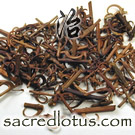 Gou Teng12-15 gExtinguish Wind and Stop Tremors
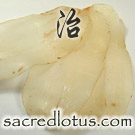 Tian Ma9 gExtinguish Wind and Stop Tremors
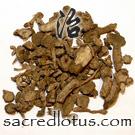 Chuan Niu Xi12 gInvigorate Blood and Remove Stagnation
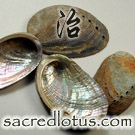 Shi Jue Ming18-24 gExtinguish Wind and Stop Tremors
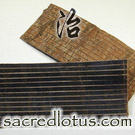 Du Zhong9-12 gTonify Yang
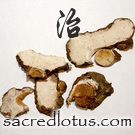 Fu Shen9-15 gRegulate Water and Drain Dampness
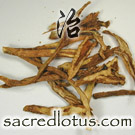 Huang Qin9 gClear Heat and Dry Dampness
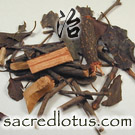 Sang Ji Sheng9-24 gTonify Yin
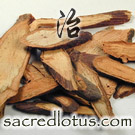 Ye Jiao Teng9-30 gNourish the Heart and Calm the Spirit
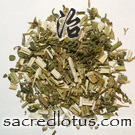 Yi Mu Cao9-12 gInvigorate Blood and Remove Stagnation
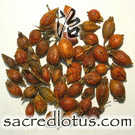 Zhi Zi9 gDrain Fire
Preparation & dosage
How is Tian Ma Gou Teng Yin prepared?
Tian Ma Gou Teng Yin is taken as a water decoction, with two ingredient-specific cooking adjustments that formulary sources consistently note.
- Shi Jue Ming is decocted first. As a mineral shell substance, it is added to the water and simmered alone for a period before the other herbs go in, giving its constituents time to extract.
- Gou Teng is added last. Its active alkaloids are heat-labile, so it is traditionally added only in the final minutes of the decoction (or briefly steeped) rather than boiled for the full cooking time, to avoid degrading its wind-extinguishing effect.
- The remaining herbs are cooked together by standard decoction method.
Source: cross-referenced against multiple online sources and Bensky & Barolet, Chinese Herbal Medicine: Formulas & Strategies.
Safety — read before use
What are the cautions for Tian Ma Gou Teng Yin?
Tian Ma Gou Teng Yin is formulated for wind arising from Liver yang excess and heat, and formulary sources caution against using it for wind due to Blood or Yin deficiency, where the underlying deficiency calls for direct tonification rather than the heat-clearing and yang-subduing approach this formula takes.
- Not indicated for internal wind arising primarily from Blood deficiency (e.g., with a pale tongue and thready pulse and no heat signs) — a different treatment strategy applies there.
- Contains Blood-invigorating herbs (Yi Mu Cao, Chuan Niu Xi) that are conventionally treated with caution in pregnancy in Chinese herbal medicine.
- Long-term or unsupervised use of any multi-herb formula, including substitution or self-selection of ingredients, is a matter for a qualified practitioner rather than self-treatment.
Source: cross-referenced against multiple online sources and Bensky & Barolet, Chinese Herbal Medicine: Formulas & Strategies.
Originally Appeared In:
- New Significance of Patterns and Treatment in Miscellaneous Diseases (Za Bing Zheng Zhi Xin Yi)
Notes:
Is Tian Ma Gou Teng Yin a classical formula?
No — Tian Ma Gou Teng Yin is a 20th-century formula, compiled by the physician Hu Guangci and published in his 1958 clinical text, making it one of the newer formulas in common use rather than one drawn from the classical canon.
How does Tian Ma Gou Teng Yin differ from other Liver-wind formulas?
It is frequently compared with two other formulas that also address ascending Liver yang and wind:
- Zhen Gan Xi Feng Tang (Sedate the Liver and Extinguish Wind Decoction) treats a more severe presentation of Liver/Kidney yin deficiency with yang rising to the point of counterflow, and relies more heavily on heavy, anchoring minerals and shells (e.g., Dai Zhe Shi, Long Gu, Mu Li) than on heat-clearing herbs.
- Long Dan Xie Gan Tang (Gentian Decoction to Drain the Liver) is a strongly heat-draining formula for genuine Liver/Gallbladder fire with damp-heat signs (e.g., genital itching or discharge) — a different pattern from the yang-rising-with-root-deficiency this formula targets.
Source: cross-referenced against multiple online sources and Bensky & Barolet, Chinese Herbal Medicine: Formulas & Strategies.
Clinical Studies & Research:
Is there modern research on Tian Ma Gou Teng Yin?
Tian Ma Gou Teng Yin has been studied mainly as an adjunct in hypertension research, though the evidence base remains preliminary. This is research context only, not a treatment claim.
- A 2012 Cochrane systematic review searching for randomized controlled trials of the formula for primary hypertension found no studies meeting its inclusion criteria, and concluded that well-designed trials had not yet been published.
- A 2013 systematic review of 22 randomized controlled trials found blood pressure improvements when the formula was combined with conventional antihypertensive medication in several patient subgroups, but rated the overall methodological quality of the included trials as generally low.
- A 2016 laboratory study in spontaneously hypertensive rats compared Tian Ma Gou Teng Yin with two other formulas for effects on hypertension-related myocardial fibrosis; Tian Ma Gou Teng Yin showed some effect but was less effective than Xue Fu Zhu Yu Tang in that model.
Sources: PMID 22696374, PMID 23710230, PMID 26852136.
Sources & References
Compiled and edited by Thomas Dehli, Founder & Editor, Sacred Lotus Updated
The information here is referenced from numerous sources — teachers, practitioners, class notes from Five Branches University, the books below, and the published research literature, with citations given as resolvable PubMed identifiers. Where sources disagree, I have flagged the discrepancies directly. If facts couldn't be verified, I have left them out. How we source our content.
Reference information for students and practitioners — not medical advice. Consult a qualified practitioner. Terms of use.
Chinese Formulas Books & References
 https://amzn.to/4fYI3f8
 https://amzn.to/4j55NRA
 https://amzn.to/4gMROyv
 https://amzn.to/4h7msSK