
Scierotium Pararadicis Poriae Cocos Poria Spirit
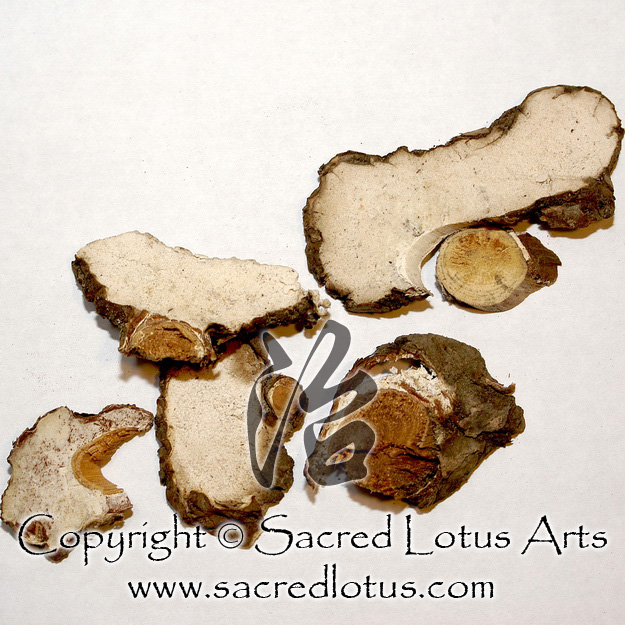
Materia Medica Data
- Temperature
- Neutral
- Nature & Flavour
- Sweet, Bland, Neutral
- Channels Entered
- HT, SP, LU
- Latin (pharmaceutical)
- Scierotium Pararadicis Poriae Cocos
- Chinese
- 茯神
- Tone Marks
- fú shén
Chinese Herb Actions
What is Fu Shen used for in Chinese medicine?
Fu Shen (Poria Spirit) is traditionally used to calm the Heart and spirit — for irritability, palpitations, insomnia, and forgetfulness — and, more mildly than Fu Ling proper, to promote urination. Sacred Lotus records its properties as sweet, bland, and neutral, entering the Heart, Lung, and Spleen channels.
Its main traditional actions:
- Calms the spirit — the herb's defining, differentiating action: for irritability, palpitations, insomnia, and forgetfulness (poor memory/concentration), reflecting a Heart/shen pattern rather than pure dampness.
- Promotes urination — drains dampness through the urine, as Fu Ling does, but this action is comparatively mild in Fu Shen; the herb is chosen primarily for its calming effect, not its diuretic strength.
Source: Sacred Lotus sources & references; cross-referenced against multiple online sources and materia medica consensus (Bensky, Materia Medica, 3rd ed.; Chen & Chen, Chinese Herbal Medicine: Materia Medica).
Chinese Herb Dosage
What is the typical dosage of Fu Shen?
Roughly 6–15 g in decoction, consistent with standard materia medica ranges for Poria-derived herbs. Fu Shen is used specifically for its calming effect on the mind and spirit rather than as a primary diuretic — when strong draining of dampness/edema is the goal, Fu Ling (the bulk sclerotium) is the more usual choice.
Source: Sacred Lotus sources & references; cross-referenced against multiple online sources and materia medica consensus (Bensky, Chen & Chen). Reference only — not a prescription.
Chinese Herb Contraindications & Cautions
Are there cautions for Fu Shen?
No specific cautions are noted in the standard materia medica references for Fu Shen beyond the general profile of Poria-derived herbs — it is a mild, neutral, well-tolerated substance. As with any Poria-type herb used for damp-draining, it would traditionally be used with more care in cases of marked yin deficiency with dryness, where excessive draining could aggravate fluid depletion, though this is a general class caution rather than a documented Fu-Shen-specific risk.
Source: Sacred Lotus sources & references; cross-referenced against multiple online sources and materia medica consensus (Bensky, Chen & Chen).
Chinese Herb Toxicity & Overdose
- None noted though allergic reactions to Fu Ling are possible.
Herb-Drug Interactions
- None noted, but this herb has a mild diuretic effect and care should be used in patients taking diuretics.
Western / Biomedical Research
Chinese Herb Clinical Studies & Research
Provided as research context — a summary of published biomedical study, not a therapeutic or medical claim.
Is there modern research on Fu Shen (Poria)?
Direct clinical research on Fu Shen specifically is sparse; the available human and animal research is on Poria cocos, the same fungal sclerotium that Fu Shen is one part of, and is described here as such rather than as Fu-Shen-specific evidence. Several recent studies have investigated sleep- and anxiety-related effects consistent with Fu Shen's traditional spirit-calming use.
- Small human pilot study — an open, pre/post clinical study in 21 adults (mean age 55) with poor sleep gave 800 mg/night of a 75% ethanol Poria cocos extract and assessed sleep by questionnaire and polysomnography; total sleep time increased significantly (about 327 to 357 minutes, p = 0.014) and time spent aroused during sleep decreased significantly (about 76 to 48 minutes, p = 0.009). The authors note pachymic acid (a Poria triterpenoid) as a candidate active compound. This was a small, uncontrolled pilot, not a randomized trial — treat as preliminary.
- Randomized controlled trial (combination product) — a 4-week, randomized, double-blind, placebo-controlled trial in 70 adults with sleep disorders tested a combined supplement of Poria cocos, Suan Zao Ren (Ziziphus spinosa), and GABA, finding improved sleep quality (Pittsburgh Sleep Quality Index) and total sleep duration versus placebo. Because Poria cocos was one of three active ingredients, this trial does not isolate Poria's individual contribution.
- Animal/mechanism research — a water-soluble Poria cocos polysaccharide reduced anxiety-like behavior in sleep-deprived rats, raised hypothalamic serotonin, dopamine, norepinephrine, and GABA levels, reduced inflammatory (TNF-α/NF-κB) signaling, and favorably shifted gut-microbiota composition; a separate rat study reported improved sleep-quality measures with Poria cocos extract. These are preclinical mechanism studies, not clinical proof.
Overall, the direction of evidence (small human pilot, one combination RCT, and consistent animal/mechanism data) is supportive of a genuine calming/sleep-related effect for Poria cocos, but well-controlled trials isolating Fu Shen itself are still lacking.
Sources: PMID 37836526 / PMC 10574255 (Nutrients 2023;15(19):4242, DOI 10.3390/nu15194242 — human pilot study); PMID 38873452 (Food Sci Nutr. 2024;12(6):3883-3892, DOI 10.1002/fsn3.4048 — randomized combination trial); PMID 35642970 (Food Funct. 2022;13(12):6648-6664, DOI 10.1039/d2fo00811d — rat polysaccharide/anxiety study); PMID 35682214 (Int J Environ Res Public Health 2022;19(11):6629, DOI 10.3390/ijerph19116629 — rat sleep-quality study). Research context, not a therapeutic claim.
Chinese Herb Notes
How is Fu Shen different from Fu Ling, Fu Ling Pi, and Chi Fu Ling?
Fu Shen, Fu Ling, Fu Ling Pi, and Chi Fu Ling all come from the same fungal sclerotium — Poria cocos, which grows attached to pine roots — but each is a distinct materia medica entry defined by which part of that sclerotium is used.
- Fu Ling — the bulk of the sclerotium (with the outer skin and any woody core removed); the general-purpose form, valued for draining dampness, tonifying the Spleen, and calming the Heart/shen all at once. One of the most widely combined herbs in the materia medica.
- Fu Shen — the portion of the sclerotium that has grown directly around and enclosed a pine root; traditionally regarded as superior to plain Fu Ling specifically for calming the spirit (irritability, palpitations, insomnia, forgetfulness), with a correspondingly milder urination-promoting effect.
- Fu Ling Pi — the discarded outer skin/rind of the sclerotium; used mainly to promote urination and reduce edema, and is considered better than plain Fu Ling specifically for skin/surface edema.
- Chi Fu Ling (“red” Poria) — the reddish-tinged layer just beneath the skin; classically described as draining damp-heat more specifically than the pale inner Fu Ling. It is a recognized processing/grade distinction in the wider materia medica, though it is not tracked as a separate page in this reference.
Common combinations: Fu Shen appears alongside Suan Zao Ren, Long Yan Rou, and Yuan Zhi in spirit-calming and Heart/Spleen-tonifying formulas of the Gui Pi Tang type, and with other spirit-anchoring herbs (e.g., Long Gu, Mu Li) in formulas addressing Heart/shen disturbance with palpitations and insomnia. (Traditional formula context, not treatment advice.)
Source: Sacred Lotus sources & references; cross-referenced against multiple online sources and materia medica consensus (Bensky, Chen & Chen); Sacred Lotus records for Fu Ling and Fu Ling Pi.
Sources & References
Compiled and edited by Thomas Dehli, Founder & Editor, Sacred Lotus Updated
The information here is referenced from numerous sources — teachers, practitioners, class notes from Five Branches University, the books below, and the published research literature, with citations given as resolvable PubMed identifiers. Where sources disagree, I have flagged the discrepancies directly. If facts couldn't be verified, I have left them out. How we source our content.
Reference information for students and practitioners — not medical advice. Consult a qualified practitioner. Terms of use.
Chinese Herbs Books & References
 https://amzn.to/3WfB3DK
 https://amzn.to/3DR1VUh
 https://amzn.to/42aMz73
 https://amzn.to/3PuD4bt