
Radix Aristolochiae Fangchi Aristolochia Root, Stephania
Also known as Fang Ji, Mu Fang Ji
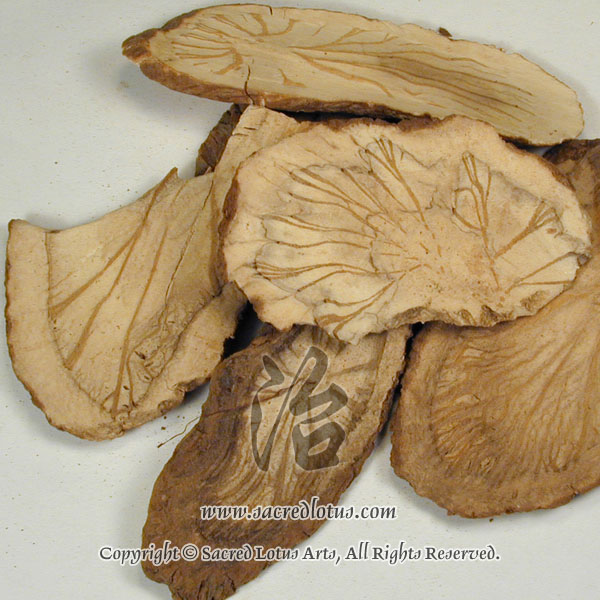
Materia Medica Data
- Temperature
- Cold
- Nature & Flavour
- Bitter, Spicy, Cold, Toxic
- Channels Entered
- BL, SP, KI
- Latin (pharmaceutical)
- Radix Aristolochiae Fangchi
- Chinese
- 广防己
- Tone Marks
- guăng fáng jĭ
- Also Known As
- Fang Ji, Mu Fang Ji
- Photo Note
- Mixed with Han Fang Ji?
Chinese Herb Actions
What is Guang Fang Ji, and is it still used?
Guang Fang Ji (广防己) is the root of Aristolochia fangchi, and it is not used. It contains aristolochic acid, a substance classified as a Group 1 human carcinogen, and it is the herb at the centre of the aristolochic acid nephropathy disaster. It has been prohibited in China since 2004, and the whole Aristolochia genus has been prohibited in medicinal products in the United Kingdom since 2001. This page exists for one purpose: so that a reader who meets the name “Fang Ji” can tell this plant apart from the safe herb it was confused with.
What the older literature recorded, in the past tense — and which is now attributed in practice to Han Fang Ji (Stephania tetrandra):
- Expelled wind-damp-heat and relieved pain — described for diffuse painful, aching joints attributed to wind-damp or wind-damp-heat.
- Promoted urination and reduced swelling — recorded for difficult urination, oedema and leg qi.
This is a naming problem, not a subtlety. Two entirely different plants have circulated under the name “fang ji”: Stephania tetrandra (Han Fang Ji) and the nephrotoxic Aristolochia fangchi (Guang Fang Ji). They share several morphological similarities as dried root, and the second has been mistakenly substituted for and used to adulterate the first. That substitution is exactly what caused the harm described in the cautions section below.
Sources: classical description cross-referenced against multiple online sources (historical only); PMID 26632529, DOI 10.1016/j.phytochem.2015.11.008 (the two “fang ji” herbs, their morphological similarity and the substitution problem); PMID 18588699, PMC 2488332, DOI 10.1186/1749-8546-3-7 (Guang Fang Ji prohibited in China since 2004); The Medicines (Aristolochia and Mu Tong etc.) (Prohibition) Order 2001, SI 2001/1841 (all Aristolochia species prohibited in medicinal products in the UK); PMID 23926199, DOI 10.1126/scitranslmed.3006086 (aristolochic acid as a Group 1 carcinogen). Historical framing; not medical advice and not a description of any usable product.
Chinese Herb Dosage
What is the dosage of Guang Fang Ji?
No dosage is published on this page. Aristolochic acid is a genotoxic carcinogen with no established safe threshold, and a dose-response relationship between cumulative aristolochia exposure and urinary-tract cancer has been demonstrated in a population of 4,594 cases. There is no quantity of this herb that can be presented as a reference dose, and older dosage figures that still circulate for it predate the identification of the hazard.
The herb that should be reached for under the name “fang ji” is Han Fang Ji (Stephania tetrandra), which contains no aristolochic acid and which is what the formulas on this site use. Its own entry carries its dosage.
Sources: PMID 20026811, PMC 2815723, DOI 10.1093/jnci/djp467 (dose-response for cumulative aristolochia exposure); PMID 10841870, DOI 10.1056/NEJM200006083422301 (cumulative dose above 200 g associated with higher cancer risk). Reference statement only — not a prescription.
Chinese Herb Contraindications & Cautions
Why is Guang Fang Ji banned, and what actually happened?
Because it caused irreversible kidney failure and urinary-tract cancer in a well-documented cohort of patients. Between 1990 and 1992, a Brussels slimming clinic’s herbal preparation had Stephania tetrandra replaced by Aristolochia fangchi. In 1993 nine young women were reported in terminal or pre-terminal renal failure with extensive interstitial fibrosis on biopsy and serum creatinine doubling in about three months; aristolochic acid was identified in the herbal material the following year.
- The cancer outcome. Of 39 patients from that cohort with end-stage kidney disease who underwent preventive removal of the kidneys and ureters, 18 had urothelial carcinoma — a prevalence of 46% (95% CI 29–62%), 17 of them in the ureter or renal pelvis. Nineteen of the remaining 21 had urothelial dysplasia. Aristolochic-acid-related DNA adducts were found in every tissue sample analysed. Cumulative dose was a significant risk factor, with total doses above 200 g associated with higher risk. The cohort ultimately exceeded 100 patients, and cases have since been reported worldwide.
- It was not confined to Belgium. One review of the two “fang ji” herbs records 128 reported cases of aristolochic acid nephropathy in Belgium and a further 116 cases of end-stage renal disease in China. UK cases were reported in 2001, one of which developed invasive transitional cell carcinoma of the urinary tract with aristolochic-acid DNA adducts present.
- The dose-response is established at population scale. A Taiwanese case-control study of 4,594 urinary-tract cancer cases against 174,701 controls found rising risk with cumulative exposure — odds ratio 1.4 (95% CI 1.1–1.8) at an estimated 151–250 mg of aristolochic acid and 2.0 (1.4–2.9) above 500 mg, with a linear trend at P < .001, independent of arsenic exposure.
- Regulatory position. Guang Fang Ji has been prohibited in China since 2004. In the United Kingdom, all species of the genus Aristolochia have been prohibited in medicinal products since 1 July 2001 under a statutory instrument that also names Stephania tetrandra, Akebia, Clematis and Cocculus species and any product labelled “Fangji” or “Mu Tong”. We deliberately do not state a United States or European Union position here: those claims are widely repeated online but we could not confirm them against the regulators’ own documents, and we do not publish what we cannot verify.
Sources: PMID 8094166, DOI 10.1016/0140-6736(93)92984-2 (index report of nine cases); PMID 7904018, DOI 10.1016/s0140-6736(94)90964-4 (identification of aristolochic acid in the herbal material); PMID 10841870, DOI 10.1056/NEJM200006083422301 (46% urothelial carcinoma; adducts in all samples; cumulative-dose threshold; the Stephania-to-Aristolochia substitution); PMID 18418355, DOI 10.1038/ki.2008.129 (cohort exceeding 100 patients; worldwide spread); PMID 26632529, DOI 10.1016/j.phytochem.2015.11.008 (128 Belgian cases; 116 Chinese end-stage cases); PMID 11705569, DOI 10.1016/s0140-6736(01)06576-x (UK case with carcinoma and adducts); PMID 20026811, PMC 2815723, DOI 10.1093/jnci/djp467 (dose-response); PMID 18588699, PMC 2488332, DOI 10.1186/1749-8546-3-7 (prohibited in China since 2004); The Medicines (Aristolochia and Mu Tong etc.) (Prohibition) Order 2001, SI 2001/1841. Neutral reference facts.
Chinese Herb Toxicity & Overdose
Is Guang Fang Ji toxic?
Yes — it contains aristolochic acid, which is classified as a Group 1 human carcinogen and is both nephrotoxic and genotoxic. The injury pattern is a rapidly progressive interstitial fibrosis of the kidney with relative sparing of the glomeruli, leading to end-stage renal failure, followed in a large fraction of survivors by carcinoma of the upper urinary tract. The damage is not reversible.
- Mechanism. Aristolochic acid forms aristolactam-DNA adducts that persist in renal tissue for years and produce a distinctive mutational signature dominated by A:T→T:A transversions. In upper-tract urothelial carcinoma associated with the exposure, the somatic mutation rate has been measured at around 150 mutations per megabase — higher than smoking-associated lung cancer or ultraviolet-associated melanoma.
- Independent confirmation. Taiwan has the highest reported incidence of upper-tract urothelial carcinoma in the world; aristolactam-DNA adducts were detected in the renal cortex of 83% of patients carrying the characteristic mutations. The same signature underlies Balkan endemic nephropathy, where the exposure route is dietary rather than medicinal.
- No safe preparation. Traditional processing and water decoction reduce measured aristolochic acid content in aristolochia-family materials, but content reduction is not risk elimination: some analogues survive decoction, and for a genotoxic carcinogen no threshold has been established. Nothing in our records should be read as suggesting a preparation method makes this herb usable.
One contested extension, noted for honesty. The aristolochic acid mutational signature has also been reported in large proportions of liver cancers in East Asia. That extension is disputed — other carcinogens produce the same transversion pattern — and we do not rely on it. The urothelial and renal evidence stands on its own and is not affected by the dispute.
Sources: PMID 23926199, DOI 10.1126/scitranslmed.3006086 (Group 1 classification; mutation burden and signature); PMID 22493262, PMC 3361449, DOI 10.1073/pnas.1119920109 (Taiwan incidence; 83% adduct positivity); PMID 17942951, DOI 10.1681/ASN.2007050537 (Balkan endemic nephropathy); PMID 10841870, DOI 10.1056/NEJM200006083422301 (renal pathology and cancer outcome); PMID 29209916, DOI 10.1007/s11684-017-0611-y (the contested non-specificity of the signature). Neutral reference facts, not medical advice.
-
This herb is considered toxic.
(while some Chinese herbs are toxic, it must be noted that many come prepared, or are combined, to mitigate their toxicity)
Herb-Drug Interactions
Does Guang Fang Ji interact with medications?
The question does not really arise, because the herb should not be taken at all. The historical caution attached to it in our records — that it should not be combined with other substances toxic to the kidney or liver — is retained only as part of the historical entry. It should not be read as implying that avoiding such combinations makes the herb usable; the hazard is intrinsic to the herb itself and does not depend on what accompanies it.
The practical interaction risk today is one of identity, not pharmacology: a preparation labelled “fang ji” may contain this plant rather than Stephania tetrandra. Anyone with existing kidney impairment or a history of urinary-tract cancer has an obvious reason to raise any herbal product containing that name with their own clinician.
Source: caution recorded on this site (historical); PMID 26632529, DOI 10.1016/j.phytochem.2015.11.008 (substitution and adulteration under the shared name). Reference only — not medical advice.
Western / Biomedical Research
Chinese Herb Clinical Studies & Research
Provided as research context — a summary of published biomedical study, not a therapeutic or medical claim.
Is there modern research on Guang Fang Ji (Aristolochia fangchi)?
Yes, and it is one of the most thoroughly characterised herbal toxicities in the medical literature — but all of it is toxicology, epidemiology and analytical chemistry, not therapeutics. There is no contemporary research programme investigating this herb as a treatment, and there could not legitimately be one.
- Clinical epidemiology — the Belgian cohort established the renal and urothelial outcome; a Taiwanese population study of 4,594 urinary-tract cancer cases established a dose-response relationship; and a nationwide Taiwanese analysis found aristolactam-DNA adducts in the renal cortex of 83% of upper-tract urothelial carcinoma patients with the characteristic mutations.
- Molecular carcinogenesis — whole-genome work identified an exceptionally high somatic mutation rate and a distinctive A:T→T:A transversion signature, which has become a template for attributing cancers to specific environmental exposures.
- Analytical chemistry and authentication — methods have been developed specifically to separate this plant from Stephania tetrandra in root powder, including hyperspectral imaging with discriminant modelling capable of detecting 10% adulteration. This strand of work exists because the mislabelling is real and ongoing.
- What we have removed. An older note on this page reported an anti-inflammatory action of aristolochic acid via prostaglandin inhibition. That laboratory observation predates the identification of the compound as a Group 1 carcinogen, and presenting it alongside the harm evidence would be misleading, so it is not carried forward.
Sources: PMID 10841870, DOI 10.1056/NEJM200006083422301; PMID 20026811, PMC 2815723, DOI 10.1093/jnci/djp467; PMID 22493262, PMC 3361449, DOI 10.1073/pnas.1119920109; PMID 23926199, DOI 10.1126/scitranslmed.3006086; PMID 18418355, DOI 10.1038/ki.2008.129; PMID 26632529, DOI 10.1016/j.phytochem.2015.11.008. Research context, not a therapeutic claim.
Chinese Herb Notes
What is the difference between Guang Fang Ji and Han Fang Ji?
They are different plants from different families, and only one of them is safe. Han Fang Ji is Stephania tetrandra and contains no aristolochic acid; Guang Fang Ji is Aristolochia fangchi and does. Both circulate under the shared short name “fang ji”, both are used as a dried root with similar appearance, and the confusion between them is documented as a cause of fatal kidney disease rather than as an academic quibble.
- Han Fang Ji — Stephania tetrandra, Radix Stephaniae Tetrandrae. Bitter, spicy, cold; Bladder, Spleen and Kidney channels. This is the herb in the formulas on this site — Fang Ji Huang Qi Tang, Xuan Bi Tang and Xiao Xu Ming Tang all use it.
- Guang Fang Ji — Aristolochia fangchi, Radix Aristolochiae Fangchi. Contains aristolochic acid. Prohibited in China since 2004 and covered by the UK prohibition of the whole genus. It has no formula links at all in our records: every formula that once pointed here was deliberately re-pointed to Han Fang Ji in an earlier safety correction, and this entry is retained purely as a disambiguation record.
Distinguishing them is a laboratory problem, not an eyeball one. Analytical methods have had to be developed specifically for the purpose — hyperspectral imaging with discriminant modelling, for example, separates the two root powders and detects adulteration of Stephania with Aristolochia down to about 10%. This is the practical reason to buy from suppliers who test, rather than to rely on the name on the label.
Two naming flags in our own records, reported rather than rewritten. First, the Chinese name recorded for Han Fang Ji is the bare 防己 — the shared short name, which does not by itself distinguish it from this herb; the fuller form 汉防己 would. Second, the English name recorded for this entry reads “Aristolochia Root, Stephania”, which places both plants under one heading and reproduces exactly the conflation this page exists to undo. We have left both identity fields unchanged and flagged them for the site editor. Separately, the alternative names recorded here include “Mu Fang Ji”, which is itself a name applied to other plants again — the UK prohibition order names Cocculus species alongside Aristolochia and Stephania tetrandra, and prohibits anything labelled “Fangji” outright, which is a fair measure of how tangled this naming is.
Sources: PMID 26632529, DOI 10.1016/j.phytochem.2015.11.008 (differentiation of the two “fang ji” herbs; adulteration detectable to ~10%); PMID 10841870, DOI 10.1056/NEJM200006083422301 (Stephania tetrandra replaced by Aristolochia fangchi as the exposure route); The Medicines (Aristolochia and Mu Tong etc.) (Prohibition) Order 2001, SI 2001/1841 (species named, including Stephania tetrandra and Cocculus species, and products labelled “Fangji”); identity and formula records held on this site.
Sources & References
Compiled and edited by Thomas Dehli, Founder & Editor, Sacred Lotus Updated
The information here is referenced from numerous sources — teachers, practitioners, class notes from Five Branches University, the books below, and the published research literature, with citations given as resolvable PubMed identifiers. Where sources disagree, I have flagged the discrepancies directly. If facts couldn't be verified, I have left them out. How we source our content.
Reference information for students and practitioners — not medical advice. Consult a qualified practitioner. Terms of use.
Chinese Herbs Books & References
 https://amzn.to/3WfB3DK
 https://amzn.to/3DR1VUh
 https://amzn.to/42aMz73
 https://amzn.to/3PuD4bt