
Ramulus Loranthi Seu Visci Mulberry Mistletoe Stems
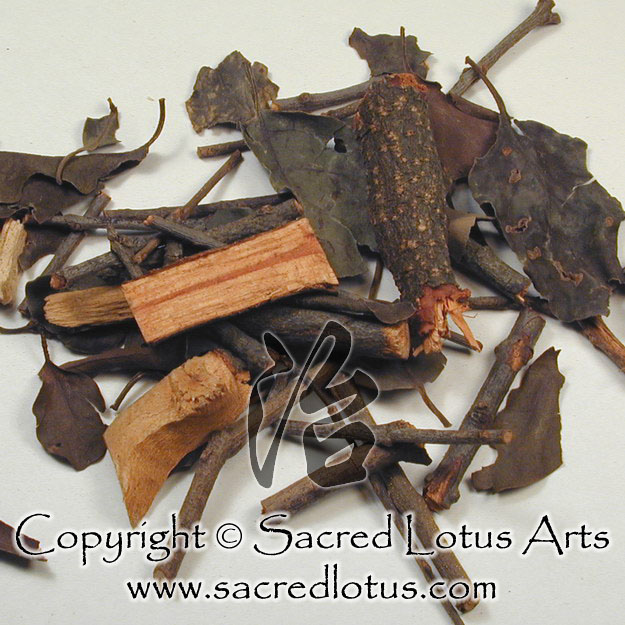
Materia Medica Data
- Category
- Herbs that Tonify Yin
- Temperature
- Neutral
- Nature & Flavour
- Bitter, Neutral
- Channels Entered
- KI, LIV
- Latin (pharmaceutical)
- Ramulus Loranthi Seu Visci
- Chinese
- 桑寄生
- Tone Marks
- sāng jì shēng
- Translation
- Mulberry Parasite
Chinese Herb Actions
What is Sang Ji Sheng used for in Chinese medicine?
Sang Ji Sheng tonifies the Liver and Kidney, strengthens the sinews and bones, expels wind-dampness, and calms a restless fetus. Unlike most wind-damp-expelling herbs, it does this without being overly drying, because it simultaneously nourishes Liver and Kidney essence — making it especially suited to chronic joint and low-back complaints in older or constitutionally deficient patients.
Its main traditional actions:
- Tonifies Liver and Kidney, strengthens sinews and bone, expels wind-dampness — for soreness and pain of the low back, knees, and joints, particularly in elderly or Yin-deficient patients with chronic weakness, soreness, joint pain, or atrophy of the sinews and joints.
- Calms the fetus — for a restless fetus with accompanying low-back pain or spotting/bleeding in pregnancy, reflecting its Liver/Kidney-tonifying, blood-nourishing character.
- Nourishes blood — for dry, scaly skin arising from blood deficiency.
Source: Sacred Lotus sources & references, cross-referenced against multiple online sources and materia medica consensus (Bensky, Chinese Herbal Medicine: Materia Medica, 3rd ed.; Chen & Chen, Chinese Medical Herbology and Pharmacology). Traditional-use framing; not medical advice.
Chinese Herb Dosage
What is the typical dosage of Sang Ji Sheng?
Typically 9–20 g in decoction — ranges vary somewhat by source (Chen & Chen give roughly 10–20 g; Bensky gives roughly 9–15 g), using the dried leafy stems of the parasitic plant harvested from its host tree. Sang Ji Sheng is a relatively gentle tonifying herb and is commonly included in longer-term formulas for chronic Liver/Kidney-deficiency joint complaints.
Source: Sacred Lotus sources & references; standard materia medica dosage ranges (Bensky; Chen & Chen). Reference only — not a prescription.
Chinese Herb Contraindications & Cautions
Are there cautions for using Sang Ji Sheng?
No specific cautions or contraindications are noted in Sacred Lotus sources & references for standard use of Sang Ji Sheng — it is generally regarded as a gentle tonifying herb. As with any herb used in pregnancy (including for its traditional fetus-calming indication), use should be under a qualified practitioner's guidance.
Source: Sacred Lotus sources & references; materia medica consensus (Bensky; Chen & Chen). Traditional-use framing, not medical advice.
Chinese Herb Toxicity & Overdose
Low. Sang Ji Sheng has a long history of medicinal use in Chinese medicine with no significant toxicity reported at standard decoction doses. Because it is a parasitic plant, its exact chemical profile can vary somewhat by host tree, which is a sourcing/quality consideration rather than a toxicity concern.
Source: materia medica consensus; pharmacology review (below). Reference note, not a safety guarantee.
Herb-Drug Interactions
No well-established clinical herb–drug interactions are documented for Sang Ji Sheng. Preclinical research has identified anti-inflammatory and antihypertensive activity in extracts and isolated constituents (see Research) — laboratory findings that support general practitioner awareness in patients on blood-pressure or anti-inflammatory medication, but these are not demonstrated clinical interactions. (Flagged for practitioner confirmation.)
Western / Biomedical Research
Chinese Herb Clinical Studies & Research
Provided as research context — a summary of published biomedical study, not a therapeutic or medical claim.
Is there modern research on Sang Ji Sheng (Taxillus chinensis) and Du Huo Ji Sheng Tang?
Yes — a 2022 comprehensive review plus mechanistic studies on quercetin (a key constituent), and separate clinical research on the formula Du Huo Ji Sheng Tang. Taxillus chinensis contains roughly 110 characterized compounds, with flavonoids (including quercetin) considered the most important bioactive class.
- Comprehensive review (2022) — a review of Taxillus chinensis botany, traditional use, phytochemistry, pharmacology, and toxicology documents traditional use since the Eastern Han dynasty for arthralgia, threatened miscarriage, and hypertension, and summarizes reported anti-inflammatory, antioxidant, antihypertensive, antimicrobial, antiviral, and antihyperglycemic activity; the authors note current evidence remains preliminary.
- Joint/arthritis mechanism (preclinical) — quercetin isolated from Herba Taxilli reduced clinical arthritis severity and joint damage in a mouse model of collagen-induced arthritis, working through SIRT1-related mitochondrial and anti-inflammatory pathways — a mechanistic link to the traditional "strengthens sinews and bones" indication.
- Formula-level clinical evidence (Du Huo Ji Sheng Tang) — a prospective clinical observation of Du Huo Ji Sheng Tang in knee osteoarthritis reported symptomatic improvement; a separate four-week safety study of the formula (which also contains Xi Xin/Asarum) found it well tolerated over that period. These are formula-level, not single-herb, findings.
Human clinical evidence is strongest at the formula level (Du Huo Ji Sheng Tang) and still preliminary at the single-herb/constituent level for Sang Ji Sheng itself.
Sources: PMID 36482376 (comprehensive review, Taxillus chinensis); PMID 34023442 (quercetin/SIRT1, collagen-induced arthritis, preclinical); PMID 17394666 (Du Huo Ji Sheng Tang, knee osteoarthritis clinical observation); PMID 20181195 (Du Huo Ji Sheng Tang four-week safety study). Research context, not a therapeutic claim.
Chinese Herb Notes
Is Chinese Sang Ji Sheng the same as European mistletoe?
No — Sang Ji Sheng (Taxillus chinensis) is a different mistletoe species from European mistletoe (Viscum album), and their research literatures should not be conflated. Both are hemi-parasitic plants that grow on host trees and are loosely called "mistletoe" in English, but they belong to different genera with different chemistry and different medical traditions:
- Sang Ji Sheng — Taxillus chinensis (family Loranthaceae; older sources also use the synonym Loranthus parasiticus), typically parasitizing mulberry and other trees in China. Used in Chinese medicine for Liver/Kidney tonification, sinew/bone strength, and calming the fetus, as above.
- European mistletoe — Viscum album, native to Europe, parasitizing oak, apple, and other trees. It has its own separate research tradition, most notably as a complementary cancer-supportive therapy (e.g., mistletoe extract injectables used in parts of Europe), driven by different constituents (viscotoxins, mistletoe lectins).
The two plants are not interchangeable, and research findings on European mistletoe (particularly oncology-related studies) do not automatically apply to Chinese Sang Ji Sheng, and vice versa.
Note: The current Sacred Lotus Latin identity for this herb, “Ramulus Loranthi Seu Visci,” reflects older pharmacopoeial naming (genera Loranthus/Viscum); the 2020 Chinese Pharmacopoeia and current research literature use Taxillus chinensis and the standardized name Taxilli Herba. We believe these refer to the same traditionally used material; the identity field is left unchanged pending owner confirmation.
Role in Du Huo Ji Sheng Tang: Sang Ji Sheng is a key supporting herb in this classic formula (alongside Du Huo, Qin Jiao, Fang Feng, and Liver/Kidney/blood tonics) for chronic Bi-syndrome — wind-damp-cold joint and low-back pain with underlying Liver/Kidney and Qi/blood deficiency, the classical presentation of long-standing arthritic-type pain in a weakened constitution.
Source: Sacred Lotus sources & references; materia medica consensus on species identity (Bensky; Chen & Chen); PMID 36482376 (Taxillus chinensis review, current pharmacopoeial naming).
Sources & References
Compiled and edited by Thomas Dehli, Founder & Editor, Sacred Lotus Updated
The information here is referenced from numerous sources — teachers, practitioners, class notes from Five Branches University, the books below, and the published research literature, with citations given as resolvable PubMed identifiers. Where sources disagree, I have flagged the discrepancies directly. If facts couldn't be verified, I have left them out. How we source our content.
Reference information for students and practitioners — not medical advice. Consult a qualified practitioner. Terms of use.
Chinese Herbs Books & References
 https://amzn.to/3WfB3DK
 https://amzn.to/3DR1VUh
 https://amzn.to/42aMz73
 https://amzn.to/3PuD4bt