
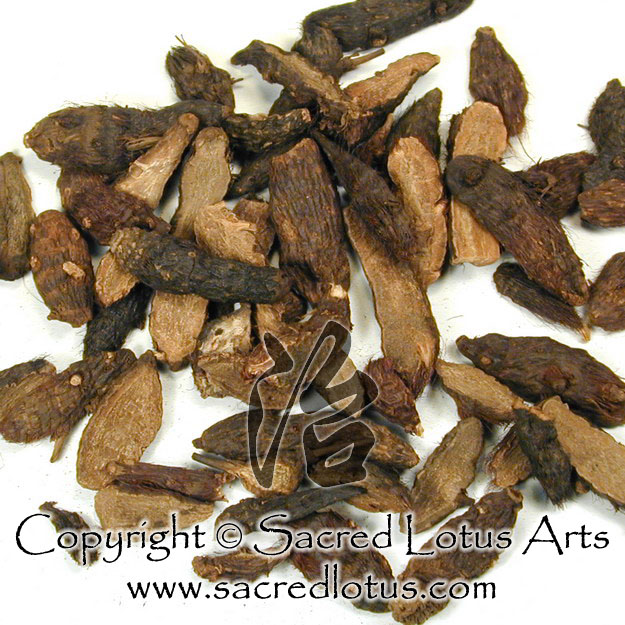
Rhizoma Cyperi Rotundi Nut Grass Rhizome
Materia Medica Data
- Category
- Herbs that Regulate the Qi
- Temperature
- Neutral
- Nature & Flavour
- Spicy, Slightly Warm, Slightly Sweet, Neutral
- Channels Entered
- LIV, SJ, SP
- Latin (pharmaceutical)
- Rhizoma Cyperi Rotundi
- Chinese
- 香附
- Tone Marks
- xiāng fù
- Translation
- Aromatic Appendage
Chinese Herb Actions
What is Xiang Fu used for in Chinese medicine?
Xiang Fu (Rhizoma Cyperi Rotundi) is the classic Liver-qi-regulating herb — it is used for the full range of Liver-qi-stagnation symptoms and is considered the leading herb for gynecological qi stagnation (menstrual pain and irregularity). It enters the Liver, San Jiao, and Spleen channels.
Its main traditional actions:
- Regulates qi and spreads Liver qi — for the full pattern of Liver-qi stagnation: pain and distension in the hypochondrium, epigastrium, and abdomen; emotional disturbance (frustration, mood swings); poor appetite; chest congestion; and frequent sighing.
- Regulates the menses and relieves pain — the herb most often reached for in gynecological Liver-qi-stagnation disorders, including dysmenorrhea and irregular menstruation; also used for breast distension.
Source: Sacred Lotus materia medica notes, cross-checked against Bensky & Barolet, Chinese Herbal Medicine: Materia Medica (3rd ed.) and Chen & Chen, Chinese Medical Herbology and Pharmacology. Traditional-use framing; not medical advice.
Chinese Herb Dosage
What is the typical dosage of Xiang Fu?
Roughly 6–12 grams in decoction, per both Chen & Chen and Bensky & Barolet — the two standard materia medica references agree on this range. Vinegar-processed (cu zhi) Xiang Fu is traditionally preferred for gynecological/menstrual indications, as processing is said to strengthen its action on the Liver and its analgesic effect; raw Xiang Fu is more often used for exterior/qi-stagnation presentations.
Source: Sacred Lotus materia medica notes (Chen; Bensky). Reference only — not a prescription; dosing should be individualized by a qualified practitioner.
Chinese Herb Contraindications & Cautions
Are there cautions for Xiang Fu?
Xiang Fu should not be used for qi deficiency, yin deficiency with heat, or heat in the blood — because it is an acrid, moving herb, it can aggravate these deficient/heat patterns rather than help them. It is also not indicated in patients who do not have qi-stagnation symptoms to begin with, since its action is specifically to move stagnant qi.
Source: Sacred Lotus materia medica notes, consistent with standard contraindications for acrid qi-moving herbs in Bensky & Barolet and Chen & Chen.
Chinese Herb Toxicity & Overdose
None noted traditionally, and low in modern testing. The Sacred Lotus materia medica notes record no toxicity for Xiang Fu at normal dosage, and this is consistent with acute-toxicity data from a 2022 systematic review: oral ethanol extract at 5,000 mg/kg body weight produced no toxic symptoms in mice, and subacute dosing up to 1,000 mg/kg showed no adverse effects. Treat as a favorable but non-exhaustive safety profile (clinical human toxicity data remain limited).
Source: Sacred Lotus materia medica notes; PMID 36278199 / PMC 9585201 (systematic review, acute/subacute toxicity data). Reference note, not a safety guarantee.
Herb-Drug Interactions
No well-established clinical herb–drug interactions are documented for Xiang Fu. Preclinical work reports estrogen-pathway and neurotransmitter (serotonin/dopamine, norepinephrine) modulating activity (see research below); this is precautionary context for patients on hormonal therapies, antidepressants/SSRIs, or neuropathic-pain medications, not a demonstrated clinical interaction. (Flagged for practitioner confirmation.)
Western / Biomedical Research
Chinese Herb Clinical Studies & Research
Provided as research context — a summary of published biomedical study, not a therapeutic or medical claim.
Is there modern research on Xiang Fu (Cyperus rotundus)?
Yes — a substantial preclinical literature, still without confirmatory human clinical trials. A 2022 systematic review of Cyperi Rhizoma summarizes antidepressant, anti-inflammatory, analgesic, antitumor, and hypoglycemic activity, chemically attributed to volatile sesquiterpenes (e.g., α-cyperone, cyperotundone) and flavonoids/phenolic acids.
- Anti-inflammatory / analgesic — the review reports that isolated compounds (e.g., isocyperol) suppress nitric oxide and prostaglandin E2 production via NF-κB/STAT3 pathway inhibition in inflammation models, and that α-cyperone reduced fever in an endotoxin-induced fever model; animal/cell research, not clinical proof.
- Antidepressant-like activity — the same review reports Cyperi Rhizoma extract produced antidepressant-like effects comparable to fluoxetine in animal models, proposed to work through serotonin (5-HT) and dopamine modulation in the brain; preclinical only.
- Gynecological / dysmenorrhea-related — the review notes CR extract reduced oxytocin-induced writhing (a pain-response model) in mice, consistent with traditional dysmenorrhea use; separately, a 2022 study found Cyperi Rhizoma extract inhibited endometrial-cell adhesion and reduced pain-related neurotrophin expression (BDNF, NGF, NT-3, NT-4/5) via Akt and NF-κB pathway suppression in an endometriosis model — a plausible mechanistic link to its traditional use for menstrual pain, though this is cell/animal-model evidence, not a clinical endometriosis treatment.
- Neuropathic pain (preclinical) — a 2024 study found Cyperus rotundus extract and its active metabolite α-cyperone reduced paclitaxel-induced neuropathic pain in mice, associated with downregulation of tyrosine hydroxylase and noradrenergic receptor expression in the norepinephrine signaling pathway; animal research only, unrelated to any TCM indication for chemotherapy side effects.
No confirmatory randomized controlled human trials were identified; all findings above are preclinical (cell or animal model).
Sources: PMID 36278199, PMC 9585201, DOI 10.3389/fphar.2022.965902 (systematic review); PMID 35334511, PMC 8953559, DOI 10.3390/medicina58030335 (endometriosis/pain-factor mechanism study); PMID 39728499, PMC 11679560, DOI 10.3390/metabo14120719 (neuropathic pain study). Research context, not a therapeutic claim.
Chinese Herb Notes
What are Xiang Fu's key formula combinations?
Xiang Fu is a chief or key herb in several classical formulas spanning qi-stagnation, gynecological, and phlegm-related patterns — its versatility as a Liver-qi regulator makes it a common partner herb rather than a formula unto itself.
- Yue Ju Wan (Escape Restraint Pill) — Xiang Fu paired with Chuan Xiong, Cang Zhu, Zhi Zi, and Shen Qu to address the classic “six stagnations” (qi, blood, fire, phlegm, damp, food) rooted in Liver-qi constraint.
- Liang Fu Wan (Galangal and Cyperus Pill) — a simple two-herb pairing of Xiang Fu with Gao Liang Jiang for cold and qi stagnation in the Stomach.
- Xiang Su San (Cyperus and Perilla Leaf Powder) — with Zi Su Ye, Chen Pi, and Zhi Gan Cao for wind-cold invasion complicated by internal qi stagnation.
- Xiang Fu Xuan Fu Hua Tang (Cyperus and Inula Decoction) — for phlegm-rheum (damp-phlegm) obstructing the Liver channel and collaterals.
- Gu Jing Wan (Stabilize the Menses Pill), Mu Xiang Bing Lang Wan, and Su He Xiang Wan also include Xiang Fu among their supporting herbs.
(Traditional formula context, not treatment advice.)
Source: Sacred Lotus formula-herb records; Bensky & Barolet, Chinese Herbal Medicine: Formulas & Strategies (2nd ed.).
Sources & References
Compiled and edited by Thomas Dehli, Founder & Editor, Sacred Lotus Updated
The information here is referenced from numerous sources — teachers, practitioners, class notes from Five Branches University, the books below, and the published research literature, with citations given as resolvable PubMed identifiers. Where sources disagree, I have flagged the discrepancies directly. If facts couldn't be verified, I have left them out. How we source our content.
Reference information for students and practitioners — not medical advice. Consult a qualified practitioner. Terms of use.
Chinese Herbs Books & References
 https://amzn.to/3WfB3DK
 https://amzn.to/3DR1VUh
 https://amzn.to/42aMz73
 https://amzn.to/3PuD4bt