
Liang Fu Wan
Galangal and Cyperus Pill
- Category
- Formulas that Regulate the Qi
- Subcategory
- Formulas that Promote the Movement of Qi
- Ingredients
- 2 herbs
Actions
What does Liang Fu Wan do?
Liang Fu Wan (Galangal and Cyperus Pill) warms the Middle Jiao, dispels cold, moves qi, and stops pain. It is a compact two-herb formula built for one job: cold that has lodged in the Stomach together with qi stagnation, producing sudden, gripping epigastric pain.
The two ingredients divide by role:
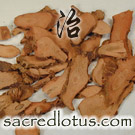
- Chief: Gao Liang Jiang (Lesser Galangal Rhizome) — spicy and hot, entering the Spleen and Stomach; it warms the Middle Jiao, disperses interior cold, and is the formula’s primary pain-stopping agent for cold-type stomach pain.
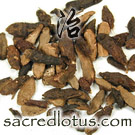
- Deputy: Xiang Fu (Nut Grass Rhizome) — spicy, slightly warm, entering the Liver, San Jiao, and Spleen; it moves qi (especially constrained Liver qi), relieves distension, and stops pain, complementing Gao Liang Jiang’s warming action with qi regulation.
The two herbs are used in equal amounts as the base formula, but classical sources describe adjusting the ratio to the presentation: increase Gao Liang Jiang when cold predominates (severe pain, marked cold-aversion); increase Xiang Fu when qi stagnation predominates (more distension/fullness than cold pain).
Source: Sacred Lotus sources & references + Bensky & Barolet, Formulas & Strategies (chief/deputy analysis and ratio-adjustment guidance). Traditional-use framing; not medical advice.
Indications
What is Liang Fu Wan used for?
Liang Fu Wan treats cold and qi stagnation lodged in the Stomach — classically described as cold invading the Stomach, or Liver qi stagnation compounding Stomach cold. The hallmark is epigastric or upper-abdominal pain that comes on suddenly, feels better with warmth and with pressure, and is aggravated by cold (cold weather, cold food or drink).
Its classic clinical presentation:
- Pain pattern: gripping or cramping epigastric/upper-abdominal pain, relieved by warmth and by pressing on the area; worse with cold exposure or cold intake.
- Accompanying signs: distension or fullness, belching, acid regurgitation, and a general aversion to cold, without thirst.
- Gynecology: also applied to menstrual pain (dysmenorrhea) arising from cold-stagnation — cramping period pain that eases with warmth.
Tongue and pulse: Sacred Lotus records a white tongue coating for this pattern; classical formula texts additionally describe a wiry and/or tight pulse, consistent with cold constraining qi movement.
Source: Sacred Lotus sources & references on tongue + Bensky & Barolet, Formulas & Strategies. Traditional-use framing; not medical advice.
Western Uses:
What is Liang Fu Wan used for in modern practice?
In modern practice Liang Fu Wan is referenced for cold-aggravated digestive discomfort and cold-type menstrual pain. Practitioners have traditionally applied its warm-the-Middle, move-qi pattern to presentations resembling chronic or functional gastritis, cold-sensitive peptic-ulcer-type discomfort, and reflux that worsens with cold food or weather — and, in gynecology, to primary dysmenorrhea with a cold-stagnation presentation.
These biomedical correlates are offered as a reference to the formula’s traditional use, not as a claim that it treats any diagnosed disease. Contemporary study of the Gao Liang Jiang–Xiang Fu herb pair is mostly mechanistic (gastric-mucosa and pharmacokinetic work in animal/cell models; see research). Any use for a diagnosed condition belongs with a qualified practitioner and appropriate medical care.
Source: traditional-use correlates summarized from Bensky & Barolet, Formulas & Strategies; reference only, not a treatment claim.
Ingredients
2 substances in Liang Fu Wan — each links to its full herb monograph.
Preparation & dosage
How is Liang Fu Wan prepared?
Traditionally prepared as a powdered pill: equal amounts of Gao Liang Jiang and Xiang Fu are processed separately — Gao Liang Jiang washed/soaked in wine, Xiang Fu washed/soaked in vinegar — then both are baked dry, ground into a fine, even powder, and formed into pills with ginger juice as a binder. The wine and vinegar processing is meant to direct and moderate each herb’s action.
In contemporary practice the same herb pair is also commonly prepared as a decoction rather than a traditional pill.
Source: classical pill-preparation method (wine-processed Gao Liang Jiang, vinegar-processed Xiang Fu, ginger-juice pill) per Bensky & Barolet, Formulas & Strategies. Traditional-use framing; not medical advice.
Classically a powdered pill (wan): equal amounts of Gao Liang Jiang and Xiang Fu, wine-washed and vinegar-washed respectively, baked, ground, and formed into pills with ginger juice; commonly referenced around 6 g of the powder taken twice daily. Also prepared as a decoction using equal amounts of each herb (reference range roughly 6-9 g each), with the ratio shifted toward Gao Liang Jiang if cold predominates or toward Xiang Fu if qi stagnation predominates. Reference only; not a prescribing recommendation.
Safety — read before use
What are the cautions for Liang Fu Wan?
Liang Fu Wan is built from two acrid, warming herbs, so it is inappropriate for heat patterns. Where Stomach pain arises from heat (burning pain, thirst, a red tongue with yellow coating) rather than cold, this formula would aggravate the condition rather than relieve it.
- Avoid in heat patterns — e.g., Stomach fire or heat-type epigastric pain with thirst, red tongue, and yellow coating.
- Use cautiously with yin deficiency or a dry constitution, since acrid-warming herbs can further consume fluids.
- Pregnancy: Xiang Fu moves qi and has traditionally been used cautiously in pregnancy — use only under professional guidance.
- Scope: as a simple two-herb formula, it is generally used for the acute cold/qi-stagnation pain itself rather than as a long-term tonic; underlying deficiency calls for a different formula.
Source: Bensky & Barolet, Formulas & Strategies (cautions for acrid-warming, qi-moving formulas). Traditional-use framing; not medical advice.
Originally Appeared In:
- Small Collection of Fine Formulas (Liang Fang Ji Ye)
Notes:
Where does Liang Fu Wan come from, and how does it compare to other qi-moving formulas?
Liang Fu Wan is a historical formula first recorded in the Qing-dynasty text Liang Fang Ji Ye (“Fine Formulas from the Sleeve,” 1842 AD), by Dong Xiyuan. Its narrow, two-herb design distinguishes it from broader qi-regulating formulas that combine warming and qi-moving action with additional strategies.
- vs Chai Hu Shu Gan San: that formula unblocks constrained Liver qi more broadly (rib-side distension, emotional constraint) and is not built around cold-dispersing; Liang Fu Wan is narrower and specifically pairs warming with qi movement for cold-type Stomach/epigastric pain.
- vs Wu Zhu Yu Tang: that formula addresses more severe Stomach/Liver cold with vomiting and headache, and includes tonifying herbs (Ren Shen, Da Zao) for an underlying deficient-cold picture; Liang Fu Wan is a lighter, purely excess-cold/qi-stagnation formula without tonics.
Key modification: the ratio of Gao Liang Jiang to Xiang Fu is classically adjusted — more Gao Liang Jiang when cold dominates the presentation, more Xiang Fu when qi stagnation and distension dominate.
Source: historical attribution cross-checked across two independent formula references (Liang Fang Ji Ye, 1842) + Bensky & Barolet, Formulas & Strategies (comparative formula analysis).
Clinical Studies & Research:
Is there modern research on Liang Fu Wan?
Yes, though it is entirely preclinical — pharmacological and mechanistic work on the Gao Liang Jiang–Xiang Fu (Alpinia officinarum–Cyperus rotundus) herb pair itself, not clinical trials of the formula. Essential-oil and network-pharmacology studies support the pair’s traditional gastroprotective use, and a pharmacokinetics study specifically modeled the pair in a dysmenorrhea animal model, echoing its traditional gynecological application.
- Gastric ulcer protection (preclinical): essential oils of Gao Liang Jiang, Xiang Fu, and their combined herbal pair reduced ethanol-induced gastric-mucosal cell damage and lowered inflammatory markers (IL-6, TNF-α, COX-2) in vitro and in vivo, with the pair outperforming either herb alone (PMID 34402190).
- Mechanism (network pharmacology): analysis of Liangfu Dropping Pills (a modern proprietary form of this herb pair) identified galangin, rhamnocitrin, galangin 3-methyl ether, and α-cyperone as blood-absorbed active compounds acting on pathways including PI3K-Akt for gastrointestinal effects (PMID 34738443).
- Dysmenorrhea pharmacokinetics (preclinical): six bioactive components of the Gao Liang Jiang–Xiang Fu pair showed altered absorption and tissue distribution in a primary-dysmenorrhea rat model compared to normal rats, offering a mechanistic lead for the formula’s traditional use in cold-stagnation menstrual pain (PMID 38941920).
Sources: PubMed 34402190; PubMed 34738443; PubMed 38941920. Research context on the constituent herb pair, not a therapeutic claim; no clinical trials of Liang Fu Wan itself were found.
Sources & References
Compiled and edited by Thomas Dehli, Founder & Editor, Sacred Lotus Updated
The information here is referenced from numerous sources — teachers, practitioners, class notes from Five Branches University, the books below, and the published research literature, with citations given as resolvable PubMed identifiers. Where sources disagree, I have flagged the discrepancies directly. If facts couldn't be verified, I have left them out. How we source our content.
Reference information for students and practitioners — not medical advice. Consult a qualified practitioner. Terms of use.
Chinese Formulas Books & References
 https://amzn.to/4fYI3f8
 https://amzn.to/4j55NRA
 https://amzn.to/4gMROyv
 https://amzn.to/4h7msSK