
Ju He Wan
Tangerine Seed Pill
- Category
- Formulas that Regulate the Qi
- Subcategory
- Formulas that Promote the Movement of Qi
- Ingredients
- 11 herbs
Actions
What does Ju He Wan do?
Ju He Wan (Tangerine Seed Pill) moves qi, warms and disperses cold, invigorates the blood, and softens and disperses masses in the Liver channel. It is built for hernial disorder (shan qi) — painful, swollen, or hardened testicular/scrotal conditions — that has progressed beyond simple cold-qi stagnation to include blood stasis and phlegm-damp accumulation.
The eleven ingredients divide by role:
- Chief: Ju He (Tangerine seed) — enters the Liver channel specifically, moving qi and dispersing clumps to relieve pain in the lower abdomen and genital region.
- Deputies: Chuan Lian Zi and Mu Xiang move qi and relieve pain alongside Ju He; Tao Ren and Yan Hu Suo invigorate the blood and dispel stasis, addressing the blood-stasis component of a longstanding, hardened presentation.
- Assistants: Rou Gui warms the Liver and Kidney channels and disperses the underlying cold; Chuan Mu Tong drains dampness; Zhi Shi and Hou Po break up qi stagnation and disperse fullness; Hai Zao and Kun Bu (the classic seaweed pair) soften hardness and resolve phlegm-damp masses.
- Preparation as envoy: no single herb is designated envoy; the formula is traditionally bound into pills with wine, which practitioners describe as helping guide the formula's warming, moving action to the lower body.
Source: this site’s own composition record + Bensky & Barolet, Formulas & Strategies (chief/deputy/assistant analysis). Traditional-use framing; not medical advice.
Indications
What is Ju He Wan used for?
Ju He Wan treats hernial disorder (shan qi) caused by damp-cold invading the Liver channel — presenting as testicular or scrotal swelling and pain, sometimes with a hard, mass-like quality, that can radiate up toward the lower abdomen or umbilicus. Traditionally the testicles are regarded as the “external Kidneys,” but the underlying pathogenesis is placed in the Liver channel, which the Liver's own meridian traverses.
Its classic clinical presentation:
- Local signs: unilateral or bilateral testicular swelling and pain, a scrotum that feels heavy, distended, or stone-hard, with pain that can radiate to the lower abdomen.
- Cold-damp signs: the condition tends to worsen with cold and improve with warmth, consistent with a damp-cold pathogen lodged in the channel.
Tongue and pulse: the tongue coat is typically white or white and greasy; the pulse is deep and wiry (or deep and taut).
Source: this site’s own pattern record + Bensky & Barolet, Formulas & Strategies, cross-referenced against multiple online sources (tongue/pulse). Traditional-use framing; not medical advice.
Western Uses:
What is Ju He Wan used for in modern practice?
In modern practice Ju He Wan is referenced by TCM sources for scrotal and testicular conditions such as hydrocele, epididymitis, orchitis, and varicocele — contexts that map onto the traditional hernial-disorder (shan qi) pattern of swelling, heaviness, and pain in the scrotal region. Some sources also note the chief herb's traditional use for breast lumps, reflecting its general qi-moving, mass-dissipating action.
These biomedical correlates are offered as a reference to the formula’s traditional use, not as a claim that it treats any diagnosed condition. As noted under cautions, traditional sources restrict it to firm, cold-type swelling and explicitly exclude soft or ulcerated presentations. Any use for a diagnosed condition belongs with a qualified practitioner and appropriate medical evaluation.
Source: traditional-use correlates summarized from multiple online sources, cross-checked against Bensky & Barolet, Formulas & Strategies; reference only, not a treatment claim.
Ingredients
11 substances in Ju He Wan — each links to its full herb monograph.
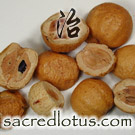 Chuan Lian Zi30 gRegulate the Qi
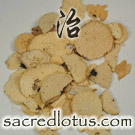 Chuan Mu Tong15 gRegulate Water and Drain Dampness
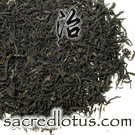 Hai Zao30 gCool and Transform Phlegm-Heat
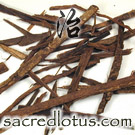 Hou Po15 gAromatic Herbs that Transform and Dissolve Dampness
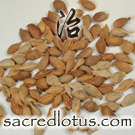 Ju He30 gRegulate the Qi
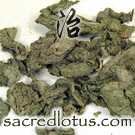 Kun Bu30 gCool and Transform Phlegm-Heat
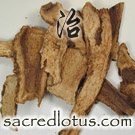 Mu Xiang15 gRegulate the Qi
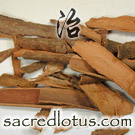 Rou Gui15 gWarm the Interior and Expel Cold
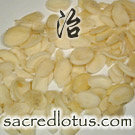 Tao Ren30 gInvigorate Blood and Remove Stagnation
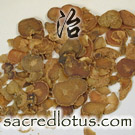 Yan Hu Suo15 gInvigorate Blood and Remove Stagnation
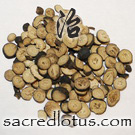 Zhi Shi15 gRegulate the Qi
Preparation & dosage
How is Ju He Wan prepared?
Traditionally the eleven herbs are ground to a fine powder and bound into pills with wine — the classic “Wan” (pill) form named in the formula itself. Modern practice sometimes decocts the same herbs as a stronger, faster-acting alternative to the pill form.
Source: this site’s own record + multiple online sources (converging on wine-bound powder pills). Reference only, not a substitute for professional guidance.
Traditionally taken as wine-bound pills, 6–9 g, once or twice daily. Reference relative amounts for decoction: Ju He, Chuan Lian Zi, Tao Ren, Hai Zao, Kun Bu 30 g each; Mu Xiang, Yan Hu Suo, Rou Gui, Chuan Mu Tong, Hou Po, Zhi Shi 15 g each. Reference only, not a prescription.
Safety — read before use
What are the cautions for Ju He Wan?
Ju He Wan is a warming, moving formula for a firm, cold-type presentation, so it is not appropriate for soft swellings or for signs of heat or infection. Traditional sources are explicit that it should not be used for soft scrotal swelling, and that if the area has already ulcerated, an appropriate topical treatment should be used instead (or alongside it).
- Avoid in heat or infected presentations: not for acute, red, hot, or ulcerated swelling — the formula's warming herbs (Rou Gui) would aggravate heat.
- Pregnancy: contains blood-invigorating and warming herbs (Tao Ren, Yan Hu Suo, Rou Gui) — use only under professional guidance.
- Constitution fit: as a moving, dispersing formula it is not intended for long-term use without reassessment once the acute pattern resolves.
Source: multiple online sources (soft-swelling/ulceration caution) + Bensky & Barolet, Formulas & Strategies (standard cautions for warming, blood-invigorating formulas). Traditional-use framing; not medical advice.
Originally Appeared In:
- Formulas to Aid the Living (Ji Sheng Fang)
Notes:
How is Ju He Wan different from Tian Tai Wu Yao San?
Both formulas treat hernial (shan qi) disorder from cold invading the Liver channel, but Ju He Wan is built for a more advanced, harder presentation. Tian Tai Wu Yao San is the lighter formula: it moves qi and warms the Liver channel to relieve pain in earlier-stage cold-qi stagnation, without addressing blood stasis or masses.
- vs Tian Tai Wu Yao San: move up to Ju He Wan when the swelling has become hard or mass-like and blood stasis is suspected — Ju He Wan adds blood-invigorating herbs (Tao Ren, Yan Hu Suo) and the phlegm/mass-resolving seaweed pair (Hai Zao, Kun Bu) that Tian Tai Wu Yao San lacks.
- Shared strategy: both belong to the qi-regulating formula family and share a Liver-channel, cold-dispelling core (qi-moving herbs plus a warming herb).
Source: Bensky & Barolet, Formulas & Strategies (formula-family classification, formulas that regulate qi / hernial disorder).
Clinical Studies & Research:
Is there modern research on Ju He Wan?
No clinical trials or pharmacology studies on the compound formula Ju He Wan were located in PubMed-indexed literature. The available modern evidence concentrates on its chief herb, Ju He (Citrus reticulata seed), rather than the eleven-herb formula as a whole.
- Chief herb, Ju He (preclinical/review): a 2026 review in the Journal of Ethnopharmacology covering Citrus reticulata seed documents its traditional use for hernia pain and breast disorders, and reports limonoid, flavonoid, and fatty-acid constituents with anti-tumor, anti-inflammatory, analgesic, and antibacterial activity in laboratory studies — while explicitly noting that research on this herb "remains limited, lacking sufficient depth" (PMID 41183693).
Sources: PubMed 41183693. Research context on the chief herb only, not a therapeutic claim for the compound formula; no formula-level clinical evidence was found.
Sources & References
Compiled and edited by Thomas Dehli, Founder & Editor, Sacred Lotus Updated
The information here is referenced from numerous sources — teachers, practitioners, class notes from Five Branches University, the books below, and the published research literature, with citations given as resolvable PubMed identifiers. Where sources disagree, I have flagged the discrepancies directly. If facts couldn't be verified, I have left them out. How we source our content.
Reference information for students and practitioners — not medical advice. Consult a qualified practitioner. Terms of use.
Chinese Formulas Books & References
 https://amzn.to/4fYI3f8
 https://amzn.to/4j55NRA
 https://amzn.to/4gMROyv
 https://amzn.to/4h7msSK