
Gu Jing Wan
Stabilize the Menses Pill
- Category
- Formulas that Stabilize and Bind
- Subcategory
- Formulas that Stabilize the Womb
- Ingredients
- 6 herbs
Actions
What does Gu Jing Wan do?
Gu Jing Wan nourishes Yin, clears deficiency heat, astringes to stop abnormal uterine bleeding, and regulates Liver qi — a combined strategy for heavy or prolonged menstrual bleeding driven by heat that arises from an underlying Yin deficiency rather than from an excess or cold cause.
- Nourishes Yin: Gui Ban and Bai Shao restore Yin (particularly of the Kidney and Liver), addressing the deficiency that allows heat to arise in the first place.
- Clears deficiency heat: Huang Qin and Huang Bai drain heat specifically from the Lower Jiao/Chong and Ren channels, where it is agitating the Blood.
- Astringes to stop bleeding: Chun Pi binds and checks abnormal uterine bleeding.
- Regulates Qi: Xiang Fu addresses accompanying Liver qi stagnation and keeps the Yin-nourishing, astringent herbs from becoming overly static.
Source: Sacred Lotus sources & references (composition) cross-referenced against multiple online sources; Bensky & Barolet, Formulas & Strategies (strategy and herb roles). Traditional-use framing; not medical advice.
Indications
What is Gu Jing Wan used for?
Gu Jing Wan is used for heavy, prolonged, or irregular uterine bleeding caused by Yin deficiency with heat — presentations where deficiency heat, rather than cold or blood stasis, is forcing Blood from its normal pathways.
- Heavy menstrual bleeding (menorrhagia) or periods that run unusually long.
- Metrorrhagia/metrostaxis — irregular, non-cyclical uterine bleeding or spotting between periods.
- Early or frequent menstruation with heavy flow, from heat agitating the Blood.
- Accompanying deficiency-heat signs: a dry mouth, five-palm heat (heat in the palms, soles, and chest), or irritability alongside the bleeding.
Source: Sacred Lotus sources & references (pattern) cross-referenced against multiple online sources; Bensky & Barolet, Formulas & Strategies. Traditional-use framing; not medical advice.
Western Uses:
What conditions is Gu Jing Wan used for in modern practice?
Gu Jing Wan "stabilises the menses" — it treats reckless movement of blood from yin deficiency with heat in the Chong and Ren vessels — so it is referenced for excessive menstrual and uterine bleeding: heavy periods (menorrhagia), uterine bleeding, and abnormal vaginal discharge (leucorrhoea).
It is chosen for the yin-deficiency-heat bleeding pattern, not for a diagnosis. Heavy, prolonged, or irregular uterine bleeding, and any bleeding after menopause, require medical assessment — the causes range from hormonal to structural to malignant and must be diagnosed. Traditional-use correlates only, not a treatment claim.
Source: Sacred Lotus sources & references (pattern) + Bensky & Barolet, Formulas & Strategies; biomedical correlates as reference only. Not medical advice.
Ingredients
6 substances in Gu Jing Wan — each links to its full herb monograph.
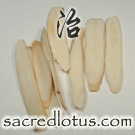 Bai Shao30 gTonify Blood
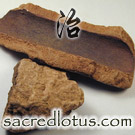 Chun Pi21 gAstringe, Stabilize, Bind
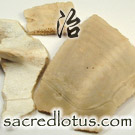 Gui Ban30 gTonify Yin
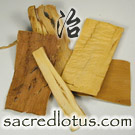 Huang Bai9 gClear Heat and Dry Dampness
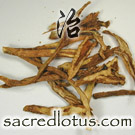 Huang Qin30 gClear Heat and Dry Dampness
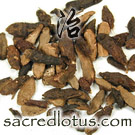 Xiang Fu7.5 gRegulate the Qi
Preparation & dosage
How is Gu Jing Wan prepared?
Gu Jing Wan is a pill ("wan"), not a decoction — the herbs are ground to a fine powder and formed into pills, traditionally taken with warm water on an empty stomach, suited to sustained use for a chronic bleeding pattern rather than a single acute dose.
- Herb processing: Xiang Fu is traditionally vinegar-processed (cu zhi) to help it enter the Blood aspect and Liver channel, strengthening its contribution to the formula's astringent, bleeding-stabilizing effect; Bai Shao is sometimes stir-fried to soften its cooling property.
- Modern forms: also produced as concentrated pills or granules for ongoing use.
Source: Sacred Lotus sources & references (composition) cross-referenced against multiple online sources; Bensky & Barolet, Formulas & Strategies.
Safety — read before use
What are the cautions for Gu Jing Wan?
Gu Jing Wan is a cooling, astringent formula suited specifically to Yin-deficiency heat, and any heavy or irregular uterine bleeding warrants professional medical evaluation before self-treatment.
- Not for bleeding due to cold or pure Blood deficiency: a pale tongue, cold signs, or bleeding without heat signs indicate a different pattern that this cooling, astringent formula is not designed for and could aggravate.
- Not for bleeding with prominent Blood stasis: dark clots or fixed pain suggest static Blood is a concomitant problem; the astringent action of Chun Pi is traditionally used cautiously here, since astringing can "lock in" stasis rather than resolve it.
- Professional evaluation is essential for any abnormal uterine bleeding: heavy, prolonged, or irregular bleeding can have structural or other underlying causes that must be ruled out medically before relying on an astringent formula that controls bleeding without addressing an organic cause.
- Caution in pregnancy, given Xiang Fu's qi-regulating action and the need for correct pattern differentiation in any pregnancy-related bleeding.
Source: Bensky & Barolet, Formulas & Strategies (pattern-based cautions) cross-referenced against multiple online sources. Traditional-use framing; not medical advice.
Originally Appeared In:
- Introduction to Medicine (Yi Xue Ru Men)
Notes:
What is the classical source of Gu Jing Wan?
Gu Jing Wan traces to the Yi Xue Ru Men (Introduction to Medicine), a Ming-dynasty medical text compiled by Li Ting and published in 1575, which places it among the classical formulas that regulate menstruation and stop bleeding.
How does Gu Jing Wan differ from Gu Ben Zhi Beng Tang?
Both stop abnormal uterine bleeding, but for different root patterns: Gu Jing Wan nourishes Yin and clears deficiency heat before astringing, for bleeding driven by heat; Gu Ben Zhi Beng Tang instead tonifies Qi and Blood and warms Yang, for heavy bleeding driven by Qi deficiency without heat signs. The two are easily confused as both are astringent "stop bleeding" formulas, but the underlying pattern — heat versus qi deficiency — is the deciding factor between them.
How does Gu Jing Wan differ from Liang Di Tang?
Liang Di Tang nourishes Yin and clears heat for uterine bleeding in a similar way but without a dedicated astringent herb, making it a milder choice for scantier bleeding with prominent heat signs; Gu Jing Wan's addition of the astringent Chun Pi and the qi-regulator Xiang Fu suits it to heavier or more prolonged bleeding.
Source: Bensky & Barolet, Formulas & Strategies (classical attribution and formula comparisons) cross-referenced against multiple online sources.
Sources & References
Compiled and edited by Thomas Dehli, Founder & Editor, Sacred Lotus Updated
The information here is referenced from numerous sources — teachers, practitioners, class notes from Five Branches University, the books below, and the published research literature, with citations given as resolvable PubMed identifiers. Where sources disagree, I have flagged the discrepancies directly. If facts couldn't be verified, I have left them out. How we source our content.
Reference information for students and practitioners — not medical advice. Consult a qualified practitioner. Terms of use.
Chinese Formulas Books & References
 https://amzn.to/4fYI3f8
 https://amzn.to/4j55NRA
 https://amzn.to/4gMROyv
 https://amzn.to/4h7msSK