
Rhizoma Phragmitis Communis Reed Rhizome
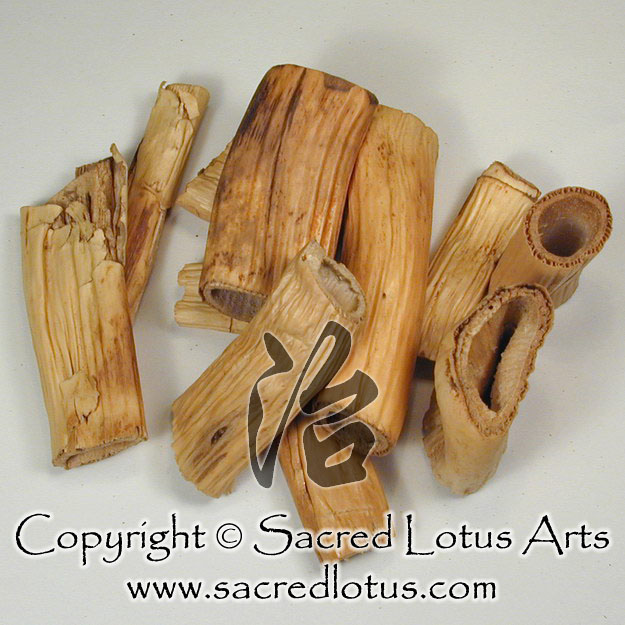
Materia Medica Data
- Category
- Herbs that Drain Fire
- Temperature
- Cold
- Nature & Flavour
- Sweet, Cold
- Channels Entered
- LU, ST
- Latin (pharmaceutical)
- Rhizoma Phragmitis Communis
- Chinese
- 芦根
- Tone Marks
- lú gēn
Chinese Herb Actions
What is Lu Gen used for in Chinese medicine?
Lu Gen (reed rhizome, Phragmites) clears heat and generates fluids, relieves irritability, and stops vomiting — a core herb for the thirst and restlessness of early febrile disease, for rebellious Stomach qi causing vomiting, and, in higher doses, for Lung abscess with cough and purulent sputum.
Its main traditional actions:
- Clears heat and generates fluids — fever with thirst and dry mouth in warm/febrile disease, protecting fluids that heat has begun to damage.
- Relieves irritability — feverish restlessness accompanying heat in the Lung and Stomach.
- Stops vomiting — Stomach heat with rebellious qi causing nausea and vomiting, by directing Stomach qi back downward.
- Clears Lung heat and expels pus — Lung abscess (fei yong) with cough, chest pain, and coughing of pus or blood-streaked sputum, typically at a higher dose.
- Vents rashes — incomplete eruption of rashes in early warm-febrile disease.
Source: cross-referenced against multiple online sources and Sacred Lotus sources & references, consistent with Bensky & Chen & Chen materia medica consensus.
Chinese Herb Dosage
What is the typical dosage of Lu Gen, and why is it sometimes used fresh?
Roughly 15–30 g in decoction, up to 60 g when used alone for incomplete rash eruption. Sacred Lotus sources specifically note that fresh Lu Gen (xian lu gen) has a stronger effect than the dried rhizome — fresh material is preferred when available, particularly for stronger heat-clearing and fluid-generating action in acute febrile disease, though dried rhizome is the more common commercial form. The part used is the rhizome.
Source: Sacred Lotus sources & references; cross-referenced against multiple online sources for standard materia medica dosage ranges. Reference only — not a prescription.
Chinese Herb Contraindications & Cautions
Are there cautions for Lu Gen?
Sacred Lotus sources note Lu Gen should be avoided in cold patterns from Spleen-Stomach deficiency. Being sweet and cold, it can aggravate a cold, deficient digestive picture — poor appetite, loose stools, and general cold intolerance — and is best reserved for true heat patterns.
Source: Sacred Lotus sources & references; cross-referenced against multiple online sources for standard materia medica cautions.
Chinese Herb Toxicity & Overdose
Low. No significant toxicity is reported for Lu Gen at standard doses; it is a food-grade rhizome also consumed in China as an everyday cooling tea/beverage, and a genotoxicity study of an aqueous Phragmites rhizome extract found no genotoxic effects under the conditions tested. Reference note, not a safety guarantee.
Source: PMID 31189082 (genotoxicity evaluation, Journal of Ethnopharmacology); cross-referenced against multiple online sources.
Herb-Drug Interactions
No well-established clinical herb–drug interactions are documented. Preclinical research (below) suggesting a protective effect against chemotherapy-related bone-marrow suppression is a research finding, not grounds to combine Lu Gen with chemotherapy without practitioner and oncology-team supervision.
Western / Biomedical Research
Chinese Herb Clinical Studies & Research
Provided as research context — a summary of published biomedical study, not a therapeutic or medical claim.
Is there modern research on Lu Gen (Phragmites)?
Yes — preclinical research spanning bone-marrow protection, neuroprotection, and a formal safety study, with human clinical trial evidence not located.
- Bone-marrow protection (preclinical) — an aqueous extract of Phragmitis rhizoma improved recovery of white blood cells, neutrophils, lymphocytes, and red blood cells after docetaxel (a chemotherapy drug) in laboratory and animal models, consistent with the traditional use of the rhizome to support recovery from febrile/depleting illness; not a substitute for oncology care.
- Neuroprotection (preclinical) — a methanolic extract of the rhizome, and a liposomal (phospholipid-based) formulation of it, showed multi-target neuroprotective effects — reduced oxidative stress and inflammatory markers — in a rat model of Parkinson’s disease, with the liposomal version performing better; animal research.
- Safety/genotoxicity (preclinical) — a formal battery of in vitro and in vivo genotoxicity assays (bacterial mutation, chromosomal aberration, micronucleus tests) found the aqueous extract to be non-genotoxic under the conditions tested, supporting its long-standing food/beverage use.
All findings are preclinical (cell or animal models); human clinical evidence specific to Lu Gen was not located.
Sources: PMID 28793897 (docetaxel myelotoxicity, BMC Complementary and Alternative Medicine); PMID 40783041 (anti-Parkinson’s activity, Fitoterapia); PMID 31189082 (genotoxicity evaluation, Journal of Ethnopharmacology). Research context, not a therapeutic claim.
Chinese Herb Notes
What formulas is Lu Gen found in?
Lu Gen is a supporting herb in two of the best-known wind-heat formulas, Yin Qiao San and Sang Ju Yin, where it helps clear heat and protect fluids without heavy, cloying tonics. In Yin Qiao San (Honeysuckle and Forsythia Powder), for early-stage wind-heat with fever, sore throat, and thirst, Lu Gen supports the formula’s heat-clearing and fluid-generating action alongside Jin Yin Hua, Lian Qiao, and Dan Zhu Ye. In Sang Ju Yin (Mulberry Leaf and Chrysanthemum Drink), a gentler wind-heat formula centered on cough, Lu Gen helps clear residual heat and generate fluids to prevent further fluid damage.
Lu Gen also appears as a chief herb in Wei Jing Tang (Reed Decoction), the classical formula for Lung abscess — combined with Yi Yi Ren, Dong Gua Ren (or Dong Gua Zi), and Tao Ren to clear Lung heat, expel pus, and disperse blood stasis in cases of cough with chest pain and purulent, foul-smelling sputum. (Traditional formula context, not treatment advice.)
Source: Sacred Lotus sources & references (formula links); cross-referenced against multiple online sources for formula composition.
Sources & References
Compiled and edited by Thomas Dehli, Founder & Editor, Sacred Lotus Updated
The information here is referenced from numerous sources — teachers, practitioners, class notes from Five Branches University, the books below, and the published research literature, with citations given as resolvable PubMed identifiers. Where sources disagree, I have flagged the discrepancies directly. If facts couldn't be verified, I have left them out. How we source our content.
Reference information for students and practitioners — not medical advice. Consult a qualified practitioner. Terms of use.
Chinese Herbs Books & References
 https://amzn.to/3WfB3DK
 https://amzn.to/3DR1VUh
 https://amzn.to/42aMz73
 https://amzn.to/3PuD4bt