

Mi Meng Hua (Buddleia Flower Bud)
Flos Buddleiae Officinalis Immaturus Buddleia Flower Bud
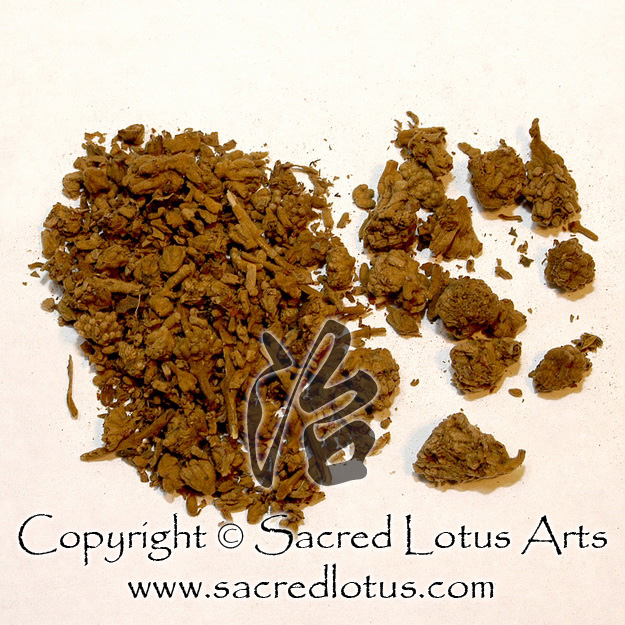
Materia Medica Data
- Category
- Herbs that Drain Fire
- Temperature
- Cool
- Nature & Flavour
- Sweet, Cool
- Channels Entered
- LIV
- Latin (pharmaceutical)
- Flos Buddleiae Officinalis Immaturus
- Chinese
- 密蒙花
- Tone Marks
- mì Méng huā
Chinese Herb Actions
What is Mi Meng Hua used for in Chinese medicine?
Mi Meng Hua — the unopened flower bud of Buddleja officinalis — is traditionally used to clear heat from the Liver channel and brighten the eyes. It is sweet and cool and enters the Liver channel only, and this site files it among the herbs that drain fire. Its indications are almost entirely ophthalmic: blurred vision, red and swollen eyes, superficial visual obstruction, excessive tearing, pterygium and light sensitivity.
Its traditional actions:
- Eliminates heat in the Liver channel and benefits the eyes — red, swollen, painful eyes, excess lacrimation, photophobia, superficial visual obstruction and pterygium; blurred or dimmed vision.
- Suits both excess and deficiency presentations — this is the distinguishing feature recorded for it on this site, and it is what practitioners actually reach for it for. Most of the fire-draining eye herbs are for heat and heat only; Mi Meng Hua is sweet and comparatively gentle, so it is also used where the eye problem arises against a background of Liver blood or yin deficiency rather than frank fire.
- Nourishing rather than purging — its sweetness is why it is not drying, and why it is used for the dry, tired, dim-visioned eye as well as the hot, red one.
A note on the plant. The genus Buddleja is far better known in the West as the butterfly bush — the fragrant purple-flowered shrub of gardens and railway embankments, whose most familiar species, Buddleja davidii, is naturalised and treated as invasive in parts of Europe and North America. The medicinal herb is a different species of the same genus, B. officinalis, and it is the flower bud, harvested before opening, that is used.
Source: the site’s own record for this herb (category, nature, flavour, channel and traditional actions), reviewed against published materia medica consensus and cross-referenced against multiple online sources. Ethnopharmacological profile and ophthalmic focus corroborated by PMID 37541402, DOI 10.1016/j.jep.2023.116993; genus context per PMID 36119599. Traditional-use framing; not medical advice.
Chinese Herb Dosage
What is the typical dosage of Mi Meng Hua?
3–9 g in decoction — this is the range this site records, and other standard references sit inside the same window (commonly cited as approximately 3–10 g). The part used is the flower and flower bud, gathered unopened.
- Part used — the immature flower bud is the officinal part; this is reflected in the recorded pharmaceutical Latin, which specifies the immature flower.
- Preparation — ordinarily decocted with the other herbs in a prescription. As a flower it is not usually subjected to prolonged hard boiling.
- External and topical forms — modern research on this herb has used eye-drop preparations of an extract in animal models (see research). That is a laboratory formulation, not a traditional dose form, and it is not a self-administration instruction.
Source: the site’s own dosage record; cross-referenced against multiple online sources and published materia medica consensus. Reference only — not a prescription.
Chinese Herb Contraindications & Cautions
Are there cautions for Mi Meng Hua?
This site’s record notes no traditional contraindications, and we found none in the sources we could verify. The sensible cautions are general category ones rather than anything specific to this plant.
- Cool nature — as a cool, heat-clearing herb it is conventionally used carefully where there is Spleen or Stomach cold with loose stools, in line with the general handling of the fire-draining category. Mi Meng Hua is among the mildest members of that group.
- Pregnancy — not documented as contraindicated in the sources we could verify. Professional guidance is the appropriate route in pregnancy.
- Do not self-treat eye disease — this is a reference note, not a caution about the herb. Red, painful or deteriorating vision needs assessment by an eye-care professional; herbal use is not a substitute for that.
- Species identity — the medicinal herb is the flower bud of Buddleja officinalis. Ornamental butterfly bush (B. davidii and its cultivars) is a different species and is not the medicinal material.
Source: the site’s own cautions record (“none noted”); general category cautions from published materia medica consensus; cross-referenced against multiple online sources. Reference note, not a safety guarantee.
Chinese Herb Toxicity & Overdose
No significant toxicity is documented for Mi Meng Hua at customary doses. This site’s record notes none, the herb is not classed among the toxic materia medica, and we found no poisoning case reports, organ-toxicity findings or restricted-substance listings for Buddleja officinalis flower in the sources we could verify. A 2024 review covering the botany, ethnopharmacology, phytochemistry and pharmacology of the species reports a broad activity profile without identifying a toxicological signal for the flower at medicinal doses.
We note honestly that the absence of reported toxicity is not the same as a formal safety evaluation: no clinical safety trial of this herb exists in the literature we could confirm.
Source: the site’s own record; PMID 37541402, DOI 10.1016/j.jep.2023.116993 (comprehensive species review). Neutral reference facts — not a safety guarantee.
Herb-Drug Interactions
No well-established clinical herb–drug interactions are documented for Mi Meng Hua. We found no interaction studies, case reports or clinical pharmacokinetic work specific to it.
Two preclinical observations are worth a practitioner’s awareness, stated as precaution rather than as demonstrated interaction: an animal study reported that an extract of this flower raised androgen-receptor expression in lacrimal gland tissue and was described by its authors as showing androgen-like activity, and a separate animal study reported xanthine-oxidase inhibition in a murine hyperuricaemia model. Neither has been shown to translate into a clinical interaction with hormone therapy or with urate-lowering medication. Patients taking prescription medication — including anyone using prescribed eye medication — should tell their prescriber about any herbal use.
Source: precautionary inference only, from PMID 22553515, PMC 3340645 (androgen-receptor expression in castrated-rat lacrimal gland) and PMID 42036343 (xanthine oxidase inhibition, murine model). No clinical interaction is claimed or demonstrated. Flagged for practitioner confirmation.
Western / Biomedical Research
Chinese Herb Clinical Studies & Research
Provided as research context — a summary of published biomedical study, not a therapeutic or medical claim.
Is there modern research on Mi Meng Hua (Buddleja officinalis)?
Yes — an unusually focused preclinical literature on the eye, which lines up closely with the traditional indication, but no clinical trials. A 2024 review in the ethnopharmacology literature catalogued 80 compounds isolated from the species, chiefly flavonoids, phenylethanoids, triterpenoids and monoterpenes, and framed the plant explicitly around its therapeutic potential in ophthalmic disease.
- Dry eye (animal models) — several studies from a Chinese ophthalmology group tested eye drops made from an extract of this flower in castrated rats and rabbits, a hormone-depletion model of dry eye. They reported improved basal tear secretion and longer tear film break-up time versus untreated model animals, reduced lacrimal gland cell apoptosis, and increased androgen-receptor expression, and interpreted the flavonoid fraction as acting through an androgen-like mechanism. Animal studies with a topical laboratory formulation, not clinical evidence.
- Cataract-related enzyme inhibition — an early study screening crude drugs against rat lens aldose reductase found a methanolic extract of this flower the most inhibitory of nine tested, with luteolin, luteolin-7-O-glucoside, apigenin and an acacetin glycoside active in the sub-micromolar to low-micromolar range. Aldose reductase is the enzyme implicated in diabetic cataract; this is an isolated-enzyme finding.
- Constituents and antioxidant activity — phenylethanoid and flavonoid glycosides from the flowers show peroxynitrite-scavenging capacity; acteoside and linarin separated from the flower showed anti-inflammatory activity in laboratory assays; flavonoid fractions attenuated hydrogen-peroxide-induced cell injury by modulating oxidative stress and autophagy in cell culture.
- Placed alongside the other “clear the Liver, brighten the eyes” flowers — a 2025 review examined the flavonoids of this species together with those of chrysanthemum (both Chrysanthemum morifolium and C. indicum) and Sophora japonica, on the basis that all four share the traditional pairing of Liver-clearing and vision-brightening actions, and summarised 125 flavonoids across them. A useful cross-check that the traditional grouping of these herbs tracks a real shared chemistry.
All of the above is laboratory, cell and animal work. No clinical trial evidence exists for the traditional indications, and none of it should be read as a treatment claim for any eye condition.
Sources: PMID 37541402, DOI 10.1016/j.jep.2023.116993 (species review, ophthalmic focus, 80 compounds); PMID 22553515, PMC 3340645, DOI 10.3980/j.issn.2222-3959.2010.01.10 (eye drops, androgen receptors, castrated-rat dry eye); PMID 20226146 and PMID 19176098 (lacrimal gland cell apoptosis; dry-eye prevention in castrated rabbits); PMID 7550105, DOI 10.1248/bpb.18.463 (aldose reductase inhibition, anti-cataract screening); PMID 19952410 (peroxynitrite scavenging by phenylethanoid and flavonoid glycosides); PMID 32031325 (acteoside and linarin, anti-inflammatory activity); PMID 36558121 (flavonoid fraction, oxidative stress and autophagy in cell injury); PMID 39532220, DOI 10.1016/j.jep.2024.119094 (flavonoids of four Liver-clearing, vision-brightening flowers). Research context, not a therapeutic claim.
Chinese Herb Notes
How does Mi Meng Hua compare with the other eye herbs?
Mi Meng Hua is the gentle, sweet, Liver-only eye herb that suits deficiency as well as excess — which is precisely what separates it from the rest. This site holds several herbs used for the eyes; they divide by how they get there. Comparison below is built from this site’s own identity records for each herb.
- Mi Meng Hua — sweet, cool; Liver; drains fire. Purely ophthalmic in emphasis. The one recorded as usable in both excess and deficiency patterns.
- Qing Xiang Zi (celosia seed) — Liver; drains fire. The strongest and coldest-acting of this group for Liver fire flaring upward into the eyes, and it also addresses ascendant Liver yang. It carries a traditional eye-specific restriction that Mi Meng Hua does not (see its own entry) — which is exactly why the two are not interchangeable despite sharing a category and a channel.
- Jue Ming Zi (cassia seed) — bitter, sweet, cool; Liver, Kidney and Large Intestine; drains fire. Also an eye herb for Liver fire, but its extra Large Intestine action makes it the choice when the eye pattern comes with constipation and a heat-bound bowel.
- Gu Jing Cao (pipewort) — sweet, neutral; Liver and Stomach; drains fire. Neutral rather than cold, with a Stomach-channel reach; traditionally the one directed at the eye disorder that comes with wind-heat in the head and face.
- Ju Hua (chrysanthemum) — sweet, bitter, slightly cold; Liver and Lung; a cool acrid exterior-releasing herb. The most familiar eye herb, but it arrives from the exterior: wind-heat with red eyes, headache and fever. Also calms ascendant Liver yang. Broader than Mi Meng Hua, and not primarily an eye herb.
- Mu Zei (scouring rush) — sweet, bitter, neutral; Liver and Lung; a cool acrid exterior-releasing herb. Traditionally directed at superficial visual obstruction with excessive tearing, so it overlaps Mi Meng Hua closely on indications while working through the exterior-releasing route.
Practical upshot. An acute red eye with fever and a wind-heat exterior points to Ju Hua; a hot, painful, Liver-fire eye points to Qing Xiang Zi or Jue Ming Zi; a chronic, dim, dry, tired eye — or a hot eye in a depleted patient — is where Mi Meng Hua is distinctive. (Traditional differentiation, not treatment advice.)
What is Mi Meng Hua commonly combined with?
It is traditionally paired with the other Liver-and-eye herbs rather than used alone — with Ju Hua, Mu Zei or Bai Ji Li where heat and superficial obstruction dominate, and with Liver-blood nourishing herbs such as Gou Qi Zi (which this site records as sweet, neutral, entering Liver, Lung and Kidney) where the eye complaint is one of depletion. This combining logic follows directly from its recorded ability to serve both excess and deficiency pictures. (Traditional combination context, not treatment advice.)
Source: the site’s own records for Mi Meng Hua, Qing Xiang Zi, Jue Ming Zi, Gu Jing Cao, Ju Hua, Mu Zei, Bai Ji Li and Gou Qi Zi; cross-referenced against multiple online sources.
Sources & References
Compiled and edited by Thomas Dehli, Founder & Editor, Sacred Lotus Updated
The information here is referenced from numerous sources — teachers, practitioners, class notes from Five Branches University, the books below, and the published research literature, with citations given as resolvable PubMed identifiers. Where sources disagree, I have flagged the discrepancies directly. If facts couldn't be verified, I have left them out. How we source our content.
Reference information for students and practitioners — not medical advice. Consult a qualified practitioner. Terms of use.
Chinese Herbs Books & References
 https://amzn.to/3WfB3DK
 https://amzn.to/3DR1VUh
 https://amzn.to/42aMz73
 https://amzn.to/3PuD4bt