
Flos Chrysanthemi Morifolii Chrysanthemum Flower
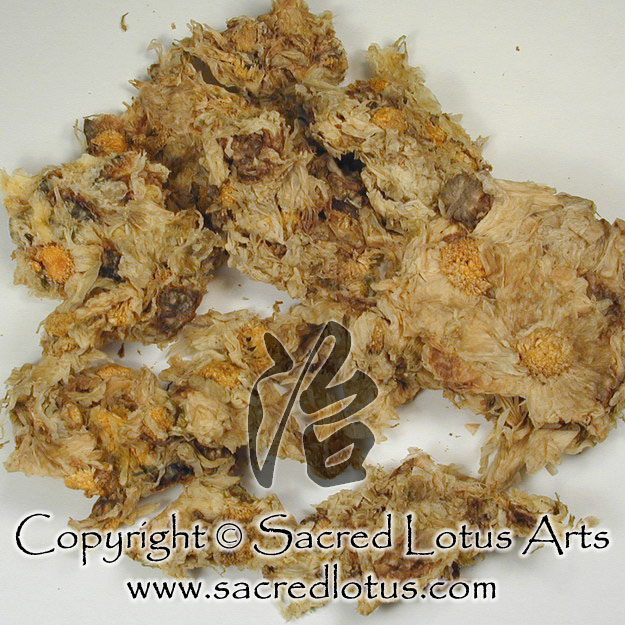
Materia Medica Data
- Temperature
- Slightly Cold
- Nature & Flavour
- Sweet, Bitter, Slightly Cold
- Channels Entered
- LIV, LU
- Latin (pharmaceutical)
- Flos Chrysanthemi Morifolii
- Chinese
- 菊花
- Tone Marks
- jú huā
Chinese Herb Actions
What is Ju Hua used for in Chinese medicine?
Ju Hua (chrysanthemum flower) is traditionally used to disperse wind-heat, clear heat from the Liver channel to brighten the eyes, and calm rising Liver yang — for early wind-heat colds with fever and headache, red, swollen, painful or dry eyes, and Liver-yang patterns of dizziness and headache. Sacred Lotus records its properties as sweet, bitter, slightly cold, entering the Liver and Lung channels.
Its main traditional actions:
- Releases wind-heat — fever, headache, and mild sore throat in the early, exterior stage of a wind-heat cold; classically paired with Sang Ye (mulberry leaf).
- Clears Liver heat and brightens the eyes — red, swollen, painful, dry eyes from Liver-channel heat, and blurry vision or floaters from Liver/Kidney yin deficiency.
- Calms Liver yang and extinguishes wind — dizziness and headache from ascending Liver yang; in more severe internal-wind presentations it is combined with heavier anchoring herbs such as antelope horn (Ling Jiao) and Gou Teng.
- Clears heat-toxin (secondary, materia-medica consensus) — a minor traditional use for early-stage sores and heat-toxin swellings.
Source: Sacred Lotus sources & references (properties/channels); cross-referenced against multiple online sources and materia medica consensus (Bensky, Materia Medica, 3rd ed.; Chen & Chen, Chinese Herbal Medicine: Materia Medica). Traditional-use framing; not medical advice.
Chinese Herb Dosage
What is the typical dosage of Ju Hua?
Roughly 4.5–15 g in decoction — the Sacred Lotus record’s range, using the dried flower head. Materia medica consensus places routine use nearer 5–10 g, with the higher end reserved for stronger eye or wind-heat presentations; Ju Hua is also taken as a mild infusion (chrysanthemum tea) and used topically as an eye wash for redness/irritation in some traditional preparations.
Source: Sacred Lotus sources & references; cross-referenced against multiple online sources and materia medica consensus. Reference only — not a prescription.
Chinese Herb Contraindications & Cautions
Are there cautions for Ju Hua?
Ju Hua’s cool, dispersing nature means it is used cautiously in patients with qi deficiency, diarrhea, or poor appetite — the Sacred Lotus record flags exactly this caution, consistent with materia medica guidance for cool/dispersing herbs in Spleen-deficient, cold-leaning presentations.
- Digestive caution — avoid or use carefully with loose stool, poor appetite, or a cold-deficient constitution.
- Allergy note (reference) — chrysanthemum belongs to the Asteraceae/Compositae plant family; contact sensitization to the fresh plant has been documented in florists and horticultural workers, so individuals with a known Asteraceae plant allergy should be aware (see safety/research below).
Source: Sacred Lotus sources & references; cross-referenced against multiple online sources and materia medica consensus. Allergy note: PMID 31483868. Traditional-use framing, not medical advice.
Chinese Herb Toxicity & Overdose
Low. Ju Hua is a food-grade flower consumed widely as chrysanthemum tea, with no significant toxicity reported at normal dietary or medicinal doses. The main documented safety signal is not systemic toxicity but occupational/contact allergy to the fresh plant (Asteraceae family) in florists and growers — a different exposure route from the dried, decocted herb.
Source: cross-referenced against multiple online sources and materia medica consensus; contact-allergy literature PMID 31483868, PMID 29057739. Reference note, not a safety guarantee.
Herb-Drug Interactions
No well-established clinical herb–drug interactions are documented for Ju Hua. Preclinical phytochemistry research on chrysanthemum flavonoids reports mild blood-pressure- and lipid-related effects, so theoretical caution is reasonable for patients on antihypertensive medication — this is precautionary, not a demonstrated clinical interaction. (Flagged for practitioner confirmation.)
Western / Biomedical Research
Chinese Herb Clinical Studies & Research
Provided as research context — a summary of published biomedical study, not a therapeutic or medical claim.
Is there modern research on Ju Hua (Chrysanthemum morifolium)?
Yes — an established phytochemistry and pharmacology literature exists, with preclinical support for the traditional “clear the Liver, brighten the eyes” action, though human clinical-trial evidence is limited. Ju Hua’s chemistry centers on flavonoids (e.g., luteolin and apigenin glycosides) and chlorogenic acids.
- Dietary/medicinal review (2020) — frames Juhua as a paradigm “medicine-food homologous” flower, documenting antimicrobial, anti-inflammatory, and neuroprotective effects in preclinical work while calling for more bioactive-compound and safety research.
- Liver and eye flavonoid research (2025) — characterizes roughly 125 flavonoids across Chrysanthemum morifolium and related medicinal flowers, reporting liver- and eye-protective activity via antioxidant and anti-inflammatory mechanisms — a direct mechanistic parallel to the traditional “clears the Liver, brightens the eyes” action. Preclinical (cell/animal) evidence.
- Medicine-food homologous flowers (2022) — situates Chrysanthemum morifolium among flowers used as both food and medicine, summarizing proposed disease-prevention mechanisms.
Overall, the evidence base is preclinical and mechanistic; controlled human trials specific to Ju Hua remain limited.
Sources: PMID 32593689 (J Ethnopharmacol, 2020, review); PMID 39532220 (J Ethnopharmacol, 2025, flavonoid liver/eye review); PMID 36165435 (J Food Biochem, 2022, medicine-food flowers review). Research context, not a therapeutic claim.
Chinese Herb Notes
What is the difference between yellow (Huang Ju) and white (Bai Ju) chrysanthemum?
Huang Ju (yellow chrysanthemum) is generally considered the stronger choice for dispersing wind-heat, while Bai Ju (white chrysanthemum) is regarded as milder and better suited to clearing Liver heat and brightening the eyes — both are cultivated forms marketed under the single “Ju Hua” heading, but practitioners commonly select by color for emphasis.
- Huang Ju (yellow) — more often chosen for exterior wind-heat with fever and headache, as in Sang Ju Yin.
- Bai Ju (white) — more often chosen for eye complaints and Liver/Kidney yin-deficiency patterns, as in Qi Ju Di Huang Wan.
Key combinations: with Sang Ye (mulberry leaf) for early wind-heat with cough — the classic pairing behind Sang Ju Yin (in the Sacred Lotus formula records). With Gou Qi Zi and Kidney/Liver-nourishing herbs (Shu Di Huang, Shan Zhu Yu) for yin-deficiency eye and vision complaints — the pattern behind Qi Ju Di Huang Wan. With antelope horn (Ling Jiao) and Gou Teng to calm more severe Liver-wind presentations, as in Ling Jiao Gou Teng Tang (also in the Sacred Lotus formula records). (Traditional formula context, not treatment advice.)
Note: Qi Ju Di Huang Wan is a widely documented classical formula for Liver/Kidney yin deficiency with eye symptoms, but it is not currently in the Sacred Lotus formula records; that reference is drawn from materia medica consensus rather than internal formula data.
Source: Sacred Lotus sources & references (Sang Ju Yin, Ling Jiao Gou Teng Tang formula links); cross-referenced against multiple online sources and materia medica consensus for the yellow/white distinction and Qi Ju Di Huang Wan.
Sources & References
Compiled and edited by Thomas Dehli, Founder & Editor, Sacred Lotus Updated
The information here is referenced from numerous sources — teachers, practitioners, class notes from Five Branches University, the books below, and the published research literature, with citations given as resolvable PubMed identifiers. Where sources disagree, I have flagged the discrepancies directly. If facts couldn't be verified, I have left them out. How we source our content.
Reference information for students and practitioners — not medical advice. Consult a qualified practitioner. Terms of use.
Chinese Herbs Books & References
 https://amzn.to/3WfB3DK
 https://amzn.to/3DR1VUh
 https://amzn.to/42aMz73
 https://amzn.to/3PuD4bt