

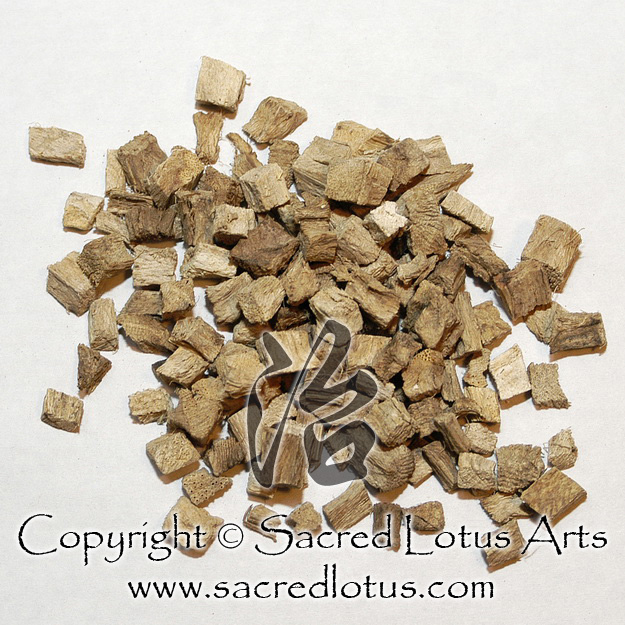
Radix Puerariae Pueraria, Kudzu Root
Materia Medica Data
- Temperature
- Cool
- Nature & Flavour
- Sweet, Spicy, Cool
- Channels Entered
- SP, ST
- Latin (pharmaceutical)
- Radix Puerariae
- Chinese
- 葛根
- Tone Marks
- gé gēn
- Photo Note
- Ye Ge Gen (Peureria Lobata)
Chinese Herb Actions
What is Ge Gen (kudzu root) used for in Chinese medicine?
Ge Gen (Pueraria, kudzu root) is a cool, sweet-and-spicy herb that releases the exterior at the muscle layer, generates fluids to stop thirst, and lifts clear yang — it is best known for relieving stiffness and tightness across the neck and upper back. It enters the Spleen and Stomach channels.
Its traditional actions:
- Releases the muscle layer and disperses wind-heat — for an external pathogen lodged in the muscle layer causing tightness and stiffness of the neck and upper back, fever, and headache; this is the action behind its reputation as a “stiff neck and shoulders” herb.
- Generates fluids and stops thirst — for thirst from Stomach heat, especially when driven by a Wind-Heat invasion.
- Promotes the eruption of rashes — traditionally used in the early stage of measles when the rash is slow to surface.
- Stops diarrhea and dysentery — for diarrhea/dysentery due to heat; also used, combined with other herbs, for diarrhea arising from Spleen deficiency.
- Traditionally used alongside hypertension — for the headache, dizziness, paresthesia, or tinnitus that can accompany elevated blood pressure, as a supportive herb rather than a blood-pressure treatment in itself.
Note on identity: Sacred Lotus lists the Latin as “Radix Puerariae,” the general pharmaceutical name. The specific source species in both classical and modern research is Pueraria lobata (Willd.) Ohwi — botanically reclassified as Pueraria montana var. lobata, though “Pueraria lobata” remains the name used across almost all TCM and pharmacology literature. “Kudzu” is simply the common Western name for the same plant.
Source: Sacred Lotus reference content, cross-checked against Bensky & Chen & Chen materia medica consensus for Radix Puerariae (Cool, Spicy Herbs that Release the Exterior category). Traditional-use framing; not medical advice.
Chinese Herb Dosage
What is the typical dosage of Ge Gen?
6–12 g in decoction is the range in Sacred Lotus’s reference notes, using the root; some materia medica references cite a somewhat broader standard range of roughly 9–15 g (occasionally up to ~30 g when Ge Gen is used alone for severe thirst).
- Processing changes the action — used raw, Ge Gen is more cooling and is favored to release the exterior, clear heat, and generate fluids; roasted until yellow, its cooling action is reduced and it is favored instead to lift Spleen yang and stop diarrhea from Spleen deficiency.
Note: our 6–12 g reflects the site’s existing reference range; it runs slightly lower than the ~9–15 g commonly cited across general materia medica sources. Both are well within normal decoction dosing for this herb; kept as-is pending owner confirmation rather than guessed at.
Source: Sacred Lotus reference content; cross-checked against general Chinese materia medica dosage conventions. Reference only, not a prescription.
Chinese Herb Contraindications & Cautions
Are there cautions for Ge Gen (kudzu root)?
Use caution in patients with excessive sweating or a cold Stomach — Ge Gen is a cooling, upward-and-outward dispersing herb, and its exterior-releasing, sweat-inducing tendency is not well suited to patients who are already sweating heavily or who have Stomach-cold digestive weakness.
Source: Sacred Lotus reference content; general materia medica cautions for cool, exterior-releasing herbs.
Chinese Herb Toxicity & Overdose
Low. Kudzu root has a long dietary history (kudzu starch, kudzu-flower tea) and materia medica sources report no significant toxicity at standard decoction doses. A rat acute/subchronic toxicity study of a standardized Pueraria lobata & Scutellaria baicalensis combination extract (HT047, 8:1 ratio) found no lethality at a single 5,000 mg/kg dose and no adverse effects at repeated doses up to 5,000 mg/kg/day over 13 weeks — though this tests a two-herb combination product, not Ge Gen in isolation, so it is supportive rather than definitive for the single herb.
Source: materia medica consensus (dietary/decoction history); PMID 32680504, DOI 10.1186/s12906-020-02998-1 (rat toxicity study of a Pueraria lobata/Scutellaria baicalensis combination extract). Reference note, not a safety guarantee.
Herb-Drug Interactions
No well-established clinical herb–drug interaction is documented, but one human pharmacokinetic study is relevant. In 18 healthy male volunteers, a single dose of puerarin (Ge Gen’s major isoflavone) inhibited CYP2D6 activity and induced CYP1A2 activity, measured via standard probe-drug metabolic ratios; the authors concluded co-administration with CYP2D6 or CYP1A2 substrate drugs “is worth attention and at times precautions are needed.” CYP2D6 metabolizes many common antidepressants, antipsychotics, and pain medications, and CYP1A2 metabolizes caffeine and some other drugs, so this is a theoretical, pharmacokinetic-level caution rather than a demonstrated clinical problem. (Flagged for practitioner confirmation, not a contraindication.)
Source: PMID 20195825, DOI 10.1007/s12272-010-0209-2 (human CYP2D6/CYP1A2 phenotyping study). Research context, not a clinical warning.
Western / Biomedical Research
Chinese Herb Clinical Studies & Research
Provided as research context — a summary of published biomedical study, not a therapeutic or medical claim.
Is there modern research on Ge Gen (Pueraria lobata)?
Yes — Ge Gen is one of the more heavily researched Chinese herbs, chemically centered on the isoflavones puerarin, daidzin, and daidzein. Research spans musculoskeletal, metabolic, and cardiovascular questions, with human clinical trial evidence strongest for alcohol-related outcomes and preliminary-to-preclinical elsewhere.
- Cervical stiffness (musculoskeletal) — a systematic review and meta-analysis of 5 randomized controlled trials (454 participants) on Gegen-decoction (a Ge Gen–based herbal formula) for cervical spondylosis found a higher response rate versus control, though the authors rated the included trials’ methodological quality as generally low. Supportive but not definitive evidence for the traditional neck/shoulder-stiffness use.
- Blood glucose / “wasting-thirst” — a pharmacology review describes puerarin lowering blood glucose, improving insulin resistance, and protecting pancreatic islets in preclinical models, with the authors explicitly noting puerarin’s clinical efficacy is limited by its pharmacokinetics and that human safety data remain to be clarified. Preclinical/mechanistic, not clinical proof.
- Cardiovascular / blood pressure — a pharmacology review reports puerarin lowering blood pressure and improving vascular/endothelial markers in several rat hypertension models (spontaneously hypertensive, angiotensin-II–infused, and renal-clip models); the cited clinical-trial evidence in the same review concerns angina and stroke, not blood-pressure treatment specifically. Preclinical for the blood-pressure findings.
Does kudzu (Ge Gen) help with hangovers or reduce alcohol consumption?
This is the best-studied research line for this herb, with two positive human trials, though evidence is still early and the effect size is modest. A randomized, double-blind, placebo-controlled trial in 17 heavy-drinking men (standardized kudzu extract NPI-031, 250 mg isoflavones three times daily for 4 weeks) reported a 34–57% reduction in weekly drinks, fewer heavy-drinking days, and more consecutive abstinent days versus placebo, with no effect on alcohol craving and no serious adverse events. An earlier naturalistic study by the same research group reported a similar drinking-reduction effect in heavy drinkers. Neither trial tested hangover symptoms directly — the research question studied is reduced drinking/binge behavior, not hangover relief.
These findings are research context on isoflavone pharmacology, not a recommendation to use kudzu to treat alcohol use.
Sources: DOI 10.1016/j.eujim.2017.12.005 (Gegen-decoction cervical spondylosis systematic review, European Journal of Integrative Medicine); PMID 30525896, DOI 10.1142/S0192415X18500891 (puerarin/diabetes review); PMID 34950032, DOI 10.3389/fphar.2021.771793 (puerarin cardiovascular review); PMID 24339367, DOI 10.1002/ptr.5083 (puerarin pharmacology review); PMID 23070022, PMC 3562758, DOI 10.1007/s00213-012-2884-9 (kudzu extract RCT, heavy drinkers). Research context, not a therapeutic claim.
Chinese Herb Notes
What formulas is Ge Gen (kudzu) commonly combined in?
Ge Gen appears across several classical formulas, most prominently as the namesake herb in Ge Gen Tang (Kudzu Decoction), the formula most associated with wind-cold stiffness of the neck and upper back. Combinations confirmed in the Sacred Lotus formula database:
- Ge Gen Tang (Kudzu Decoction, 12 g) — the classic Shang Han Lun formula for wind-cold invasion with stiff neck and upper back, no sweating, and aversion to wind-cold.
- Chai Ge Jie Ji Tang (Bupleurum and Kudzu Decoction to Release the Muscle Layer, 6–12 g) — for a combined Shaoyang/Yangming pattern where surface cold is starting to transform into interior heat, with headache and thirst.
- Ge Gen Huang Lian Huang Qin Tang (Kudzu, Coptis, and Scutellaria Decoction, 18–24 g, its largest dose among these formulas) — clears interior heat while releasing the exterior, for diarrhea with fever and thirst; Ge Gen’s fluid-generating, clear-yang-raising action is central here.
- Sheng Ma Ge Gen Tang (Cimicifuga and Kudzu Decoction, 3–9 g) — releases the exterior and vents rashes, traditionally for the early stage of measles when the rash has not fully surfaced.
- Yu Ye Tang (Jade Fluid Decoction, 4.5 g) — a wasting-thirst (xiao ke) formula where Ge Gen generates fluids and lifts clear yang alongside qi- and yin-tonifying herbs.
- Cong Bai Qi Wei Yin (Scallion Decoction with Seven Ingredients, 9–12 g) — a gentle exterior-releasing formula for wind-cold invasion in a patient with concurrent blood deficiency.
(Traditional formula context, not treatment advice.)
Does Ge Gen (kudzu) help with neck and shoulder stiffness?
This is Ge Gen’s signature traditional indication — “releasing the muscle layer” specifically targets the tight, stiff sensation across the neck and upper back (xiang bei jiang tong) that classically accompanies an early wind-cold or wind-heat invasion, which is why Ge Gen Tang remains a first-line formula choice for that presentation. See Research for a modern systematic review of herbal formulas built around this herb for cervical stiffness.
Source: Sacred Lotus formula database (formula–herb links); Bensky & Chen & Chen materia medica consensus.
Sources & References
Compiled and edited by Thomas Dehli, Founder & Editor, Sacred Lotus Updated
The information here is referenced from numerous sources — teachers, practitioners, class notes from Five Branches University, the books below, and the published research literature, with citations given as resolvable PubMed identifiers. Where sources disagree, I have flagged the discrepancies directly. If facts couldn't be verified, I have left them out. How we source our content.
Reference information for students and practitioners — not medical advice. Consult a qualified practitioner. Terms of use.
Chinese Herbs Books & References
 https://amzn.to/3WfB3DK
 https://amzn.to/3DR1VUh
 https://amzn.to/42aMz73
 https://amzn.to/3PuD4bt