
Flos Carthami Tinctorii Safflower Flower
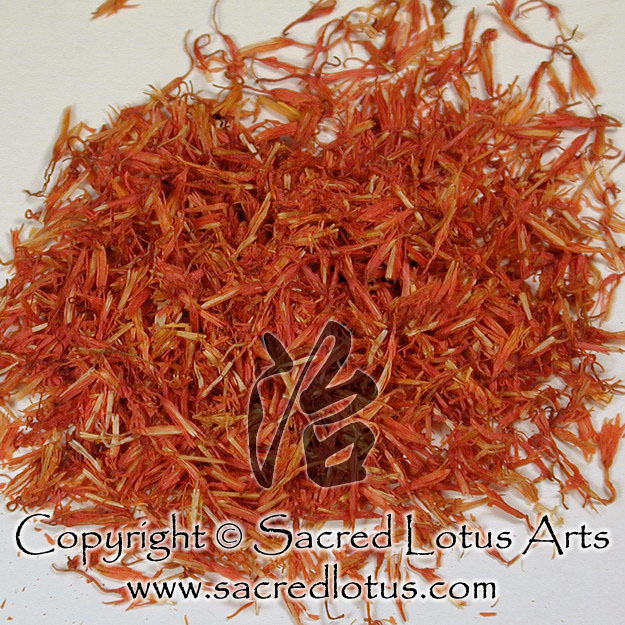
Materia Medica Data
- Temperature
- Warm
- Nature & Flavour
- Spicy, Warm
- Channels Entered
- HT, LIV
- Latin (pharmaceutical)
- Flos Carthami Tinctorii
- Chinese
- 红花
- Tone Marks
- hóng huā
- Translation
- Red Flower
Chinese Herb Actions
What is Hong Hua used for in Chinese medicine?
Hong Hua (safflower flower) is traditionally used to invigorate the blood, eliminate blood stasis, and regulate menstruation — for the full range of blood-stasis patterns, including gynecological disorders (amenorrhea, dysmenorrhea, postpartum abdominal pain), chest and abdominal pain or masses, trauma and sports injuries, and stasis-type skin sores. Sacred Lotus records its properties as spicy and warm, entering the Heart and Liver channels.
Its main traditional actions:
- Invigorates the blood, eliminates blood stasis, regulates menses, nourishes blood — used for amenorrhea, dysmenorrhea, postpartum pain, trauma injuries, skin sores, carbuncles, and (historically) to help expel a stillbirth or ease difficult labor.
- Opens the channels — joint pain or paralysis associated with blood stasis obstructing the channels.
Source: Sacred Lotus sources & references; cross-referenced against multiple online sources and materia medica consensus (Bensky, Materia Medica, 3rd ed.; Chen & Chen, Chinese Herbal Medicine: Materia Medica). Traditional-use framing; not medical advice.
Chinese Herb Dosage
What is the typical dosage of Hong Hua?
Roughly 3–10 g in decoction — Bensky gives 3–9 g and Chen & Chen give 3–10 g, a narrow, consistent range across sources. Critically, the dose itself changes the herb’s traditional emphasis (see below): smaller doses are used to harmonize and nourish the blood, while larger doses within this range are used to more forcefully break stasis.
Source: Sacred Lotus sources & references (Bensky, Chen & Chen ranges recorded); cross-referenced against multiple online sources. Reference only — not a prescription.
Chinese Herb Contraindications & Cautions
Are there cautions for Hong Hua?
Hong Hua must not be used in pregnancy, and overdose should be avoided as it may cause excess bleeding — both cautions are recorded directly in the Sacred Lotus record and are consistent across materia medica sources, reflecting Hong Hua’s strong blood-moving action.
- Pregnancy — contraindicated; its blood-invigorating, stasis-breaking, menses-unblocking action carries a real risk of provoking uterine bleeding or miscarriage.
- Overdose / heavy menstrual bleeding — excessive dosing may cause excess bleeding; caution is also warranted in patients with bleeding disorders or heavy menstrual flow.
Source: Sacred Lotus sources & references; cross-referenced against multiple online sources and materia medica consensus. Traditional-use framing, not medical advice.
Chinese Herb Toxicity & Overdose
Is Hong Hua safe / toxic in overdose?
At traditional doses Hong Hua has a good long-term safety record, but overdose can cause headache, nausea, dilated pupils, and raised intraocular pressure — the Sacred Lotus record notes this directly, along with rare reports of skin allergy and anaphylactic shock. Large doses have also been used for long periods in some traditional contexts without reported harm, so the overdose effects appear to be dose-acute rather than cumulative-chronic.
- Overdose effects — headache, nausea, dilated pupils, increased intraocular pressure.
- Rare hypersensitivity — skin allergy and anaphylactic shock have been reported.
- Long-term use — large doses taken over long periods have reportedly been tolerated without harm in some traditional accounts, but this is not a safety guarantee.
Source: Sacred Lotus sources & references; cross-referenced against multiple online sources and materia medica consensus. Reference note, not a safety guarantee.
Herb-Drug Interactions
Hong Hua may interfere with anticoagulant/antiplatelet medications (the Sacred Lotus record flags this directly). This is consistent with Hong Hua’s core traditional action of strongly invigorating the blood, and with preclinical pharmacology showing that safflower constituents (notably hydroxysafflor yellow A) affect vascular tone and circulation. No large-scale human interaction trials have been published, so this should be treated as a reasonable precaution for patients on warfarin or other anticoagulant/antiplatelet drugs rather than a fully quantified clinical interaction. (Flagged for practitioner confirmation.)
Western / Biomedical Research
Chinese Herb Clinical Studies & Research
Provided as research context — a summary of published biomedical study, not a therapeutic or medical claim.
Is there modern research on Hong Hua (Carthamus tinctorius)?
Yes — safflower flower has a substantial phytochemistry and cardiovascular pharmacology literature, centered on the compound hydroxysafflor yellow A (HSYA), with preclinical support for the traditional blood-invigorating action; human clinical-trial evidence is more limited.
- Phytochemistry/pharmacology review — a comprehensive review of Carthamus tinctorius documents its traditional use across China, Korea, and Japan for gynecological and cardiovascular conditions and summarizes its major bioactive compounds.
- Cardiovascular systems pharmacology — a systems-pharmacology analysis identified numerous active compounds and protein targets linked to cardiovascular disease treatment mechanisms, and separate network-pharmacology work modeled safflower’s anti-myocardial-ischemia mechanisms.
- Hydroxysafflor yellow A (HSYA) — reviewed as a promising therapeutic compound across a broad range of disease models; specific studies report that HSYA promotes angiogenesis (via the Angiopoietin 1/Tie-2 pathway) and induces vascular dilation in animal mesenteric artery tissue through a calcium-dependent mechanism — laboratory/animal findings relevant to blood-moving, stasis-clearing traditional use.
- Cardioprotective / anti-inflammatory (preclinical) — safflower extract has been shown to inhibit inflammatory signaling in cardiac cell models and to protect against myocardial ischemia in animal and cell studies.
Overall, the evidence base is predominantly preclinical (cell and animal) pharmacology consistent with the traditional blood-invigorating, stasis-breaking action; controlled human clinical trials specific to Hong Hua remain limited.
Sources: PMID 27080938 (Am J Chin Med, 2016, phytochemistry/pharmacology review); PMID 31203131 (Biomed Pharmacother, 2019, cardiovascular systems pharmacology); PMID 36895345 (Heliyon, 2023, anti-myocardial-ischemia network pharmacology); PMID 30356354 (Evid Based Complement Alternat Med, 2018, HSYA review); PMID 27894114 (J Vasc Res, 2016, HSYA angiogenesis); PMID 32234595 (J Ethnopharmacol, 2020, HSYA vascular dilation); PMID 20538053 (J Ethnopharmacol, 2010, anti-inflammatory cardiomyoblast study); PMID 19394208 (Phytomedicine, 2009, myocardial ischemia protection). Research context, not a therapeutic claim.
Chinese Herb Notes
Does the dose of Hong Hua change what it does?
Yes — classical materia medica draws a small-dose versus large-dose distinction for Hong Hua: a small dose harmonizes and nourishes the blood, while a larger dose disperses and breaks blood stasis more forcefully. This dose-dependent emphasis is a long-standing feature of Hong Hua’s use and is reflected directly in the Sacred Lotus record.
- Small dose — gentler, blood-harmonizing and nourishing use, closer to the low end of the 3–10 g range.
- Large dose — stronger stasis-breaking, blood-moving use, closer to the upper end of the range.
Key combination: Hong Hua is classically paired with Tao Ren (peach kernel) as the core blood-invigorating duo in Chinese medicine — both herbs move blood and break stasis, and together they anchor formulas such as Xue Fu Zhu Yu Tang (blood stasis in the chest with Liver qi stagnation), where Tao Ren and Hong Hua appear together as chief herbs in the Sacred Lotus formula records, alongside the related classical pairing in Tao Hong Si Wu Tang. Hong Hua also appears in Bu Yang Huan Wu Tang (qi deficiency causing blood stagnation), Fu Yuan Huo Xue Tang (invigorating blood after trauma), and Qi Li San — all in the Sacred Lotus formula records. (Traditional formula context, not treatment advice.)
Note: Tao Hong Si Wu Tang is a widely documented classical formula built on the Tao Ren–Hong Hua pairing, but it is not currently in the Sacred Lotus formula records; that reference is drawn from materia medica consensus rather than internal formula data.
Source: Sacred Lotus sources & references (dose-dependent use note; Xue Fu Zhu Yu Tang, Bu Yang Huan Wu Tang, Fu Yuan Huo Xue Tang, Qi Li San formula links); cross-referenced against multiple online sources and materia medica consensus for the Tao Ren pairing and Tao Hong Si Wu Tang.
Sources & References
Compiled and edited by Thomas Dehli, Founder & Editor, Sacred Lotus Updated
The information here is referenced from numerous sources — teachers, practitioners, class notes from Five Branches University, the books below, and the published research literature, with citations given as resolvable PubMed identifiers. Where sources disagree, I have flagged the discrepancies directly. If facts couldn't be verified, I have left them out. How we source our content.
Reference information for students and practitioners — not medical advice. Consult a qualified practitioner. Terms of use.
Chinese Herbs Books & References
 https://amzn.to/3WfB3DK
 https://amzn.to/3DR1VUh
 https://amzn.to/42aMz73
 https://amzn.to/3PuD4bt