
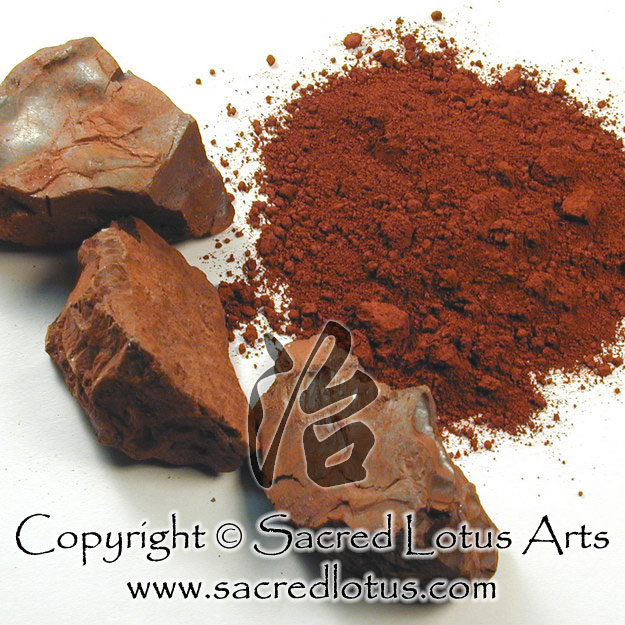
Haematitum Hematite
Materia Medica Data
- Temperature
- Cold
- Nature & Flavour
- Bitter, Cold
- Channels Entered
- HT, LIV, PER
- Latin (pharmaceutical)
- Haematitum
- Chinese
- 代赭石
- Tone Marks
- dài zhĕ shí
- Translation
- Red Stone from Dai Country
Chinese Herb Actions
What is Dai Zhe Shi (Hematite) used for in Chinese medicine?
Dai Zhe Shi (Hematite, Haematitum) is a heavy, settling mineral used to pacify the Liver and anchor ascendant yang, to strongly direct rebellious qi downward, and to cool the blood and stop bleeding. Its weight and bitter-cold nature draw upward-rising and rebellious qi down — calming the Liver, redirecting rebellious Stomach and Lung qi, and settling reckless bleeding driven by heat.
Its main traditional actions:
- Pacifies the Liver and anchors yang; clears Liver fire — dizziness, vertigo, headache, tinnitus, a sensation of pressure around the eyes, and irritability from ascendant Liver yang.
- Strongly directs rebellious qi downward — belching, hiccups, nausea and vomiting, and wheezing or asthma.
- Cools the blood and stops bleeding — vomiting of blood, nosebleeds, and heavy menstruation or flooding (its bitter-cold nature settling heat-driven bleeding).
Source: owner’s Five Branches notes (Calm Spirit & Stop Tremors categories), cross-referenced with Bensky, Materia Medica. Traditional-use framing; not medical advice.
Chinese Herb Dosage
What is the typical dosage of Dai Zhe Shi, and how is it prepared?
9–30 g in decoction — crushed and decocted first (cooked longer) as a hard mineral; or 1–3 g as a finely ground powder. Because it is dense, it is broken into small pieces and cooked ahead of the other herbs so its properties can be extracted.
Source: owner’s Five Branches notes (dose 3–10 qian; “cook first”); standard materia medica ranges. Reference only — not a prescription.
Chinese Herb Contraindications & Cautions
Are there cautions or contraindications for Dai Zhe Shi?
Contraindicated in pregnancy. Being heavy and cold, it can injure the Stomach qi and Spleen, so it is used cautiously in Spleen/Stomach deficiency or cold patterns and is not intended for prolonged use. It is crushed and decocted first, and — as an iron-oxide mineral that may carry trace heavy metals (see Toxicity) — properly processed material and short-term use are advised.
Source: owner’s Five Branches notes (contraindication: pregnancy); Calm Spirit category cautions (heavy minerals injure Stomach qi).
Chinese Herb Toxicity & Overdose
Use short-term and at routine doses; avoid high doses and prolonged use. Dai Zhe Shi is hematite — ferric oxide (Fe2O3) — and can contain trace arsenic and lead, so quality-sourced, properly processed material matters. In a 2024 toxicity study, routine short-term doses were relatively safe, high-dose decoction caused lung damage in mice, and calcination significantly reduced toxicity. Avoid in pregnancy; keep any pediatric use brief.
Source: PubMed 38838923 (toxicity study of mineral medicine haematitum, J Ethnopharmacol 2024); owner’s notes (pregnancy contraindication).
Herb-Drug Interactions
No well-established clinical herb–drug interactions are documented. As an insoluble iron-oxide mineral that may carry trace heavy metals, it is generally reserved for short courses and quality-sourced material rather than combined with prolonged or high-dose regimens. (Flagged for practitioner confirmation — absence of documented interactions is not proof of safety.)
Source: no interaction data identified in the reviewed research; general mineral-medicine precaution.
Western / Biomedical Research
Chinese Herb Clinical Studies & Research
Provided as research context — a summary of published biomedical study, not a therapeutic or medical claim.
Is there modern research on Dai Zhe Shi (hematite, Haematitum)?
Limited — Dai Zhe Shi is a mineral, so research centers on its composition and safety rather than efficacy. Its principal component is ferric oxide (Fe2O3), typically with trace elements including silicon, aluminum, manganese, and arsenic. A 2024 toxicity study found routine short-term doses relatively safe, high-dose decoction toxic to the lungs of mice, and calcination able to significantly reduce toxicity. Robust clinical efficacy trials are lacking.
Source: PubMed 38838923 (toxicity study of mineral medicine haematitum, J Ethnopharmacol 2024). Research context, not a therapeutic claim.
Chinese Herb Notes
How is Dai Zhe Shi combined in classical formulas?
Dai Zhe Shi anchors the two directions it is famous for — settling rising Liver yang and redirecting rebellious Stomach qi — and is paired accordingly. Its heavy, downward-directing quality makes it a key mineral in formulas that must both settle the Liver and lead qi (or blood) downward.
Representative combinations:
- With Xuan Fu Hua and Ban Xia (Xuan Fu Dai Zhe Tang) — for rebellious Stomach qi with belching, hiccups, and vomiting.
- With Huai Niu Xi, Long Gu, Mu Li, and Gui Ban (Zhen Gan Xi Feng Tang) — to sedate the Liver and anchor ascendant yang.
- With Dang Shen and Shan Zhu Yu — to direct qi downward while supporting the qi when there is no accompanying excess/heat.
Source: owner’s Five Branches notes (formula corpus & combination notes).
Sources & References
Compiled and edited by Thomas Dehli, Founder & Editor, Sacred Lotus Updated
The information here is referenced from numerous sources — teachers, practitioners, class notes from Five Branches University, the books below, and the published research literature, with citations given as resolvable PubMed identifiers. Where sources disagree, I have flagged the discrepancies directly. If facts couldn't be verified, I have left them out. How we source our content.
Reference information for students and practitioners — not medical advice. Consult a qualified practitioner. Terms of use.
Chinese Herbs Books & References
 https://amzn.to/3WfB3DK
 https://amzn.to/3DR1VUh
 https://amzn.to/42aMz73
 https://amzn.to/3PuD4bt