
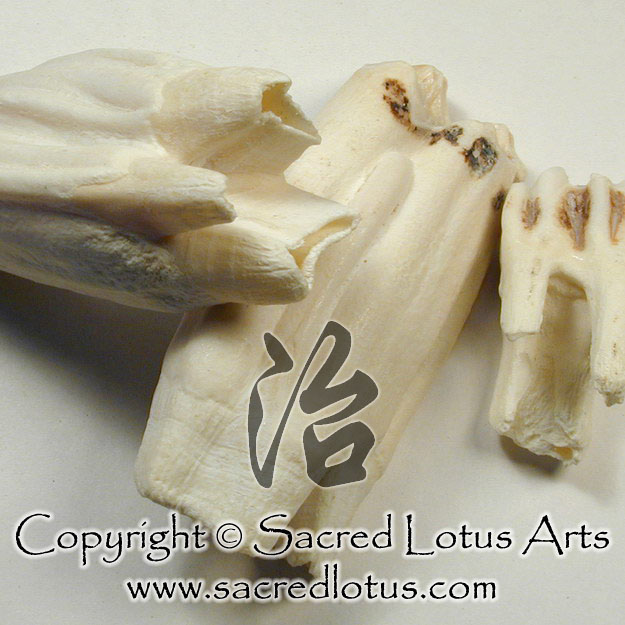
Dens Draconis Fossilized Mammal Teeth
Materia Medica Data
- Temperature
- Cool
- Nature & Flavour
- Astringent, Cool
- Channels Entered
- HT, KI, LIV
- Latin (pharmaceutical)
- Dens Draconis
- Chinese
- 龙齿
- Tone Marks
- lóng chĭ
- Translation
- Dragon's Teeth
Chinese Herb Actions
What is Long Chi (dragon's teeth) used for in Chinese medicine?
Long Chi (Dens Draconis) is a fossilized-tooth mineral substance traditionally used to settle fright and calm the spirit — its single strongest action. It is used for restlessness, palpitations with anxiety, insomnia and dream-disturbed sleep, and childhood fright, particularly where an agitated Heart–Liver picture includes a heat/irritability component or spasm from Liver wind.
Its main traditional actions:
- Settles fright & calms the spirit — restlessness, palpitations with anxiety, insomnia, night-dreaming/disturbed sleep, and childhood fright disorders; the owner’s notes describe Long Chi as having a stronger calm-spirit action than its bone counterpart, Long Gu.
- Clears heat & relieves irritability — its cool nature (vs Long Gu’s neutral-to-slightly-cold) suits spirit disturbance with a concurrent heat/agitation component.
- Calms the Liver & stops spasm from Liver wind — irritability and, per the owner’s notes, spasm arising from Liver wind stirring; traditionally used for convulsions, including in children.
- Severe/manic presentations — for more marked ascendant Heart–Liver disturbance manifesting as agitation bordering on manic behavior.
Source: owner’s Five Branches notes (Bensky Chapter Summaries, Calm Spirit chapter); standard materia medica (Bensky, Chinese Herbal Medicine: Materia Medica, 3rd ed.) consensus. Traditional-use framing; not medical advice.
Chinese Herb Dosage
What is the typical dosage of Long Chi, and how is it prepared?
Roughly 15–30 g in decoction, crushed and cooked first — the owner’s notes give 5–10 qián (at ~3 g/qián), added 20–30 minutes before the other herbs because it is a dense fossil substance. Raw (生龙鸽) is favored for heat-clearing and settling fright; calcined (煾龙鸽) shifts the action toward gentler, more astringent spirit-calming suited to chronic use.
Note: Several widely-cited materia medica summaries give a more conservative everyday range of about 9–15 g (up to ~30 g for acute presentations), somewhat lower at the low end than the owner’s 5–10 qián (≈15–30 g). Both ranges overlap substantially and describe the same substance; we keep the owner’s figure as primary and note the wider published range for context.
Source: owner’s Five Branches notes (5–10 qián; “cook 20–30 minutes before”); standard materia medica ranges (≈9–15 g typical, up to ~30 g). Reference only — not a prescription.
Chinese Herb Contraindications & Cautions
Are there cautions for Long Chi?
As a dense mineral substance, Long Chi can injure Stomach qi and is not intended for long-term use — the owner’s notes flag indigestion and loss of appetite as the general caution for this entire class of heavy anchor/settle minerals and shells. It is generally best avoided in Spleen–Stomach deficiency-cold patterns and while an exterior pathogen remains unresolved.
Source: owner’s Five Branches notes (general caution for the Anchor/Settle/Calm Spirit mineral-shell class, incl. Long Gu, Long Chi, Mu Li).
Chinese Herb Toxicity & Overdose
Low for authentic material. Genuine Long Chi is fossilized mammalian tooth — dentin and enamel, both forms of carbonated hydroxyapatite, the same calcium-phosphate mineral family as Long Gu — with no significant toxicity reported at normal doses. As with Long Gu, the market for fossil “dragon” materials carries a documented counterfeiting problem, so authenticated sourcing bears directly on safety and correct identification.
Source: PMID 23019901 (XRD identification method distinguishing authentic Dens Draconis/Os Draconis from counterfeits); PMID 28220276 (taxonomic survey of longgu/longchi fossil material from Japanese & Chinese crude-drug markets). Neutral sourcing-quality note.
Herb-Drug Interactions
No well-established clinical herb–drug interactions are documented. Long Chi is chiefly carbonated hydroxyapatite (a calcium-phosphate mineral, like Long Gu); a theoretical potential exists for mineral binding to reduce absorption of certain co-administered oral drugs, so spacing is a reasonable practitioner precaution. (Flagged for practitioner confirmation — theoretical, not a documented interaction.)
Western / Biomedical Research
Chinese Herb Clinical Studies & Research
Provided as research context — a summary of published biomedical study, not a therapeutic or medical claim.
Is there modern research on Long Chi (dragon's teeth)?
Very limited, and — like its bone counterpart Long Gu — focused on identity and authentication rather than efficacy. Long Chi consists of fossilized teeth (enamel and dentin) from Mesozoic/Cenozoic-era mammals such as three-toed horses, rhinoceros, Stegodon (elephant relatives), deer, and cattle/antelope species, recovered from the same fossil beds as Long Gu.
- Identification/authentication (XRD) — an X-ray diffraction method was developed to fingerprint authentic Dens Draconis and Os Draconis and distinguish them from counterfeit material, reporting shared diagnostic peaks; Dens Draconis samples from different sources were more consistent with one another than Os Draconis samples were.
- Taxonomic market survey — an examination of 20,939 fossil fragments from Japanese and Chinese crude-drug markets (the great majority mammalian) taxonomically classified longgu and the related crude drug longchi, supporting quality control and the search for sustainable substitutes as fossil stock depletes.
No dedicated clinical trials or pharmacological efficacy studies specific to Long Chi were located; its traditional spirit-calming and anticonvulsive reputation should be read as historical/clinical-tradition evidence, not modern research support.
Note: The Sacred Lotus currently records Long Chi’s flavor as “Astringent, Cool” and its channels as Heart, Kidney, Liver. The owner’s own Five Branches/Bensky-based notes, and most published materia medica summaries, describe Long Chi as “sweet, astringent, cool,” entering only the Heart and Liver channels. We believe this is a real (if minor) discrepancy rather than a naming variant — some references add Kidney because teeth are considered the “surplus of bone,” governed by Kidney essence — and flag it here pending owner review of Sacred Lotus sources & references fields; this content follows Sacred Lotus sources & references without contradicting it.
Sources: PMID 23019901 (XRD identification of Dens Draconis and Os Draconis); PMID 28220276 (taxonomic examination of longgu and longchi from crude-drug markets). Research context, not a therapeutic claim.
Chinese Herb Notes
How is Long Chi different from Long Gu, and what is it combined with?
Long Chi and Long Gu come from the same fossil source — mineralized remains of ancient large mammals — but Long Chi is the tooth and Long Gu is the bone; Long Chi is regarded as the stronger, more direct calmer of the spirit and fright, while Long Gu leans further toward anchoring rising yang and astringing leaking fluids. Both belong to the “Anchor, Settle & Calm Spirit” class of heavy mineral/shell substances used, by weight and density, to weigh down an unsettled Heart or floating Liver yang.
- vs Long Gu (Os Draconis) — Long Chi’s action is weighted toward calming the spirit and settling fright (irritability, insomnia, night-dreaming); Long Gu adds a stronger astringent action for sweat, seminal, and uterine leakage, plus an external use (calcined, powdered, for weeping eczema) not attributed to Long Chi.
- vs Mu Li (Oyster Shell) — Mu Li additionally softens hardness/dissipates nodules and buffers stomach acidity; within the anchor/settle class, Long Gu and Long Chi are regarded as the more direct spirit-calmers of the group.
- Formula context — Long Chi is the anchoring/settling herb in An Shen Ding Zhi Wan (Settle the Emotions Pill; with Ren Shen, Fu Ling, Fu Shen, Yuan Zhi, Shi Chang Pu, and Suan Zao Ren), a formula for Heart–Gallbladder qi deficiency following shock or fright — palpitations, anxiety, and insomnia in someone easily startled. (Traditional formula context, not treatment advice.)
Source: owner’s Five Branches notes (Calm Spirit comparative-functions set); An Shen Ding Zhi Wan formula composition per standard materia medica/formula references.
Sources & References
Compiled and edited by Thomas Dehli, Founder & Editor, Sacred Lotus Updated
The information here is referenced from numerous sources — teachers, practitioners, class notes from Five Branches University, the books below, and the published research literature, with citations given as resolvable PubMed identifiers. Where sources disagree, I have flagged the discrepancies directly. If facts couldn't be verified, I have left them out. How we source our content.
Reference information for students and practitioners — not medical advice. Consult a qualified practitioner. Terms of use.
Chinese Herbs Books & References
 https://amzn.to/3WfB3DK
 https://amzn.to/3DR1VUh
 https://amzn.to/42aMz73
 https://amzn.to/3PuD4bt