
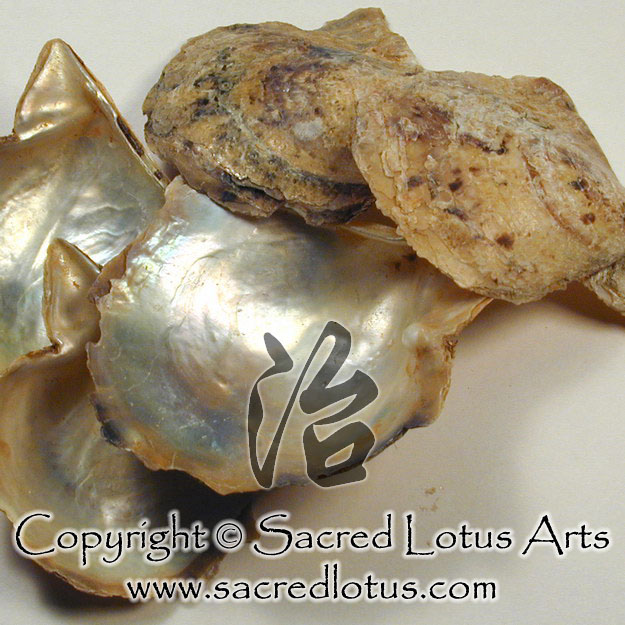
Concha Margaratiferae Mother of Pearl
Materia Medica Data
- Temperature
- Cold
- Nature & Flavour
- Sweet, Salty, Cold
- Channels Entered
- HT, LIV
- Latin (pharmaceutical)
- Concha Margaratiferae
- Chinese
- 珍珠母
- Tone Marks
- zhēn zhū mŭ
Chinese Herb Actions
What is Zhen Zhu Mu used for in Chinese medicine?
Zhen Zhu Mu (mother-of-pearl, the nacre layer of the pearl-oyster shell) is a sweet, salty, cold substance that calms the Liver and anchors floating Liver yang, settles the spirit, and clears Liver heat to brighten the eyes. Its heaviest traditional emphasis is Liver-yang-rising headache and dizziness, though it also eases palpitations and insomnia and treats red, painful eyes from Liver-channel heat.
Its main traditional actions:
- Calms the Liver, anchors/subdues Liver yang — headache (especially temple/vertex), dizziness, vertigo, and tinnitus from Liver-yang rising; its heavy, salty, cold, descending nature is described as weighing down excess rising yang.
- Settles the spirit, calms fright — palpitations, insomnia, anxiety and irritability tied to Liver-yang or Heart-disturbed patterns; a milder, more affordable complement to Zhen Zhu (Pearl) for this action.
- Clears Liver heat, brightens the eyes, removes visual obstruction — red, swollen, painful, or photophobic eyes and blurred vision/film from Liver-channel heat; commonly paired with other eye-clearing, Liver-cooling herbs.
- Calcined form (processed, topical/secondary use) — heated until crisp and friable, the calcined shell is applied as a fine powder to astringe and promote healing of eczema, itching skin, and non-healing sores; contemporary practitioner sources also describe it easing excess stomach acidity. This is distinct from the raw form's internal Liver/spirit actions above.
Source: Sacred Lotus Sacred Lotus sources & references (category, properties, channels); consensus of published Chinese materia medica references (Bensky/Chen & Chen–style); cross-checked against contemporary practitioner references for the calcined-form use. Traditional-use framing; not medical advice.
Chinese Herb Dosage
What is the typical dosage of Zhen Zhu Mu?
Commonly 10–25 g in decoction (some references extend to 30 g), always crushed and cooked first (先爍, xiān jiān) for 20–30 minutes before the other herbs are added — because the shell is a hard, dense mineral-type material that needs prolonged boiling to release its constituents into the decoction. As a finely levigated powder (taken in pills or capsules), the dose is much smaller, roughly 1.5–3 g.
Note: A minority of contemporary practitioner references give a wider decoction range extending toward 60 g cook-first. We keep 10–25 g (up to ~30 g) as the primary range since it reflects the majority materia medica consensus, and flag the wider figure as a real variant rather than an error.
Source: consensus of published Chinese materia medica references; cross-checked against contemporary practitioner reference sites. Reference only — not a prescription.
Chinese Herb Contraindications & Cautions
Are there cautions for Zhen Zhu Mu?
As a cold, heavy, settling mineral-type substance, Zhen Zhu Mu is traditionally avoided or used cautiously in Spleen/Stomach deficiency-cold — poor appetite, loose stools, and cold limbs — consistent with general cautions for the “anchor, settle, and calm the spirit” category. Several contemporary practitioner references also advise caution in pregnancy.
- Digestive caution — its cold, heavy nature can aggravate an already weak, cold Spleen/Stomach; traditionally combined with warming/Spleen-supporting herbs when used in such a constitution, and best used under a qualified practitioner.
- Pregnancy (reference note) — multiple contemporary practitioner references advise caution in pregnancy, but we could not confirm this as an explicit classical-text contraindication; treated here as a secondary-source precaution rather than a confirmed classical rule.
- Shell/mollusk-derived (reference note) — an animal/shellfish-derived material; not suitable for strict vegans, and sourcing should be disclosed to practitioners working with shellfish-sensitive patients.
- Preparation — must be crushed and cooked first (see dosage) for its dose to be properly released; its mineral density and preparation requirements make it unsuitable for casual self-dosing.
Source: consensus of published Chinese materia medica references (category-level cautions); contemporary practitioner references for the pregnancy note (flagged as secondary-source, not confirmed classical). Reference disclosures, not usage instructions.
Chinese Herb Toxicity & Overdose
Low at traditional doses. The material is predominantly calcium carbonate (roughly 90–95%) with a small fraction of organic conchiolin protein, and no significant classical or modern toxicity is reported for the raw or calcined shell at standard decoction doses. The more established concern is not intrinsic toxicity but marine-sourcing quality control: a 2023 review of heavy-metal risk in marine Chinese medicines found that Margaritifera Concha (Zhen Zhu Mu) is one of the 11 marine materials listed in the 2020 Chinese Pharmacopoeia but — unlike Margarita (Zhen Zhu, pearl), which does have an established heavy-metal inspection standard — it currently lacks a specific heavy-metal inspection item in its own quality standard, a gap the review flags for future quality-control work.
Source: Guo et al. 2023, Chinese Medicine 18:73 (heavy-metal quality-control review of marine TCM), DOI 10.1186/s13020-023-00776-y, PMC 10276398. Reference note, not a safety guarantee.
Herb-Drug Interactions
No well-established clinical herb–drug interactions are documented for Zhen Zhu Mu specifically. As a calcium-carbonate-rich mineral/shell material, it carries the general precaution given for other calcium-rich mineral substances: taking it close in time to certain oral medications (for example tetracycline-class antibiotics, thyroid hormone, or iron supplements) could in principle reduce their absorption via calcium binding, so separating dose timing by a couple of hours is a reasonable practitioner precaution. This is a general pharmacological caution extrapolated from its calcium-carbonate content, not a demonstrated clinical interaction for Zhen Zhu Mu itself. (Flagged for practitioner confirmation.)
Western / Biomedical Research
Chinese Herb Clinical Studies & Research
Provided as research context — a summary of published biomedical study, not a therapeutic or medical claim.
Is there modern research on Zhen Zhu Mu (Concha Margaritiferae)?
Yes — mostly preclinical (animal/lab) research into the shell’s nacre and matrix proteins, offering some pharmacological support for its traditional sedative and skin-healing uses, alongside a documented quality-control gap; no human clinical trials of Zhen Zhu Mu itself were located.
- Sedative / anticonvulsant (preclinical) — a 2016 mouse study found that nacre (mother-of-pearl) powder and its protein fractions, alongside pearl powder, down-regulated brain 5-HT3 receptor expression and up-regulated GABA-B levels, reduced spontaneous locomotor activity, and prolonged the time to drug-induced convulsions — findings offered as pharmacological support for the traditional use of nacre as a settling/sedative substance. Animal study, not clinical evidence.
- Matrix-protein bioactivity (preclinical review) — a 2021 review of nacre and pearl matrix proteins summarizes laboratory/animal evidence for osteogenic (bone-cell), antioxidant, anti-inflammatory, and wound-healing/fibroblast-migration activity, and notes nacre draws particular research interest as a lower-cost, waste-utilization alternative to pearl for these applications. Laboratory and animal evidence, not human clinical proof.
- Quality control / heavy metals — a 2023 review of heavy-metal risk in marine Chinese medicines lists Margaritifera Concha among the 11 marine materials in the 2020 Chinese Pharmacopoeia but finds it currently lacks an established heavy-metal inspection standard, unlike Margarita (pearl) — a recognized regulatory gap rather than a demonstrated safety problem (see Toxicity).
Human clinical evidence for Zhen Zhu Mu itself is currently absent; existing support is preclinical.
Sources: DOI 10.1016/j.jep.2016.01.039, PMID 26826326 (nacre/pearl sedative–anticonvulsant activity, mouse model); DOI 10.3389/fbioe.2021.649665, PMID 33959598, PMC 8095667 (nacre matrix-protein bioactivity review); DOI 10.1186/s13020-023-00776-y, PMC 10276398 (heavy-metal quality-control review, marine TCM). Research context, not a therapeutic claim.
Chinese Herb Notes
How is Zhen Zhu Mu different from Zhen Zhu (Pearl)?
Zhen Zhu Mu is the mother-of-pearl shell/nacre lining of the pearl oyster, not the pearl itself — it is far more affordable and available than Zhen Zhu, used in much larger decocted doses, and its traditional emphasis is on anchoring Liver yang (headache, dizziness, tinnitus) rather than on settling the Heart spirit, even though it shares Zhen Zhu’s category, flavor profile, and channels.
- Zhen Zhu Mu (Mother-of-Pearl) — the shell’s nacre layer; ~10–25 g (up to ~30 g), a mineral-type decoction ingredient cooked first before the other herbs; primary emphasis on subduing Liver yang, with secondary spirit-calming and eye-clearing actions.
- Zhen Zhu (Pearl) — the concretion itself; ~0.1–0.3 g, levigated powder in pills/capsules, never decocted; the stronger and far more costly choice, emphasized for settling the Heart spirit and for topical flesh-generating/sore-healing use.
- Shared ground — both are Sweet, Salty, Cold; enter the Heart and Liver channels; both belong to the “Substances that Anchor, Settle, and Calm the Spirit” category and both clear Liver heat to brighten the eyes.
Raw vs. calcined processing: raw Zhen Zhu Mu (crushed, decocted) is used for its internal Liver-yang/spirit actions; the calcined form (Duan Zhen Zhu Mu — heated until crisp and friable) shifts toward topical astringent/wound-healing use and is easier to grind to a fine powder.
Common combinations: for Liver-yang headache and dizziness, traditionally combined with other Liver-calming/wind-extinguishing herbs such as Gou Teng, Bai Shao, and Ju Hua; for Heart-spirit disturbance, paired with Long Gu and Long Chi (Fossilized Mammal Bones/Teeth). This Zhen Zhu Mu + Long Chi anchoring pair is the core of the classical formula named for it, Zhen Zhu Mu Wan (Mother-of-Pearl Pill, from Pu Ji Ben Shi Fang, Song dynasty), which combines it with Heart-nourishing herbs (Suan Zao Ren, Bai Zi Ren, Fu Shen) and blood-nourishing herbs (Shu Di Huang, Dang Gui). (Traditional formula context, not treatment advice; this formula is not currently linked in the Sacred Lotus formula database.)
Source: Sacred Lotus (category/properties/channels for both herbs; cross-referenced with zhen-zhu-pearl content); consensus of published Chinese materia medica references for the pearl/mother-of-pearl differentiation and processing; secondary practitioner references for the classical formula context.
Sources & References
Compiled and edited by Thomas Dehli, Founder & Editor, Sacred Lotus Updated
The information here is referenced from numerous sources — teachers, practitioners, class notes from Five Branches University, the books below, and the published research literature, with citations given as resolvable PubMed identifiers. Where sources disagree, I have flagged the discrepancies directly. If facts couldn't be verified, I have left them out. How we source our content.
Reference information for students and practitioners — not medical advice. Consult a qualified practitioner. Terms of use.
Chinese Herbs Books & References
 https://amzn.to/3WfB3DK
 https://amzn.to/3DR1VUh
 https://amzn.to/42aMz73
 https://amzn.to/3PuD4bt