
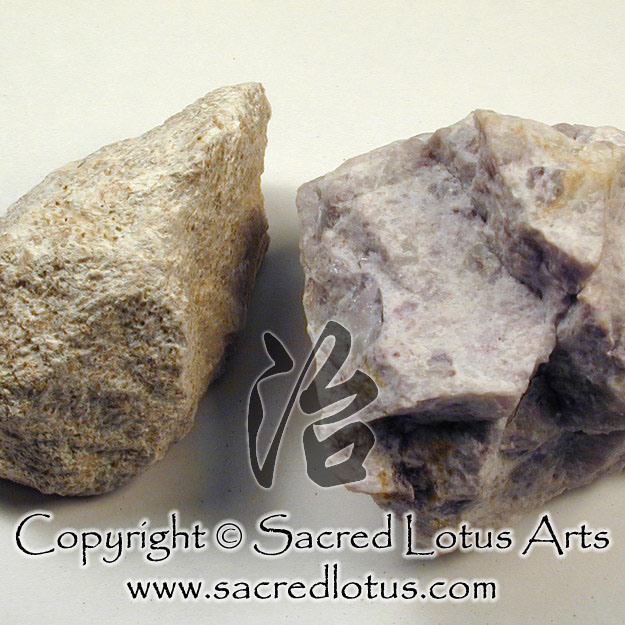
Materia Medica Data
- Temperature
- Warm
- Nature & Flavour
- Sweet, Warm
- Channels Entered
- HT, LIV
- Latin (pharmaceutical)
- Fluoritum
- Chinese
- 紫石英
- Tone Marks
- zĭ shí yīng
- Translation
- Purple Stone Radiance
Chinese Herb Actions
What is Zi Shi Ying (Fluorite) used for in Chinese medicine?
Zi Shi Ying (fluorite) is a heavy mineral that anchors and calms the spirit, warms the Lungs to ease cold-type wheezing and cough, and warms the Kidney/uterus for infertility and deficiency-cold uterine bleeding. It is unusual among the spirit-settling minerals for being warm rather than cool or neutral, which is why it is chosen specifically for fright, palpitations, and insomnia set against an underlying cold picture.
Its main traditional actions:
- Anchors and calms the spirit (Heart) — fright, restlessness, palpitations, anxiety, insomnia, and disorientation, especially from Heart-blood deficiency or Liver yang stirring.
- Warms the Lungs and directs qi downward — cold-type chronic cough and wheezing with thin, watery (copious) sputum from Lung deficiency-cold.
- Warms the Kidney/uterus and unblocks the Chong and Ren vessels — infertility from a cold uterus, and deficiency-cold uterine bleeding or excessive menstruation.
Source: standard materia medica (Bensky-lineage TCM references); identity confirmed against the Sacred Lotus record. Traditional-use framing; not medical advice.
Chinese Herb Dosage
What is the typical dosage of Zi Shi Ying, and how is it prepared?
Roughly 9–15 g in decoction, with some references citing a wider range of about 6–18 g. As a hard mineral, it must be crushed into small pieces and decocted first (“打碎先燭,” dá suì xiān jiān) — simmered roughly 20–30 minutes before the other herbs are added, so its minerals can release into the decoction.
Both raw (sheng) and vinegar-calcined (cu duan) forms are used; the calcined form is described in some sources as concentrating the Lung- and uterus-warming action, though it appears less often in clinical use than the raw mineral.
Source: standard materia medica ranges; preparation practice for heavy mineral substances. Reference only — not a prescription.
Chinese Herb Contraindications & Cautions
Are there cautions for Zi Shi Ying?
Zi Shi Ying is contraindicated in yin-deficiency patterns with effulgent (empty) heat and in Lung-heat cough, since its warming action would aggravate heat. As with other dense mineral substances, it is best used short-term rather than continuously, and under a qualified practitioner — particularly during pregnancy, given both its uterus-warming action and general mineral-drug caution around prolonged use.
- Yin-deficiency fire — avoid; the herb’s warming nature would aggravate deficiency heat.
- Lung-heat cough — avoid; reserved for cold-type, not heat-type, cough/wheezing.
- Prolonged use — as with other hard mineral drugs, use is traditionally kept short-term/cyclical rather than continuous; see toxicity note below.
- Pregnancy / pediatric use — professional supervision advised.
Source: standard materia medica cautions for warming spirit-calming minerals.
Chinese Herb Toxicity & Overdose
Low at normal, short-term therapeutic doses when authenticated, properly processed material is used. Zi Shi Ying is chemically fluorite — calcium fluoride (CaF₂) — and is not classified among the herbs the Chinese Pharmacopoeia flags as acutely toxic. The main practical concerns, as with mineral drugs generally, are sourcing/authentication (only medicinal-grade, properly crushed and processed material should be used) and quality control. Because the mineral itself contains fluoride, the general fluoride-toxicology literature (not specific to Zi Shi Ying) describes a dose- and duration-dependent risk of dental and skeletal fluorosis with excessive or prolonged fluoride intake from any source — the traditional caution against continuous, long-term use of this herb is consistent with that general chemistry, though no case reports specifically linking Zi Shi Ying use to fluorosis were found in this research.
Source: mineralogical identity (calcium fluoride); DOI 10.3390/ma16031242, PMID 36770248, PMC 9920376 (narrative review of fluoride compound safety, general toxicology – not Zi Shi Ying-specific). General mineral-safety context, not a documented adverse-event report.
Herb-Drug Interactions
No well-established clinical herb–drug interactions specific to Zi Shi Ying are documented. As an insoluble oral mineral, general precautions applied to other hard mineral drugs — spacing administration from other medications and favoring quality-controlled, authenticated material — are reasonable but precautionary rather than evidence of a demonstrated interaction. (Flagged for practitioner confirmation.)
Western / Biomedical Research
Chinese Herb Clinical Studies & Research
Provided as research context — a summary of published biomedical study, not a therapeutic or medical claim.
Is there modern research on Zi Shi Ying (Fluoritum)?
Essentially none specific to the medicinal mineral itself — direct pharmacological or clinical study of Zi Shi Ying is sparse to absent in PubMed, so modern use remains grounded in classical materia medica and pharmacopeial processing rather than clinical trials. What is available is general chemistry/toxicology context rather than herb-specific research:
- Mineral identity/chemistry — Zi Shi Ying is fluorite, calcium fluoride (CaF₂). A 2023 narrative review of fluoride compound safety describes dose-dependent effects of fluoride exposure from any source, including dental and skeletal fluorosis mechanisms with excessive or prolonged intake; this is general fluoride toxicology, not a study of the TCM substance.
- Mineral-medicine quality control (general, not herb-specific) — a 2021 survey of heavy-metal contamination across herbal medicines found roughly 30% of sampled materials exceeded Chinese Pharmacopoeia safety limits for at least one metal, underscoring why authenticated sourcing matters for mineral-derived crude drugs broadly.
No dedicated pharmacological, toxicological, or clinical study of Zi Shi Ying (Fluoritum) as a medicinal substance was located; the evidence base here is essentially traditional and pharmacopeial.
Sources: DOI 10.3390/ma16031242, PMID 36770248, PMC 9920376 (fluoride compound safety review, general toxicology); PMID 33597875 (heavy metal contamination in herbal medicines, Frontiers in Pharmacology, 2021). Research context, not a therapeutic claim.
Chinese Herb Notes
How is Zi Shi Ying different from other spirit-calming minerals, and what does it combine with?
Zi Shi Ying is distinctive among the anchor/settle/calm-spirit minerals for being warm and for combining spirit-calming with warming the Lung and the uterus — most of its category-mates (Long Gu, Mu Li, Ci Shi, Zhen Zhu Mu) are neutral or cool and settle without a warming action.
How it compares with its neighbors:
- vs Long Gu / Mu Li — these also anchor and settle the spirit, but are neutral/cool and do not warm the Lung or uterus; Zi Shi Ying is chosen instead when the underlying picture is cold.
- vs Ci Shi — Ci Shi is cold and pairs spirit-anchoring with subduing Liver yang and aiding the Kidney’s grasp of qi; Zi Shi Ying pairs spirit-anchoring with warming.
Sacred Lotus-confirmed formula: Zi Shi Ying is an ingredient in Zhen Ling Dan (“Rouse the Spirit Special Pill”), consistent with its spirit-settling category.
Note on channels: Standard materia medica (matching the herb’s full action set — Heart-spirit calming, Lung-warming, Kidney/uterus-warming) lists Zi Shi Ying as entering the Heart, Liver, Lung, and Kidney channels. Several simplified references list only Heart and Liver (reflecting the spirit-calming action alone); the Sacred Lotus Sacred Lotus sources & references currently shows Heart and Liver. This looks like a real gap rather than a naming variant, and is flagged here for owner review rather than silently changed.
Source: standard materia medica (differentiation set); Sacred Lotus formula link (Zhen Ling Dan) and channels field, queried directly.
Sources & References
Compiled and edited by Thomas Dehli, Founder & Editor, Sacred Lotus Updated
The information here is referenced from numerous sources — teachers, practitioners, class notes from Five Branches University, the books below, and the published research literature, with citations given as resolvable PubMed identifiers. Where sources disagree, I have flagged the discrepancies directly. If facts couldn't be verified, I have left them out. How we source our content.
Reference information for students and practitioners — not medical advice. Consult a qualified practitioner. Terms of use.
Chinese Herbs Books & References
 https://amzn.to/3WfB3DK
 https://amzn.to/3DR1VUh
 https://amzn.to/42aMz73
 https://amzn.to/3PuD4bt