

Chi Xiao Dou (Aduki Bean, Phaseolus)
Semen Phaseoli Calcarati Aduki Bean, Phaseolus
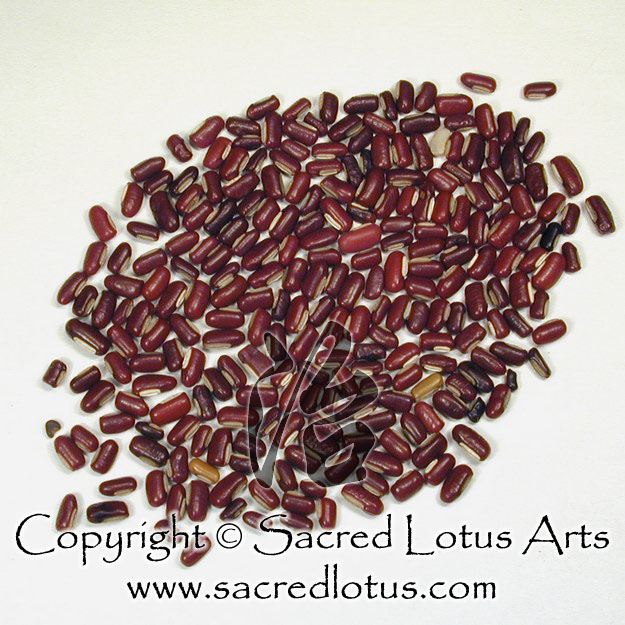
Materia Medica Data
- Temperature
- Neutral
- Nature & Flavour
- Sweet, Sour, Neutral
- Channels Entered
- HT, SI
- Latin (pharmaceutical)
- Semen Phaseoli Calcarati
- Chinese
- 赤小豆
- Tone Marks
- chì xiăo dòu
- Translation
- Dark Red Little Bean
Chinese Herb Actions
What is Chi Xiao Dou used for in Chinese medicine?
Chi Xiao Dou is the small red aduki bean, and its classical job is promoting urination and reducing swelling. Sweet, sour and neutral, entering the Heart and Small Intestine channels, it sits among the herbs that regulate water and drain dampness. It is used for oedema, ascites, abdominal fullness, difficult urination and leg-qi swelling from water accumulation — in short, for fluid that is not moving.
Its traditional actions as recorded here:
- Promotes urination and reduces swelling — oedema, ascites, abdominal swelling and fullness, urinary difficulty, and leg-qi oedema from water accumulation. This is the primary action and the reason the herb sits where it does.
- Clears damp-heat and relieves jaundice — for mild jaundice from damp-heat accumulation.
- Disperses blood stagnation, reduces swelling and toxin, drains pus — erysipelas, carbuncles, furuncles, sores and toxic swellings. Applied externally as well as taken internally; the powdered bean made into a paste is the traditional topical form.
The sour flavour is the distinguishing detail. Most beans in the materia medica are simply sweet. Chi Xiao Dou is recorded here as sweet and sour, and that sourness is traditionally credited with its unusually strong draining action — the reason it is the bean reached for when the problem is standing water rather than heat or weakness.
The name. Chi xiao dou translates as “dark red little bean” — a plain physical description, and a useful one, since the herb should be a small, deep-red bean and not one of the many other beans it gets confused with.
Source: Sacred Lotus sources & references (recorded actions, nature/flavour, channels, category and translation); cross-referenced against multiple online sources and materia medica consensus (Bensky, Materia Medica 3rd ed.; Chen & Chen). Traditional-use framing; not medical advice.
Chinese Herb Dosage
What is the typical dosage of Chi Xiao Dou?
10–30 g in decoction, or 9–30 g depending on the source, used internally or topically — both figures are carried in our record and they describe the same range. As with any medicinal that is also a staple food, the number is a guide for its use inside a decoction rather than a limit on eating red beans: a bowl of red bean soup contains far more than 30 g and nobody treats it as a dose.
- 10–30 g / 9–30 g in decoction internally. Higher doses within the range go with the oedema indications.
- Part used: the dried ripe seed — our record gives the pharmaceutical Latin as Semen Phaseoli Calcarati.
- External use — the bean is ground to a powder and made into a paste with water or another liquid, applied to sores, swellings and bruises. Our own legacy reference notes record this topical use in older Chinese clinical reports.
- As a food — aduki beans are boiled into soups and porridges and made into the sweet red bean paste used across East Asian confectionery. Culinary quantities are not measured as doses.
Source: Sacred Lotus sources & references (both recorded dosage ranges and the recorded internal/topical note); preparation conventions per materia medica consensus, cross-referenced against multiple online sources. Reference only — not a prescription.
Chinese Herb Contraindications & Cautions
Are there cautions for Chi Xiao Dou?
The recorded caution is that it leaches the yin and yang fluids — it should not be used in yin deficiency, or where there is no dampness to drain. That is the standard limitation on a strong water-draining herb: if there is no excess fluid, what it removes is fluid the body needed.
- Yin deficiency — do not use. A draining herb worsens a dryness pattern.
- No dampness present — do not use. Our record is explicit that this herb is for water accumulation, not for general use.
- Long-term use — the traditional note carried here is that its strong draining action “will dry people out” over extended use. It is a herb for a presentation, not a daily supplement.
- Pregnancy — our record states that overdose can lead to miscarriage. Medicinal-dose use in pregnancy should be under professional supervision only. This concerns the herb at medicinal dose, not red beans eaten as food.
- Allergy — allergic reactions are recorded here, including itching, flushing, nausea and vomiting, palpitations and hives. Legume allergy is a real phenomenon and these reports are consistent with it.
- Oedema has causes. Swelling, ascites and jaundice can signal heart, liver or kidney disease. Persistent or unexplained swelling is a matter for medical assessment, not self-treatment. Framing note.
Source: Sacred Lotus sources & references (recorded cautions on fluid leaching, yin deficiency and absence of dampness; recorded overdose/miscarriage and allergy entries; the recorded long-term-use note); cross-referenced against multiple online sources and materia medica consensus. Medical framing added editorially. Neutral reference facts, not usage instructions.
Chinese Herb Toxicity & Overdose
Is Chi Xiao Dou toxic?
No — aduki bean is a food, eaten as a staple across East Asia, and it is not classified as a toxic herb. Two specific items are nevertheless recorded in our own reference data and are repeated here as neutral facts: overdose has been associated with miscarriage, and allergic reactions have been reported, including pruritus, flushing, nausea and vomiting, palpitations and urticaria. Neither describes intrinsic toxicity of the bean; the first is a consequence of a strongly draining herb taken to excess in pregnancy, and the second is an individual hypersensitivity of the kind seen with legumes generally.
The ordinary food-safety points for any pulse also apply: dried beans are cooked thoroughly before eating, and raw or undercooked legumes are not eaten. That is a kitchen matter rather than a property of the herb.
Source: Sacred Lotus sources & references (recorded toxicity entry — overdose/miscarriage and the listed allergic reactions); food and nutritional profile per PMID 36144812, PMC 9506481, DOI 10.3390/molecules27186079. Reference note, not a safety guarantee.
Herb-Drug Interactions
No well-established clinical herb–drug interactions are documented for Chi Xiao Dou. No interaction study was located, and none would ordinarily be expected for a bean eaten as food. Two precautionary points, neither of them a demonstrated interaction: the herb’s traditional action is promoting urination, so combination with prescribed diuretics is worth raising with a prescriber, particularly where fluid balance or electrolytes are already being managed; and adzuki bean and its constituents have been studied for effects on glucose metabolism in preclinical and narrative-review work (PMID 38276567), so patients on glucose-lowering medication who begin taking the herb at medicinal dose are reasonably monitored. (Flagged for practitioner confirmation.)
Source: PMID 38276567, PMC 10820388, DOI 10.3390/nu16020329. Precautionary reference, not documented clinical interactions.
Western / Biomedical Research
Chinese Herb Clinical Studies & Research
Provided as research context — a summary of published biomedical study, not a therapeutic or medical claim.
Is there modern research on Chi Xiao Dou (adzuki bean)?
Yes, but it is overwhelmingly food science and nutrition research on the bean rather than research on Chi Xiao Dou as a Chinese herb. Adzuki bean is well characterised: rich in starch, with a protein fraction notable for high lysine content that complements cereal-based diets, plus polysaccharides and polyphenols, with composition varying substantially between varieties (PMID 36144812). A comprehensive food-science review covers its chemical composition, physicochemical properties, reported health benefits and food applications (PMID 35365946).
- What the preclinical literature reports — antioxidant, antibacterial and anti-inflammatory activity, and effects in models of diabetes, diabetes-related kidney damage, obesity and high-fat-diet-induced cognitive decline (PMID 36144812). A 2019 study reported that an adzuki bean water extract attenuated obesity in mice by modulating macrophage polarisation and gut microbiota composition (PMID 31574574). A 2024 narrative review examines the bean and its bioactive compounds in relation to type 2 diabetes and glucose metabolism (PMID 38276567). All cell and animal work.
- The one that touches the traditional use — a 2025 review of food-medicine homologous herbs in diabetic kidney disease discusses this bean directly, describing it as one of the common beans used as a Chinese herb for its decongestive (swelling-reducing) effect, and citing work in which seed-coat polyphenols reduced a fibrosis-associated signal in a diabetic-nephropathy rat model (PMID 41459479). It is preclinical, and it concerns the kidney rather than oedema as Chinese medicine defines it — but it is the closest adjacency to the classical water-draining indication that this review located.
- Formula-level chemistry — a 2025 study profiled Chi Xiao Dou Dang Gui San (the bean with Dang Gui) by liquid chromatography–tandem mass spectrometry, tentatively characterising 97 constituents and finding that the flavonoids and triterpenoid saponins in the formula come specifically from the bean rather than from Dang Gui (PMID 40907972). Ma Huang Lian Qiao Chi Xiao Dou Tang, the other classical formula containing this herb, has its own modern research literature covering eczema and atopic dermatitis models (PMID 33645094, PMID 37783411) and liver failure models (PMID 36359765). These study whole formulas, not the single herb.
- Crop genetics — a chromosome-level reference genome of adzuki bean with resequencing of 322 accessions was published in 2024 (PMID 38497586), and the domestication history of the Vigna genus, including both adzuki and rice bean, has been reviewed (PMID 36338960). Relevant here mainly because they underpin the species-identity question flagged in the notes.
- What is not established — no controlled human trial of Chi Xiao Dou for oedema, jaundice or any other traditional indication was located. The traditional use rests on materia medica consensus and long practice.
Legacy clinical reports held in our own reference data. Three older Chinese-language clinical observations are recorded on this site: topical application in mumps (Ha Er Bing Zhong Yi, 1965), a topical plaster for swelling, bruises, strains and sprains in 52 patients (Zhong Xi Yi Jie He Za Zhi, 1985), and a lactation study in 20 patients (Chi Jiao Yi Shi Za Zhi, 1975). These are small, uncontrolled, mid-twentieth-century reports in journals that are not indexed in the international databases, so they could not be independently verified during this review. They are retained because they are part of the site’s long-standing reference record and they document the traditional topical use, but they should be read as historical case reports rather than as evidence.
Sources: PMID 36144812, PMC 9506481, DOI 10.3390/molecules27186079 (nutritional composition, efficacy and processing of Vigna angularis); PMID 35365946, DOI 10.1111/1541-4337.12945 (adzuki bean composition, properties and food applications review); PMID 38276567, PMC 10820388, DOI 10.3390/nu16020329 (adzuki bean and glucose metabolism); PMID 31574574, DOI 10.1002/mnfr.201900626 (adzuki bean water extract, obesity and gut microbiota); PMID 41459479, PMC 12738359, DOI 10.3389/fimmu.2025.1698240 (food-medicine homologous herbs in diabetic kidney disease); PMID 40907972, DOI 10.1002/rcm.10134 (Chixiaodou Danggui San chemical profiling); PMID 33645094, PMID 37783411, PMID 36359765, PMC 9656135 (Ma Huang Lian Qiao Chi Xiao Dou Tang formula research); PMID 38497586, PMC 11258975, DOI 10.1111/pbi.14337 (adzuki bean reference genome); PMID 36338960, PMC 9634637, DOI 10.3389/fgene.2022.960200 (Vigna domestication). Plus Sacred Lotus sources & references for the three legacy clinical reports noted above. Research context, not a therapeutic claim.
Chinese Herb Notes
How is Chi Xiao Dou different from Lu Dou (mung bean)?
Different bean, different category, different job. Chi Xiao Dou drains water; Lu Dou clears summerheat. They are both small beans, both foods, and both held on this site — but they are filed in entirely different parts of the materia medica, and swapping them is not a small adjustment.
- Chi Xiao Dou (aduki bean; sweet, sour, neutral; Heart and Small Intestine) — among the herbs that regulate water and drain dampness. Promotes urination and reduces swelling and oedema. The draining one.
- Lu Dou (mung bean; sweet, cool; Heart and Stomach) — among the herbs that clear and relieve summerheat. Relieves summerheat and thirst, and carries the classical toxin-resolving role. The cooling one.
- Bai Bian Dou (hyacinth bean; sweet, neutral; Spleen and Stomach) — also held here, in the summerheat category. Strengthens the Spleen and transforms dampness. The strengthening one.
On the classical “three beans”: older texts commonly group Chi Xiao Dou with Lu Dou and Hei Dou (black soybean) as three beans that all promote urination, reduce oedema, resolve toxicity and treat skin lesions, with Chi Xiao Dou the strongest at draining water because of its sour flavour — and correspondingly the one that will dry a person out if taken long term. Hei Dou is not currently held in the Sacred Lotus herb records, so no cross-link is offered for it here.
Which formulas contain Chi Xiao Dou?
Two formulas in the Sacred Lotus records list it: Xuan Bi Tang (Disband Painful Obstruction Decoction) and Gua Di San (Melon Pedicle Powder). Beyond those, the two classical prescriptions most associated with this herb are Ma Huang Lian Qiao Chi Xiao Dou Tang, from the Shang Han Lun, used for jaundice and damp-heat skin presentations, and Chi Xiao Dou Dang Gui San, from the Jin Gui Yao Lue, a two-ingredient formula of the bean with Dang Gui. Both are well documented and both remain in modern use — the first is the subject of a substantial modern research literature — but neither is currently held in the Sacred Lotus formula records, so no cross-link is offered. (Traditional formula context, not treatment advice.)
Botanical identity — two different beans are sold as “Chi Xiao Dou”, and this is a real substitution issue. The bean generally understood as aduki (adzuki) is Vigna angularis (Willd.) Ohwi & H. Ohashi. In Chinese herbal commerce, however, the name Chi Xiao Dou is also applied to Vigna umbellata (Thunb.) Ohwi & H. Ohashi — the rice bean, a longer, narrower, related but distinct pulse. The conflation reaches the research literature: a 2025 review lists the herb as “Semen Phaseoli Angularis (Chi Xiao Dou)” while giving its botanical source as Vigna umbellata, and separately notes that V. umbellata is one of the common beans used as a Chinese herb for its decongestive (swelling-reducing) effect (PMID 41459479). Our own record gives the Latin as Semen Phaseoli Calcarati and the common name as Aduki Bean, Phaseolus, i.e. it identifies the herb as adzuki. That identity field has not been altered; it is flagged here so that readers are not surprised when a supplier, a text or a paper attaches a different species name to the same herb. The genus name Phaseolus in the Latin is itself historical — the Asian Vigna beans were formerly classified under Phaseolus and were later moved to Vigna, which is why so many older pharmaceutical Latin names for these beans still read “Phaseoli” (PMID 36338960). Practically: authenticated material matters, and “small red bean” on a label is not by itself an identification.
Source: Sacred Lotus sources & references (records for Chi Xiao Dou, Lu Dou and Bai Bian Dou including category, nature/flavour and channels; the recorded three-bean note; the Xuan Bi Tang and Gua Di San formula links; herb records checked and Hei Dou not held; formula records checked and Ma Huang Lian Qiao Chi Xiao Dou Tang and Chi Xiao Dou Dang Gui San not held); species conflation per PMID 41459479, PMC 12738359, DOI 10.3389/fimmu.2025.1698240; Phaseolus-to-Vigna reclassification per PMID 36338960, PMC 9634637, DOI 10.3389/fgene.2022.960200; cross-referenced against multiple online sources and materia medica consensus.
Sources & References
Compiled and edited by Thomas Dehli, Founder & Editor, Sacred Lotus Updated
The information here is referenced from numerous sources — teachers, practitioners, class notes from Five Branches University, the books below, and the published research literature, with citations given as resolvable PubMed identifiers. Where sources disagree, I have flagged the discrepancies directly. If facts couldn't be verified, I have left them out. How we source our content.
Reference information for students and practitioners — not medical advice. Consult a qualified practitioner. Terms of use.
Chinese Herbs Books & References
 https://amzn.to/3WfB3DK
 https://amzn.to/3DR1VUh
 https://amzn.to/42aMz73
 https://amzn.to/3PuD4bt