
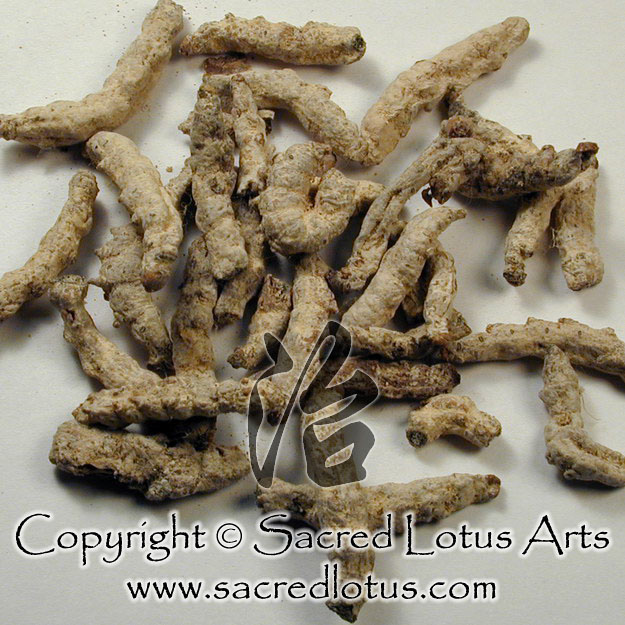
Bombyx Batryticatus Body of Sick Silkworm
Materia Medica Data
- Temperature
- Neutral
- Nature & Flavour
- Spicy, Salty, Neutral
- Channels Entered
- LIV, LU
- Latin (pharmaceutical)
- Bombyx Batryticatus
- Chinese
- 僵蚕
- Tone Marks
- jiāng cán
Chinese Herb Actions
What is Jiang Can (Silkworm) used for in Chinese medicine?
Jiang Can (Bombyx Batryticatus) is a spicy, salty, neutral substance traditionally used to extinguish internal wind and stop spasms, tremors, and convulsions — and, because it also transforms phlegm, it is favored where wind is joined by phlegm. Entering the Liver and Lung channels, it additionally dispels wind to relieve headache, itch, sore throat, and hoarseness, and softens phlegm nodules such as scrofula.
The substance itself is the dried body of the silkworm (Bombyx mori larva) that has stiffened after infection by the fungus Beauveria bassiana (white muscardine) — hence “body of sick silkworm.”
Its main traditional actions:
- Extinguishes wind, stops spasms & transforms phlegm — childhood convulsions, seizures, and facial paralysis (wind-phlegm deviation of the eye and mouth); especially where wind and phlegm combine.
- Dispels wind, stops pain & relieves the throat and skin — wind-heat headache, red eyes, sore or hoarse throat, and wind-type skin itching and rashes.
- Transforms phlegm, dissipates nodules — scrofula (luo li), phlegm nodules, and goiter.
Source: standard materia medica consensus (Bensky et al., Chinese Herbal Medicine: Materia Medica, 3rd ed.; “Substances that Extinguish Wind and Stop Tremors”). Traditional-use framing; not medical advice.
Chinese Herb Dosage
What is the typical dosage of Jiang Can?
3–9 g in decoction. As a powder (a common form for this substance), 1–1.5 g per dose. It is used both raw and dry-fried (chao), the fried form being gentler and often preferred for internal wind and phlegm patterns.
Source: standard materia medica ranges (Bensky et al., 3rd ed.). Reference only — not a prescription.
Chinese Herb Contraindications & Cautions
Are there cautions or contraindications for Jiang Can?
Jiang Can is generally well tolerated, but it is not suited to wind arising from deficiency. It is traditionally used with caution — or avoided — where convulsions or spasms stem from blood or yin deficiency rather than wind-phlegm or wind-heat, and where there is no phlegm or heat sign to warrant it. Practitioner caution is also reasonable in those with known sensitivity to animal- or insect-derived materia medica, as occasional allergic reactions have been reported.
Source: standard materia medica consensus (Bensky et al., 3rd ed.); the allergy note reflects reported case-level sensitivity and is flagged for practitioner confirmation.
Chinese Herb Toxicity & Overdose
Low. Jiang Can is regarded as having low toxicity at customary doses. As with all animal- and insect-derived materia medica, clean sourcing, correct species identity, and proper processing are the practical safety considerations; a modern pharmacology review notes that its toxic constituents and quality control still warrant further study.
Source: standard materia medica consensus; PubMed 29053625 / PMCID PMC 6151799 (review noting toxic constituents and quality control need further study). Sourcing note.
Herb-Drug Interactions
No well-established clinical herb–drug interactions are documented. There is a theoretical, mechanism-based bleeding-risk caution: laboratory review reports anticoagulant activity for Bombyx batryticatus (see Research). On that basis, practitioner caution is reasonable alongside anticoagulant or antiplatelet drugs (e.g., warfarin, DOACs, aspirin, clopidogrel) or around surgery. This is a theoretical, mechanism-based caution, not an established clinical interaction. (Flagged for practitioner confirmation before publishing — absence of documented interactions is not proof of safety.)
Western / Biomedical Research
Chinese Herb Clinical Studies & Research
Provided as research context — a summary of published biomedical study, not a therapeutic or medical claim.
Is there modern research on Jiang Can (Bombyx batryticatus)?
Yes, but it is largely preclinical. Reported constituents include proteins and peptides, fatty acids, flavonoids, nucleosides, steroids, coumarin, and polysaccharides, and laboratory studies describe a broad range of activities that have not been established in humans.
- Comprehensive review (2017). A review of traditional uses, chemistry, pharmacology, and toxicity records traditional use for convulsions, headaches, skin prurigo, scrofula, tonsillitis, and fever, and catalogues in vitro and animal effects on the nervous system plus anticoagulant, antitumor, antibacterial/antifungal, antioxidant, and hypoglycemic activities — while flagging that bioactive and toxic constituents and quality control need further study.
- Cerebral ischemia model (preclinical, 2024). In rats with cerebral ischemia/reperfusion injury, a Bombyx batryticatus extract activated coagulation factor XII and promoted angiogenesis and neuronal recovery markers — an animal mechanistic study aligned with its traditional use in stroke, not a clinical result.
- Immunomodulation (preclinical, 2021). A protein-rich extract matured dendritic cells and promoted a Th1 T-cell response in mice, suggesting a possible immune-adjuvant role in cancer immunotherapy; this is early laboratory work.
Bottom line: modern interest centers on neuroactive, anticoagulant, and antitumor/immune signals, but the human clinical evidence base is thin. Not a basis for treatment claims.
Sources: PubMed 29053625 / PMCID PMC 6151799 (traditional uses, chemistry & pharmacology review, 2017); PubMed 37633622 (factor-XII/angiogenesis, cerebral ischemia rats, 2024); PubMed 33477499 / PMCID PMC 7831066 (dendritic-cell/Th1 immunomodulation, mice, 2021). Research context, not a therapeutic claim.
Chinese Herb Notes
How is Jiang Can different from the other wind-extinguishing herbs, and what is it combined with?
Jiang Can is the milder, phlegm-transforming member of the “extinguish wind / stop tremors” group, so it is favored where internal wind is joined by phlegm, and where there is a wind-heat component affecting the head, throat, or skin. Unlike the toxic insect wind-herbs, it is low in toxicity and adds a distinct phlegm-and-nodule reach.
How it compares within its category:
- vs Quan Xie and Wu Gong — those are stronger, slightly toxic spasm-stoppers weighted toward severe wind, convulsions, and stubborn pain; Jiang Can is gentler, additionally transforms phlegm, dispels wind-heat, and treats the throat and skin.
- vs Di Long — Di Long is cold and drains heat (best where wind arises from heat) and also calms wheezing; Jiang Can is neutral and works more on wind-phlegm and nodules.
Common combinations: with Bai Fu Zi and Quan Xie in Qian Zheng San for wind-phlegm facial paralysis (deviation of the eye and mouth); with Quan Xie for convulsions and spasms; with wind-heat herbs such as Sang Ye, Jie Geng, and Bo He for wind-heat sore throat and hoarseness; and with Bei Mu, Xia Ku Cao, and Lian Qiao to soften and dissipate scrofula and phlegm nodules.
Source: standard materia medica consensus (differentiation & classical combinations, Bensky et al., 3rd ed.).
Sources & References
Compiled and edited by Thomas Dehli, Founder & Editor, Sacred Lotus Updated
The information here is referenced from numerous sources — teachers, practitioners, class notes from Five Branches University, the books below, and the published research literature, with citations given as resolvable PubMed identifiers. Where sources disagree, I have flagged the discrepancies directly. If facts couldn't be verified, I have left them out. How we source our content.
Reference information for students and practitioners — not medical advice. Consult a qualified practitioner. Terms of use.
Chinese Herbs Books & References
 https://amzn.to/3WfB3DK
 https://amzn.to/3DR1VUh
 https://amzn.to/42aMz73
 https://amzn.to/3PuD4bt