

Shao Yao Gan Cao Tang
Peony and Licorice Decoction
- Category
- Formulas that Tonify
- Subcategory
- Formulas that Tonify the Blood
- Ingredients
- 2 herbs
Actions
What does Shao Yao Gan Cao Tang do?
Shao Yao Gan Cao Tang (Peony and Licorice Decoction) nourishes blood and yin and relaxes spasm to stop pain. It is a two-herb pair formula built on the classical principle “sour and sweet combine to transform yin” (suan gan hua yin, 酸甘化阴): Bai Shao’s sour, astringing, yin-preserving action combines with Zhi Gan Cao’s sweet, moderating, qi-tonifying action to generate fluids that moisten and nourish the sinews (jin), which the Liver governs, so they stop contracting painfully.
With only two herbs in roughly equal classical proportion, both are usually read as co-chiefs rather than a strict chief/deputy/assistant/envoy hierarchy:
- Bai Shao (bitter, sour, cool; Liver and Spleen channels) — nourishes blood, preserves and astringes yin, softens and pacifies the Liver, and directly relaxes the sinews to relieve spasm and pain.
- Zhi Gan Cao (sweet, warm; traditionally said to enter all twelve channels) — tonifies middle/Spleen qi, moderates urgency and spasm (huan), and harmonizes the pair so the sour astringency of Bai Shao does not constrain.
Together the pair generates yin fluid to nourish what is deficient while directly easing the muscle/tendon spasm that deficiency has allowed to occur.
Source: Sacred Lotus sources & references + Bensky & Barolet, Formulas & Strategies. Traditional-use framing; not medical advice.
Indications
What is Shao Yao Gan Cao Tang used for?
Shao Yao Gan Cao Tang treats spasmodic, cramping pain from blood-and-yin deficiency that leaves the sinews undernourished — classically the sudden, painful cramping of the calves and legs sometimes called “leg qi,” but the same mechanism is applied wherever muscle/tendon tissue cramps from a lack of nourishing yin-blood.
Its classic clinical presentation:
- Calf/leg cramps: sudden, painful spasmodic contraction of the calf muscles, often at night or at rest, frequently eased by pressure or warmth.
- Abdominal cramping: spasmodic abdominal pain that likewise tends to ease with pressure.
- Other spasm/pain sites: applied by extension to cramping of the hands, hypertonicity of the extremities, and other sinew-spasm pain where the underlying pattern is deficiency rather than excess.
Tongue and pulse: the tongue is typically pale, sometimes with little or no coating (Sacred Lotus records this formula’s tongue as “no tongue coat”); the pulse is classically described as thin and wiry, reflecting Liver/sinew involvement layered on deficiency.
Source: Sacred Lotus sources & references on pattern/tongue + Bensky & Barolet, Formulas & Strategies. Traditional-use framing; not medical advice.
Western Uses:
What is Shao Yao Gan Cao Tang used for in modern practice?
In modern practice Shao Yao Gan Cao Tang (known in Japan as Shakuyaku-kanzo-to) is referenced for muscle cramps and spasmodic pain — most studied for the nocturnal leg cramps common in maintenance hemodialysis and for cramping associated with lumbar spinal stenosis. A 2025 randomized crossover trial and a small 2003 preliminary study both examined it specifically for hemodialysis-related cramps, and a Japanese trial in lumbar spinal stenosis patients established a minimum effective as-needed dose.
A 2025 pharmacology review also summarizes broader modern-practice interest in gastrointestinal spasm (e.g., irritable-bowel-type cramping), gynecological cramping pain (dysmenorrhea), and neuralgia, alongside proposed multi-target mechanisms (calcium-channel and smooth-muscle effects, reduced inflammatory signaling). These biomedical correlates are offered as reference to the formula’s traditional spasm-relieving use, not as a claim that it treats any diagnosed disease; any use for a medical condition belongs with a qualified practitioner and appropriate medical care.
Source: traditional-use correlates summarized from Bensky & Barolet, Formulas & Strategies, and the research cited below; reference only, not a treatment claim.
Ingredients
2 substances in Shao Yao Gan Cao Tang — each links to its full herb monograph.
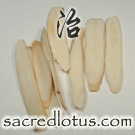
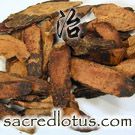
Preparation & dosage
How is Shao Yao Gan Cao Tang prepared?
Prepared as a simple water decoction of the two herbs, taken warm. Because it is used for acute spasmodic pain as often as for an ongoing pattern, it is commonly taken as-needed at the onset of cramping rather than only on a fixed schedule; a controlled dosing study found a small as-needed dose gave comparable relief to a larger daily scheduled dose (see cautions).
Source: Sacred Lotus sources & references + PubMed 27363396.
Decoction. Reference relative amounts (Sacred Lotus): Bai Shao 12-30 g; Zhi Gan Cao 9-20 g. The classical Shang Han Lun formula uses equal parts (4 liang each). For acute spasm, as-needed dosing at a lower amount has shown relief comparable to a higher scheduled daily dose in a controlled study (PubMed 27363396). Reference only.
Safety — read before use
What are the cautions for Shao Yao Gan Cao Tang?
The main documented concern is Zhi Gan Cao (licorice) itself: sustained or high-dose use can cause glycyrrhizin-related pseudoaldosteronism — hypokalemia, hypertension, and edema — particularly with prolonged daily dosing rather than short-term or as-needed use. A published case report describes severe hypokalemia requiring correction during emergency surgery after two years of continuous Shakuyaku-kanzo-to use.
- Duration/dose matters: a Japanese dosing study found a small as-needed dose gave relief comparable to a higher scheduled daily dose for muscle cramps, suggesting PRN use may reduce cumulative licorice exposure.
- Monitor potassium with prolonged use, especially alongside diuretics, corticosteroids, or in patients with renal or cardiac disease (e.g., hemodialysis patients, who are also managed for potassium balance).
- Classical incompatibility: Gan Cao is traditionally listed as incompatible with Da Ji, Gan Sui, Yuan Hua, and Hai Zao (the “eighteen incompatible medicinals,” shi ba fan) and should not be combined with them.
- Pattern fit: as a sour-astringing, yin-nourishing pair, it is intended for deficiency-type spasm; it does not clear excess, damp, or cold-diarrhea patterns and is not a substitute for treating an underlying structural or excess cause of cramping.
Source: PubMed 21384669 (hypokalemia case report); PubMed 27363396 (minimum effective dose); Bensky & Barolet, Formulas & Strategies (pattern fit, classical incompatibilities). Traditional-use framing; not medical advice.
Originally Appeared In:
- On Cold Damage (Shang Han Lun)
Notes:
How is Shao Yao Gan Cao Tang related to other formulas?
Shao Yao Gan Cao Tang is a small, focused pair formula that is often absorbed as a module into larger prescriptions rather than used alone for a broad pattern. Both of its herbs also appear individually in many other formulas, but this specific combination targets sinew spasm.
- Shao Yao Gan Cao Fu Zi Tang (add Fu Zi): the Shang Han Lun modification for cramping/spasm complicated by yang deficiency and cold limbs (e.g., after excessive sweating injures both yin and yang) — adds warming, yang-restoring action to the same sour-sweet base.
- vs Si Ni San: Si Ni San also contains Bai Shao (with Chai Hu, Zhi Shi, Zhi Gan Cao) but treats Liver-qi constraint with cold extremities from qi stagnation, not blood/yin deficiency — a different mechanism for a different presentation of limb/extremity symptoms.
- As a module: the pair is commonly added into other formulas (digestive formulas for gastrointestinal spasm, gynecological formulas for cramping dysmenorrhea) specifically to contribute its spasm-relieving action rather than to treat their primary pattern.
Source: Bensky & Barolet, Formulas & Strategies (Shang Han Lun formula relationships).
Clinical Studies & Research:
Is there modern research on Shao Yao Gan Cao Tang?
Yes — it is one of the better clinically studied classical pair formulas, with several controlled and preliminary trials specifically for muscle cramps. A 2025 randomized crossover trial found it reduced muscle cramps in maintenance hemodialysis patients; an earlier small preliminary study reported similar benefit; a separate Japanese trial in lumbar spinal stenosis patients defined an effective as-needed dose; and a 2025 review synthesizes proposed multi-target mechanisms.
- Hemodialysis muscle cramps (RCT): a prospective randomized crossover controlled trial found Shaoyao-Gancao decoction reduced cramp frequency/severity in maintenance hemodialysis patients (PMID 40204247, Journal of Ethnopharmacology, 2025).
- Hemodialysis muscle cramps (preliminary): an earlier open-label study in 5 hemodialysis patients found all 5 improved after 4 weeks, with 2 achieving complete relief (PMID 12943175, American Journal of Chinese Medicine, 2003).
- Lumbar spinal stenosis cramps (dosing study): a trial establishing a minimum effective as-needed dose (2.5 g) as comparable to a scheduled 7.5 g/day regimen for painful muscle cramps (PMID 27363396).
- Mechanisms and modern applications (review): a 2025 review summarizes proposed multi-target mechanisms (central nervous system excitability, calcium-channel regulation, inflammatory-mediator inhibition, direct smooth-muscle relaxation) and modern clinical interest across neurological, digestive, and gynecological cramping/spasm conditions (PMC 12580183, Frontiers in Pharmacology, 2025).
Sources: PubMed 40204247; PubMed 12943175; PubMed 27363396; PMC 12580183. Research context, not a therapeutic claim; most trials are small, and licorice-related safety (see cautions) should be weighed alongside efficacy.
Sources & References
Compiled and edited by Thomas Dehli, Founder & Editor, Sacred Lotus Updated
The information here is referenced from numerous sources — teachers, practitioners, class notes from Five Branches University, the books below, and the published research literature, with citations given as resolvable PubMed identifiers. Where sources disagree, I have flagged the discrepancies directly. If facts couldn't be verified, I have left them out. How we source our content.
Reference information for students and practitioners — not medical advice. Consult a qualified practitioner. Terms of use.
Chinese Formulas Books & References
 https://amzn.to/4fYI3f8
 https://amzn.to/4j55NRA
 https://amzn.to/4gMROyv
 https://amzn.to/4h7msSK