
Lycopodii Herba Japanese Club Moss
Also known as Shi Song
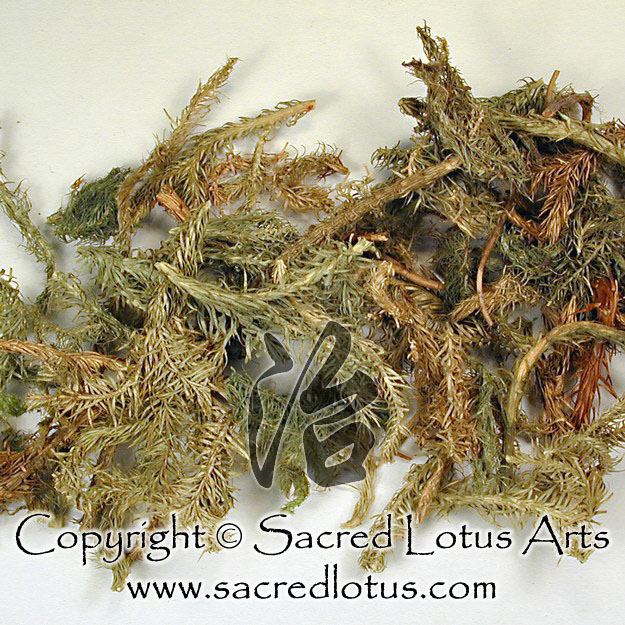
Materia Medica Data
- Category
- Herbs that Dispel Wind-Dampness
- Nature & Flavour
- Spicy, Bitter, Warm
- Channels Entered
- LIV, SP, KI
- Latin (pharmaceutical)
- Lycopodii Herba
- Tone Marks
- shēn jīn căo
- Also Known As
- Shi Song
- Translation
- Stretch Sinew Herb
Chinese Herb Actions
What is Shen Jin Cao used for in Chinese medicine?
Shen Jin Cao (Herba Lycopodii) is traditionally used to dispel wind-cold-damp and relax the sinews — for wind-cold-damp painful obstruction (Bi syndrome) with contracted, stiff sinews, joint aches, and difficulty flexing or extending the limbs, as well as for traumatic injury. Its name literally means “stretch-the-sinew herb” (Sacred Lotus translation is “Stretch Sinew Herb”), reflecting its signature action.
Its main traditional actions:
- Dispels wind-damp — wind-cold-damp Bi (painful obstruction) presenting as joint pain, stiffness, and numbness of the limbs.
- Relaxes the sinews (shū jīn) — contracted or stiff tendons and muscles, cramping, and difficulty bending or straightening the joints.
- Unblocks and invigorates the channels and collaterals — promotes local qi and blood movement where stiffness and reduced mobility are present.
- Used adjunctively for traumatic injury — swelling, bruising, and pain following sprains, strains, or trauma.
Source: Bensky-style materia medica consensus (category: Herbs that Dispel Wind-Dampness), cross-checked against multiple reputable TCM references; Sacred Lotus Sacred Lotus sources & references (properties: acrid/spicy & bitter, warm; channels: Liver, Spleen, Kidney). Traditional-use framing; not medical advice.
Chinese Herb Dosage
What is the typical dosage of Shen Jin Cao?
Roughly 9–15 g in decoction — the figure already on file for this herb (sourced to Bensky). Wider materia medica literature gives a broadly consistent standard range of about 3–15 g for the dried herb, with up to ~30 g sometimes used when prepared as a medicinal wine, and external use (wash, compress, or a powder mixed with oil) also described for topical application to stiff, painful joints.
Source: Bensky-sourced site figure (9–15 g); cross-checked against multiple reputable TCM references for the broader 3–15 g decoction range and external-use preparations. Reference only — not a prescription.
Chinese Herb Contraindications & Cautions
Are there cautions for Shen Jin Cao?
Shen Jin Cao is traditionally contraindicated in pregnancy — the caution already on file for this herb — and is used with caution in patients with active or heavy bleeding, consistent with general practice for channel-invigorating wind-damp herbs.
- Pregnancy — contraindicated; multiple reputable TCM references list this consistently alongside our existing caution note.
- Active/heavy bleeding — use cautiously, per general convention for herbs in this action category.
Source: existing Sacred Lotus caution (“Caution during Pregnancy”), cross-checked against multiple reputable TCM references. Reference only, not medical advice — consult a qualified practitioner, especially in pregnancy.
Chinese Herb Toxicity & Overdose
Low. Shen Jin Cao is not classified as a toxic herb in materia medica sources, and the Sacred Lotus does not flag it as toxic/endangered. No established human toxic-dose or LD₀ data was found in the literature reviewed; treat this as a general low-toxicity reference note rather than a safety guarantee, and use standard decoction-range dosing under practitioner guidance.
Source: materia medica consensus (non-toxic classification); Sacred Lotus flag (not set). Reference note, not a safety guarantee.
Herb-Drug Interactions
No well-established clinical herb–drug interactions are documented for Shen Jin Cao in the literature reviewed. Given its traditional channel- and collateral-invigorating action and use for post-traumatic bruising/swelling, general practitioner awareness is reasonable for patients on anticoagulant or antiplatelet therapy — this is precautionary, not a demonstrated clinical interaction. (Flagged for practitioner confirmation.)
Western / Biomedical Research
Chinese Herb Clinical Studies & Research
Provided as research context — a summary of published biomedical study, not a therapeutic or medical claim.
Is there modern research on Shen Jin Cao (Herba Lycopodii / Lycopodium japonicum)?
Yes — mostly preclinical (cell- and animal-model) pharmacology and phytochemistry, not human clinical trials. Chemically, the plant is dominated by lycopodine-type alkaloids and serratane-type triterpenoids, and modern findings offer mechanistic support for its traditional anti-inflammatory, joint/sinew reputation without yet rising to clinical-trial-level evidence.
- Osteoarthritis (preclinical, cell + mouse model) — a 2024 study found that a Lycopodium japonicum extract reduced chondrocyte apoptosis, cellular senescence, and inflammatory signaling in IL-1β-stimulated mouse cartilage cells and in a surgically induced mouse osteoarthritis model, acting through the STING/NF-κB signaling pathway. This is laboratory/animal evidence relevant to the herb’s traditional joint-pain use, not proof of effect in humans.
- Phytochemistry & bioactivity review — a 2020 review catalogs roughly 132 compounds isolated from L. japonicum (chiefly alkaloids and serratane triterpenoids) and reports that individual isolated compounds show anti-inflammatory, cytotoxic, acetylcholinesterase-inhibitory, anti-HIV-1, and α-glucosidase-inhibitory activity in laboratory assays — evidence about isolated constituents, not the whole herb as traditionally decocted.
- Alkaloid chemistry (preclinical) — a 2014 study isolated three new lycopodine-type alkaloids from L. japonicum (plus seventeen known ones) and tested them for acetylcholinesterase-inhibitory activity, finding no significant effect — a negative result included here for balance.
Note: Some retail/vendor listings label this herb’s source plant as “Lycopodium clavatum,” but Chinese-materia-medica sources identify the TCM source plant as Lycopodium japonicum Thunb.; L. clavatum is a related but distinct species used mainly in Western herbalism/homeopathy. The Sacred Lotus Latin field (“Lycopodii Herba”) is genus-level and not in conflict, but the species distinction is worth flagging for accuracy.
Overall, human clinical evidence is currently lacking; support is preclinical/laboratory.
Sources: PMID 39121926, DOI 10.1016/j.jep.2024.118660 (Journal of Ethnopharmacology, 2024, osteoarthritis mouse/cell model); DOI 10.1016/j.arabjc.2020.03.023 (Arabian Journal of Chemistry, 2020, phytochemistry/bioactivity review); PMID 25089239, PMC 4111880 (Natural Products and Bioprospecting, 2014, alkaloid isolation). Research context, not a therapeutic claim.
Chinese Herb Notes
How is Shen Jin Cao different from Mu Gua and Wei Ling Xian?
All three are used for wind-damp Bi with sinew/joint involvement, but they specialize differently — Shen Jin Cao is valued specifically for relaxing the sinews and opening the collaterals; Mu Gua is sour and has a particular affinity for cramped, contracted sinews (with an added stomach-harmonizing action); Wei Ling Xian is more strongly channel-unblocking and is favored for stubborn, generalized joint pain.
- Shen Jin Cao — relaxes the sinews and unblocks the channels/collaterals; classic choice when stiffness and contracture of the tendons predominate.
- Mu Gua (Fructus Chaenomelis) — sour and sinew-relaxing, with a stronger affinity for muscle cramping, often combined with Spleen/Stomach-friendly herbs.
- Wei Ling Xian — acrid, salty, warm; more powerful at unblocking the channels for stubborn, widespread joint obstruction.
Sang Zhi (mulberry twig) is also commonly grouped with these wind-damp herbs, favored for joint involvement of the upper limbs. (General materia medica differentiation, not treatment advice; no formula combinations for Shen Jin Cao are currently recorded in the Sacred Lotus.)
Source: Bensky-style “Herbs that Dispel Wind-Dampness” chapter differentiation, cross-checked against multiple reputable TCM references.
Sources & References
Compiled and edited by Thomas Dehli, Founder & Editor, Sacred Lotus Updated
The information here is referenced from numerous sources — teachers, practitioners, class notes from Five Branches University, the books below, and the published research literature, with citations given as resolvable PubMed identifiers. Where sources disagree, I have flagged the discrepancies directly. If facts couldn't be verified, I have left them out. How we source our content.
Reference information for students and practitioners — not medical advice. Consult a qualified practitioner. Terms of use.
Chinese Herbs Books & References
 https://amzn.to/3WfB3DK
 https://amzn.to/3DR1VUh
 https://amzn.to/42aMz73
 https://amzn.to/3PuD4bt