

Du Huo (Pubescent Angelica Root)
Radix Angelicae Pubescentis Pubescent Angelica Root
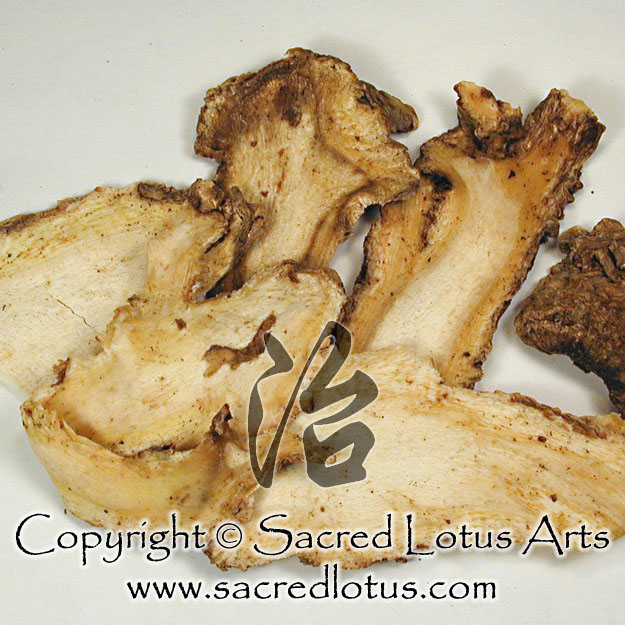
Materia Medica Data
- Category
- Herbs that Dispel Wind-Dampness
- Temperature
- Warm
- Nature & Flavour
- Bitter, Spicy, Warm
- Channels Entered
- KI, BL
- Latin (pharmaceutical)
- Radix Angelicae Pubescentis
- Chinese
- 独活
- Tone Marks
- dú huó
- Translation
- Self Reliant Existence
Chinese Herb Actions
What is Du Huo used for in Chinese medicine?
Du Huo (pubescent angelica root) dispels wind-damp and relieves pain, with a traditional specialty for the LOWER body — the low back, legs, knees, and lower-body joints — and also releases exterior wind-cold-damp. It is bitter, spicy, and warming, entering the Kidney and Bladder channels.
Its main traditional actions:
- Dispels wind-damp and relieves pain (lower body) — chronic or acute low back and knee pain, and aches/pain in the lower extremities and joints; traditionally considered the best-suited herb of its category for pain located in the lower half of the body.
- Releases the exterior, dispels wind-cold-damp — common-cold-type presentations with headache, chills, fever, body/joint aches, heavy sensation, and aversion to cold.
- Treats Shaoyin (Lesser Yin)-stage headache or toothache — a more specialized classical indication, used when wind-cold-damp settles into the deeper Shaoyin channel pathway.
Source: Sacred Lotus sources & references, cross-referenced against multiple online sources and materia medica consensus (Bensky, Materia Medica, 3rd ed.; Chen & Chen, Chinese Herbal Medicine: Materia Medica). Traditional-use framing; not medical advice.
Chinese Herb Dosage
What is the typical dosage of Du Huo?
Roughly 3–10 g in decoction — Chen & Chen give 3–10 g, Bensky gives a slightly narrower 3–9 g, both consistent with the Sacred Lotus reference range. The root is the part used, typically sliced and decocted with the other herbs of a formula rather than added separately.
Source: Sacred Lotus sources & references; cross-referenced against multiple online sources and standard materia medica ranges (Chen & Chen; Bensky). Reference only — not a prescription.
Chinese Herb Contraindications & Cautions
Are there cautions for Du Huo?
Du Huo is acrid and warming, so it is used cautiously in Yin- or Blood-deficiency patterns without a genuine wind-damp component, since its dispersing, warming nature can further deplete Yin or Blood if used alone or in excess. It is also avoided where internal Liver wind (e.g., dizziness, tremor, or spasm from Liver-Yang rising or Blood deficiency generating wind) is the primary pattern, as it is not indicated for that mechanism of "wind."
Source: Sacred Lotus sources & references; cross-referenced against multiple online sources and materia medica consensus. Reference only, not a substitute for individualized practitioner guidance.
Chinese Herb Toxicity & Overdose
Low at standard therapeutic doses, but overdose is documented as serious. The Sacred Lotus reference notes that overdose of Du Huo can lead to poisoning with symptoms including rapid breathing, agitation, hallucinations, delirium, generalized tetanic spasms, total paralysis, and death — underscoring that dosage should stay within standard materia medica ranges and be supervised by a qualified practitioner, particularly with concentrated extracts or long-term use.
Source: Sacred Lotus sources & references. Reference note, not a safety guarantee.
Western / Biomedical Research
Chinese Herb Clinical Studies & Research
Provided as research context — a summary of published biomedical study, not a therapeutic or medical claim.
Is there modern research on Du Huo (Angelica pubescens)?
Yes — laboratory and animal research on Du Huo's coumarin constituents (notably osthole) supports anti-inflammatory and analgesic-relevant mechanisms, and clinical meta-analyses support its signature formula, Du Huo Ji Sheng Tang, as an adjunct for certain joint conditions.
- Osthole pharmacology — a 2017 review of osthole, a major coumarin found in Angelica pubescens and related Apiaceae plants, reports anti-inflammatory, anti-proliferative, anti-convulsant, antiallergic, and platelet-aggregation-inhibiting activity in laboratory and animal studies, along with effects on bone metabolism; this is compound-level preclinical evidence, not a clinical finding for the crude herb.
- Du Huo Ji Sheng Tang for knee osteoarthritis — a 2022 pooled analysis of 11 randomized controlled trials (895 patients) found the formula, used alone or added to conventional therapy, improved clinical effective rate, reduced WOMAC and VAS pain scores, and lowered inflammatory markers (IL-6, TNF-α) in "cold-dampness obstruction" type knee osteoarthritis; combining it with glucosamine sulfate or warm-needle acupuncture outperformed either alone.
- Other formula-level evidence — additional meta-analyses have examined Du Huo Ji Sheng Tang as an add-on for ankylosing spondylitis and for osteoporosis, generally reporting improved outcomes when combined with conventional treatment, though trial quality in this literature is often rated low-to-moderate.
This evidence supports plausible mechanisms and formula-level clinical benefit as an adjunct, not proof that Du Huo alone treats any condition; most positive clinical results are for the multi-herb formula rather than Du Huo in isolation.
Sources: PMID 28513464 (osthole pharmacology review); PMID 35774274 (Du Huo Ji Sheng Tang pooled analysis, knee osteoarthritis); PMID 36809734 (meta-analysis, ankylosing spondylitis, add-on therapy). Research context, not a therapeutic claim.
Chinese Herb Notes
What is the difference between Du Huo and Qiang Huo?
Qiang Huo and Du Huo are a classic paired contrast in the wind-damp category: Qiang Huo is used for the UPPER body and back, while Du Huo is used for the LOWER body and legs — both dispel wind-damp and relieve pain from Bi (painful obstruction) syndrome, and both release the exterior in wind-cold-damp invasion, but their site of action differs. This upper/lower contrast is one of the most commonly taught herb-pair distinctions in the wind-damp category, and the two are frequently combined so their actions cover the whole body.
- Qiang Huo (Notopterygium) — stronger for the upper body, shoulders, upper back, and neck; more strongly releases the exterior; can be harsher on the stomach in higher doses.
- Du Huo (Angelica pubescens) — stronger for the low back, legs, and knees; gentler, gentler on the digestion; also used for the deeper Shaoyin-stage headache noted above.
Key formula — Du Huo Ji Sheng Tang (Angelica Pubescens and Sangjisheng Decoction): the signature formula built around Du Huo, combining it with Sang Ji Sheng, Qin Jiao, Fang Feng, and blood/Kidney tonics (Du Zhong, Niu Xi, Dang Gui, Shu Di Huang, etc.) for chronic wind-damp Bi syndrome of the low back and legs in patients with underlying Liver/Kidney and Qi/Blood deficiency — the classic pattern behind long-standing low-back pain, sciatica, or joint pain in an older or weaker patient.
Other combinations: with Qiang Huo, Fang Feng, and Cang Zhu in Qiang Huo Sheng Shi Tang (for wind-damp exterior invasion with generalized body aches) and in Juan Bi Tang and Ren Shen Bai Du San for Bi syndrome and externally-contracted wind-damp with underlying deficiency. (Traditional formula context, not treatment advice.)
Source: Sacred Lotus sources & references (formula links); cross-referenced against multiple online sources and materia medica consensus.
Sources & References
Compiled and edited by Thomas Dehli, Founder & Editor, Sacred Lotus Updated
The information here is referenced from numerous sources — teachers, practitioners, class notes from Five Branches University, the books below, and the published research literature, with citations given as resolvable PubMed identifiers. Where sources disagree, I have flagged the discrepancies directly. If facts couldn't be verified, I have left them out. How we source our content.
Reference information for students and practitioners — not medical advice. Consult a qualified practitioner. Terms of use.
Chinese Herbs Books & References
 https://amzn.to/3WfB3DK
 https://amzn.to/3DR1VUh
 https://amzn.to/42aMz73
 https://amzn.to/3PuD4bt