
Cortex Fraxini Korean Ash Branch Bark
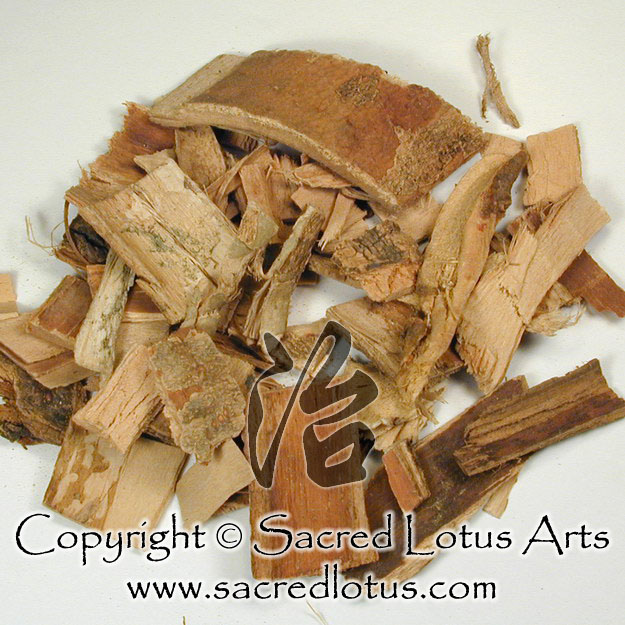
Materia Medica Data
- Temperature
- Cold
- Nature & Flavour
- Bitter, Cold
- Channels Entered
- GB, LI, LIV, ST
- Latin (pharmaceutical)
- Cortex Fraxini
- Chinese
- 秦皮
- Tone Marks
- qín pí
Chinese Herb Actions
What is Qin Pi used for in Chinese medicine?
Qin Pi is used to clear heat, dry dampness, and check dysenteric diarrhoea — and, distinctively among the bitter-cold herbs, to brighten the eyes. Bitter and cold, entering the Gall Bladder, Large Intestine, Liver and Stomach channels, it is grouped with the herbs that clear heat and dry dampness. Its combination of a draining, heat-clearing nature with an astringent, discharge-checking quality is what sets it apart from its neighbours in that category.
Its main traditional actions:
- Clears heat, dries dampness, and stops dysenteric diarrhoea — damp-heat diarrhoea or dysentery, particularly where blood is present. Because it is astringent as well as bitter and cold, it restrains the discharge rather than only draining the heat.
- Clears Liver heat and brightens the eyes — red, swollen, painful eyes and superficial visual obstruction attributed to Liver heat. Traditional sources also connect it to cataract-type presentations.
- Dispels wind-damp — painful obstruction (bi) patterns with a heat component.
Identity: the material is the branch or stem bark of several Fraxinus (ash) species — a modern review of Fraxini cortex identifies bark from four Fraxinus species as the recognised source, so readers should expect some botanical range behind the single drug name (PMID 38301981).
Source: Sacred Lotus sources & references (herb identity, category, channel and action data), cross-referenced against multiple online sources and materia medica consensus; PMID 38301981 for botanical source range. Traditional-use framing; not medical advice.
Chinese Herb Dosage
What is the typical dosage of Qin Pi?
Roughly 4.5–15 g in decoction, consistent with standard materia medica ranges. The part used is the bark — the branch or stem bark of the ash tree, dried. For eye conditions it is also traditionally prepared as a decoction used externally as an eye wash, in addition to being taken internally.
- 4.5–15 g in decoction internally.
- Part used: branch/stem bark.
- External use: decocted and used as a wash for the eyes.
Source: Sacred Lotus sources & references (existing dosage record); standard materia medica ranges. Reference only — not a prescription.
Chinese Herb Contraindications & Cautions
Are there cautions for Qin Pi?
Contraindicated in cold from Spleen and Stomach deficiency — as a bitter, cold herb, Qin Pi is unsuited to cold, deficient digestive patterns and can aggravate them. Sacred Lotus's own reference data also carries a traditional incompatibility note: Qin Pi is reported to antagonize Wu Zhu Yu (Fructus Evodiae Rutaecarpae), one of the classical herb-pair cautions rather than a modern pharmacological finding.
- Spleen/Stomach cold from deficiency — avoid.
- Traditional antagonism with Wu Zhu Yu — a classical pairing caution recorded in the materia medica tradition; we present it as such, not as a demonstrated interaction.
- Pregnancy — professional supervision is appropriate; precautionary reference note.
Source: Sacred Lotus sources & references (traditional contraindications and herb-pair caution), cross-referenced against multiple online sources and materia medica consensus.
Chinese Herb Toxicity & Overdose
Low. Qin Pi is not classed among the toxic herbs and no significant toxicity is reported at normal medicinal doses; reviews of Fraxini cortex and of its principal coumarins do not document notable adverse-event findings, while consistently noting that clinical data overall remain limited (PMID 38301981, PMID 35599456). One pharmacological point is worth recording for accuracy rather than as a hazard: the active coumarins have low oral bioavailability — esculin in particular undergoes extensive first-pass metabolism (PMID 35599456), and reviews of the whole bark note the same constraint (PMID 42389286). Isolated-compound findings therefore transfer poorly to the decocted herb in either direction, benefit or harm.
Sources: PMID 38301981; PMID 35599456; PMID 42389286. Reference note, not a safety guarantee.
Herb-Drug Interactions
No well-established clinical herb–drug interactions are documented for Qin Pi. The traditional literature records an antagonism with Wu Zhu Yu (see cautions), which is a classical herb-pair caution rather than a pharmacological interaction. On the modern side, the practical point is the reverse of an interaction warning: Qin Pi's principal coumarins are subject to serious first-pass metabolism and low systemic exposure (PMID 35599456, PMID 42389286), which makes clinically significant pharmacokinetic interactions less likely than isolated-compound studies alone might suggest — though this has not been formally tested. (Flagged for practitioner confirmation.)
Sources: PMID 35599456; PMID 42389286; Sacred Lotus sources & references for the traditional Wu Zhu Yu caution.
Western / Biomedical Research
Chinese Herb Clinical Studies & Research
Provided as research context — a summary of published biomedical study, not a therapeutic or medical claim.
Is there modern research on Qin Pi (Cortex Fraxini)?
Yes — and Qin Pi is an unusually well-characterised case chemically: its principal actives are the coumarins esculin (aesculin), esculetin, fraxin and fraxetin, and their identity as the bark's main constituents is not in dispute. A comprehensive review of Fraxini cortex catalogued 132 phytochemicals, with coumarins established as the primary active class, and summarised anti-inflammatory, anti-tumour, anti-fibrotic, antioxidant and cardioprotective activities — while explicitly noting that clinical evidence remains limited (PMID 38301981).
- Esculin — the 6-O-glucoside of esculetin, and the bark's signature compound. A comprehensive pharmacological and pharmacokinetic review describes anti-inflammatory, antioxidant, antimicrobial, antiviral, neuroprotective and anticoagulant activities, and reports that esculin distributes rapidly but undergoes serious first-pass metabolism (PMID 35599456).
- Esculin and esculetin together — a review of the pair describes antioxidant, anti-inflammatory, antibacterial, antitumour and immunomodulatory effects operating through free-radical scavenging and the Nrf2, NF-κB and MAPK pathways (PMID 37800835).
- A familiar compound family — readers may recognise esculin and fraxin from horse chestnut. Both are among the four main constituents identified in Aesculus hippocastanum bark extract (PMID 34206691); esculin is named for that genus and is routinely described in the literature as a coumarin derivative found in Aesculus hippocastanum (PMID 26391063). Qin Pi and horse chestnut are unrelated plants that happen to share a coumarin chemistry.
- Anti-tumour research — a review of the anti-tumour actions of Cortex Fraxini's active metabolites summarises the mechanisms proposed in laboratory models (PMID 39346560). Preclinical only; not a cancer treatment claim.
- Contemporary reframing — a 2026 review recasts Fraxini cortex as an immune-metabolic regulator acting on glycolytic enzymes, bacterial virulence factors and metabolic transporters, and notes clinical interest in psoriasis and gouty arthritis, while flagging low oral bioavailability of the key coumarins as the central limitation (PMID 42389286).
The traditional damp-heat dysentery and Liver-heat eye indications are not the same thing as these modern findings, and none of the above establishes a treatment. The phytochemistry, however, is genuinely solid ground.
Sources: PMID 38301981 (Journal of Ethnopharmacology, 2024, Fraxini cortex phytochemistry/pharmacology/ethnomedicine review); PMID 35599456 (Phytotherapy Research, 2022, esculin pharmacology and pharmacokinetics); PMID 37800835 (Medicine, 2023, esculin and esculetin review); PMID 34206691 (Antioxidants, 2021, esculin and fraxin in Aesculus hippocastanum bark); PMID 26391063 (International Immunopharmacology, 2015, esculin described as an Aesculus hippocastanum coumarin); PMID 39346560 (Frontiers in Pharmacology, 2024, anti-tumour actions of Cortex Fraxini metabolites); PMID 42389286 (Frontiers in Pharmacology, 2026, Fraxini cortex as immune-metabolic regulator). Research context, not a therapeutic claim.
Chinese Herb Notes
Which formula is Qin Pi used in?
Bai Tou Weng Tang (Pulsatilla Decoction) — Sacred Lotus's own formula data records Qin Pi as one of its four ingredients, alongside Bai Tou Weng (chief), Huang Lian, and Huang Bai. All four are bitter and cold; Qin Pi's particular contribution is that it is also astringent, so it checks the dysenteric discharge while the others clear the heat and toxicity driving it. This is the clearest illustration of what distinguishes Qin Pi within the bitter-cold, damp-drying group.
How is Qin Pi different from Huang Lian and Huang Bai?
- Huang Lian — the strongest at draining fire and drying damp-heat, especially of the middle burner; purely draining.
- Huang Bai — directed at damp-heat of the lower burner.
- Qin Pi — weaker at draining fire than either, but astringent as well as cold, so it restrains discharge; and uniquely among the three it has an established traditional use for the eyes via the Liver channel.
(Traditional formula and comparison context, not treatment advice.)
Source: Sacred Lotus sources & references (formula composition data for Bai Tou Weng Tang), cross-referenced against multiple online sources and materia medica consensus.
Sources & References
Compiled and edited by Thomas Dehli, Founder & Editor, Sacred Lotus Updated
The information here is referenced from numerous sources — teachers, practitioners, class notes from Five Branches University, the books below, and the published research literature, with citations given as resolvable PubMed identifiers. Where sources disagree, I have flagged the discrepancies directly. If facts couldn't be verified, I have left them out. How we source our content.
Reference information for students and practitioners — not medical advice. Consult a qualified practitioner. Terms of use.
Chinese Herbs Books & References
 https://amzn.to/3WfB3DK
 https://amzn.to/3DR1VUh
 https://amzn.to/42aMz73
 https://amzn.to/3PuD4bt