
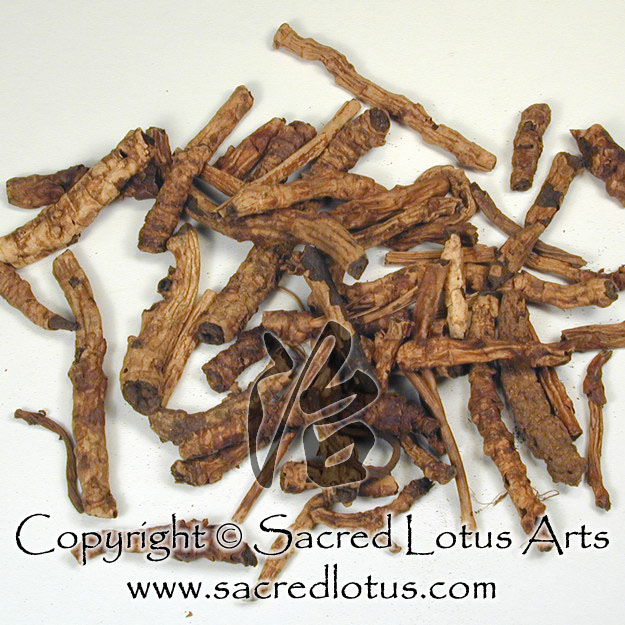
Materia Medica Data
- Temperature
- Cold
- Nature & Flavour
- Bitter, Cold
- Channels Entered
- LIV, ST, LI.
- Latin (pharmaceutical)
- Rhizoma Picrorrhizae
- Chinese
- 胡簧莲
- Tone Marks
- hú huáng lián
- Translation
- Barbarian Yellow Link
Chinese Herb Actions
What is Hu Huang Lian used for in Chinese medicine?
Hu Huang Lian is a bitter, cold herb that clears damp-heat from the lower burner, clears heat arising from yin deficiency, and reduces the heat of childhood nutritional impairment. Our record classifies it with the herbs that clear heat and dry dampness and gives it the Liver, Stomach and Large Intestine channels. The combination is distinctive: very few herbs in the drying, damp-heat group also address deficiency heat, and that dual capacity is what defines this herb’s place in the materia medica.
Its traditional actions:
- Clears damp-heat — for dysenteric disorders, diarrhoea and haemorrhoids, drawing heat and damp downward and out of the intestines.
- Clears heat from deficiency — for heat signs generated by an underlying yin deficiency, the pattern described traditionally as steaming bone or afternoon fever. This is the action that separates it from most of its category.
- Clears heat and reduces childhood nutritional impairment — used where a child shows the classic picture of accumulation with heat: poor absorption, irritability, fever and abdominal fullness.
- Enters the Liver, Stomach and Large Intestine channels — consistent with a digestive-tract and lower-burner focus.
The rhizome is the part used. It is intensely bitter — the genus name itself derives from the Greek for “bitter root” — and the bitterness is the signature that materia medica writers use to place it.
Source: our own herb record (category, nature and flavour, channels, indications, part used), cross-referenced against multiple online sources and published materia medica consensus. Traditional-use framing; not medical advice.
Chinese Herb Dosage
What is the typical dosage of Hu Huang Lian?
Our record gives 3–9 g. That is a moderate, conventional range for a bitter cold heat-clearing herb, and the herb is not used at the large doses seen with the bland toxin-resolving herbs. Its intense bitterness is itself a practical limit on how much can comfortably be taken.
- Decoction — 3–9 g.
- Part used — our record records the root; the medicinal article is conventionally described as the dried rhizome, and the two descriptions refer to the same underground portion of the plant.
- Preparation — used unprocessed for damp-heat in the intestines; some traditions describe wine-processing when the intent is to direct the herb upward or to temper its coldness.
Source: our own herb record dosage and part-used entries, cross-referenced against multiple online sources and published materia medica consensus. Reference only — not a prescription.
Chinese Herb Contraindications & Cautions
Are there cautions for Hu Huang Lian?
Our record's stated caution is weakness of the Spleen and Stomach. This is the standard and expected warning for an intensely bitter, cold, draining herb: where digestion is already weak or cold, a herb of this character can worsen appetite, produce loose stools and deepen the underlying deficiency. It is a corrective, not a tonic, and it is not intended for extended use once the heat pattern has cleared.
- Spleen and Stomach deficiency-cold — caution per our record; poor appetite, loose stools and aversion to cold are the signs that argue against it.
- Absence of true heat — a heat-clearing herb given where there is no heat has no target and only its cold, drying burden.
- Pregnancy — our record does not list pregnancy as a contraindication. As with all bitter cold herbs, use during pregnancy is a decision for a qualified practitioner rather than a self-treatment matter.
- Product identity — because two Himalayan species trade under this name and both are under collection pressure, knowing what is actually in the packet matters more than usual here. See the sourcing section.
Source: our own herb record caution entry; general category cautions cross-referenced against multiple online sources and published materia medica consensus. Reference information, not medical advice.
Chinese Herb Toxicity & Overdose
Is Hu Huang Lian toxic or endangered?
The herb is not classed as toxic, but its conservation status is a genuine and well-documented problem. Picrorhiza kurroa is a slow-growing, high-altitude perennial endemic to the Himalaya, it is almost entirely wild-collected, and it is reported in the botanical literature as listed in Appendix II of CITES — the international convention category for species that are not yet threatened with extinction but may become so unless trade is controlled. Published assessments describe it as endangered to critically endangered under IUCN criteria in India.
- The supply gap is quantified — researchers report an approximate global annual demand of around 500 tonnes against a supply of about 375 tonnes, with India contributing roughly 75 tonnes a year, and rank the species among the most-traded Indian medicinal plants by trade revenue. Overexploitation from wild Himalayan populations is the stated cause of its threatened status.
- An independent listing check — a separate study of barcode authentication of endangered Indian medicinal plants traded in Indian markets likewise places Picrorhiza kurroa among the species covered by CITES Appendix II.
- The Chinese species is under the same pressure — Neopicrorhiza scrophulariiflora is described in the literature as an endangered species endemic to the Himalayan region, and a study of its demand, end-uses and conservation in the central Himalaya documents the harvest pressure directly.
- Why substitution happens — wild-collected, high-value, hard-to-reach material is exactly the profile that produces adulteration. DNA barcoding and chromatographic markers have both been developed for authentication of this genus for that reason.
- Cultivation — conservation work has focused on identifying high-picroside genotypes for cultivation so that demand can be met without wild collection. Cultivated material is the responsible choice where it can be identified.
Discrepancy note: CITES appendix listings are amended periodically and the statements above are drawn from the peer-reviewed botanical literature rather than from a direct reading of the current appendices. Anyone importing, exporting or trading this herb commercially should check the current official listing rather than rely on a reference page.
Sources: PMID 33967459, PMC 8055752, DOI 10.1007/s12298-021-00972-w (CITES Appendix II listing, endangered status, demand and supply figures, conservation genetics); PMID 30956417, PMC 6419693, DOI 10.1007/s12298-018-0610-8 (barcoding authentication of CITES-listed endangered Indian medicinal plants); PMID 33365601, PMC 7687538 (Neopicrorhiza scrophulariiflora described as endangered Himalayan endemic); PMID 30018658, PMC 6029480, DOI 10.1155/2018/6024263 (demand, end-uses and conservation in the central Himalaya). Neutral reference facts, not a safety or legal guarantee.
Western / Biomedical Research
Chinese Herb Clinical Studies & Research
Provided as research context — a summary of published biomedical study, not a therapeutic or medical claim.
Is there modern research on Hu Huang Lian (Picrorhiza)?
Yes — a substantial body of it, concentrated on the liver and on two marker compounds, picroside I and picroside II. These are iridoid glycosides; the standardised fraction containing them has been studied under the name picroliv, and hepatoprotective activity in laboratory and animal models is the single most-investigated property of the genus. Almost all of this work is preclinical, and most of it was done on Picrorhiza kurroa, the Ayurvedic species, rather than on the Chinese article.
- Chemistry — a review of the two Picrorhiza species catalogued 141 isolated compounds, including 46 iridoid glycosides, 29 tetracyclic triterpenoids, 25 phenylpropanoids and 11 phenylethanoid glycosides.
- Liver — picroliv, the standardised picroside fraction from the roots and rhizomes, has been reviewed specifically as a hepatoprotective compound, and a further review examines the genus in the context of fatty liver disease and its translational potential. Translational potential is not the same as demonstrated clinical benefit.
- Breadth of reported activity — the combined review of both species reports liver-, heart-, brain-, kidney- and nerve-cell-protective effects together with antitumour, anti-inflammatory, antibacterial, anti-asthma, antidiabetic, immunomodulatory and lipid-lowering activities in laboratory models. Comprehensive reviews of the pharmacology and clinical efficacy of the genus and its secondary metabolites have been published.
- Inflammatory bowel models — a network-pharmacology study of the glycoside fraction of P. scrophulariiflora in experimental colitis is one of the few modern investigations working on the Chinese species and on an indication close to the traditional damp-heat dysentery use.
- Chemical variability — picroside content varies enormously between wild populations. One survey across 124 genotypes from ten Himalayan populations found picroside I ranging from 0.01% to 4.15% and picroside II from 0.01% to 3.18%. A several-hundred-fold spread in the marker compounds is a serious caution about generalising any research finding to an arbitrary batch of herb.
Honest summary: the hepatoprotective literature on this genus is real, sizeable and almost entirely preclinical, and it largely concerns a species that may not be the one in a given Chinese prescription. Nothing here establishes a treatment for liver disease or any other condition.
Sources: PMID 34951239, DOI 10.19540/j.cnki.cjcmm.20210708.601 (chemistry and pharmacology of both species, 141 compounds); PMID 19619118, DOI 10.2174/138920109789069314 (picroliv pharmacology and chemistry); PMID 35659739, PMC 10105242, DOI 10.1016/j.jaim.2022.100558 (traditional uses, phytopharmacology and fatty liver disease); PMID 36500409, PMC 9738980, DOI 10.3390/molecules27238316 (comprehensive pharmacological and clinical review); PMID 33797375, DOI 10.2174/1389557521666210401090028 (ethnobotany, phytochemistry and pharmacology review, 2010–2020); PMID 37249930, PMC 10224697 (glycoside fraction of P. scrophulariiflora in experimental colitis); PMID 33967459, PMC 8055752 (picroside content variation across Himalayan populations); PMID 21413048, DOI 10.1002/bmc.1626 (comparative picroside quantification in the two species). Research context, not a therapeutic claim.
Chinese Herb Notes
Is Hu Huang Lian the same as Huang Lian?
No. They are entirely different plants from different families, and the shared name is misleading. Huang Lian is Rhizoma Coptidis — Coptis, a buttercup-family (Ranunculaceae) plant native to China. Hu Huang Lian comes from the genus Picrorhiza, a high-altitude Himalayan herb placed in the Scrophulariaceae in most of the medicinal literature and in the Plantaginaceae under current botanical treatment. They are not relatives. They were given similar names because both are bitter, cold and yellow-rooted, and the prefix hú (胡) is the classical Chinese marker for something arriving from the western and northern peoples beyond the frontier — our own record translates the name as “Barbarian Yellow Link.” The name is a note of origin, not of botanical kinship.
- Hu Huang Lian — Picrorhiza rhizome. Bitter, cold; Liver, Stomach, Large Intestine per our record. Clears damp-heat, and clears deficiency heat, and reduces childhood nutritional impairment.
- Huang Lian — Rhizoma Coptidis. Bitter, cold; our record gives Heart, Large Intestine, Liver and Stomach. It drains fire, particularly Heart and Stomach fire, and resolves toxicity. It does not clear deficiency heat, and it enters the Heart channel where Hu Huang Lian does not.
- The practical distinction — if the clinical picture is fire excess with irritability, insomnia or agitation, that is Huang Lian territory. If it is low-grade heat on a background of yin deficiency, or a child with accumulation and heat, that is where Hu Huang Lian is chosen. The overlap is damp-heat dysentery, where either may appear.
- A parallel worth noting — the same “imported herb” naming convention appears elsewhere on this site: Fan Xie Ye carries the prefix fān (番) for the same reason. Chinese herb names quietly record trade history.
Which plant is Hu Huang Lian actually made from?
Two closely related Himalayan species share this name, and the answer depends on which tradition and which market you are in. The article listed in the Chinese Pharmacopoeia is Picrorhiza scrophulariiflora Pennell — now more correctly Neopicrorhiza scrophulariiflora (Pennell) D.Y.Hong — a species distributed in southeastern Tibet and northwestern Yunnan, official in China since 1977 and used there for exactly the indications our record lists: childhood nutritional impairment, dysentery, jaundice and haemorrhoids. Its sister plant Picrorhiza kurroa Royle ex Benth. — kutki — is the western-Himalayan species that is famous in Ayurvedic medicine and that dominates the English-language research literature.
- They are treated as substitutes for one another in the analytical literature, and comparative work has quantified the marker compounds picroside I and picroside II in both, reporting higher levels in P. scrophulariiflora than in P. kurroa.
- They are reviewed together — a Chinese review of the chemistry and pharmacology of the two species catalogued 141 compounds shared across them, including 46 iridoid glycosides.
- What this means for a reader — a paper about “Picrorhiza” may be about either plant. Most of the hepatoprotective research described below was done on P. kurroa. Whether those findings transfer wholesale to the Chinese article is not established.
Discrepancy note: our own record gives the Latin as Rhizoma Picrorrhizae, which does not specify a species, and names the common source as Picrorhiza rhizome. Sources genuinely differ — the Chinese official source is Neopicrorhiza scrophulariiflora, while Picrorhiza kurroa is the Ayurvedic drug and the species most studied. Both are reported here rather than one being asserted; the ambiguity is real and sits in the source literature, not in this description.
Sources: our own Hu Huang Lian and Huang Lian records (Latin, family, category, nature and flavour, channels, name translations); Chinese Pharmacopoeia listing and traditional indications of P. scrophulariiflora per PMID 37249930, PMC 10224697, DOI 10.2147/DDDT.S407339; comparative picroside content per PMID 21413048, DOI 10.1002/bmc.1626; combined chemistry and pharmacology review per PMID 34951239; Neopicrorhiza nomenclature and family placement per PMID 33365601, PMC 7687538; comprehensive Neopicrorhiza review per PMID 31586694, DOI 10.1016/j.jep.2019.112250. Cross-referenced against multiple online sources.
Sources & References
Compiled and edited by Thomas Dehli, Founder & Editor, Sacred Lotus Updated
The information here is referenced from numerous sources — teachers, practitioners, class notes from Five Branches University, the books below, and the published research literature, with citations given as resolvable PubMed identifiers. Where sources disagree, I have flagged the discrepancies directly. If facts couldn't be verified, I have left them out. How we source our content.
Reference information for students and practitioners — not medical advice. Consult a qualified practitioner. Terms of use.
Chinese Herbs Books & References
 https://amzn.to/3WfB3DK
 https://amzn.to/3DR1VUh
 https://amzn.to/42aMz73
 https://amzn.to/3PuD4bt