

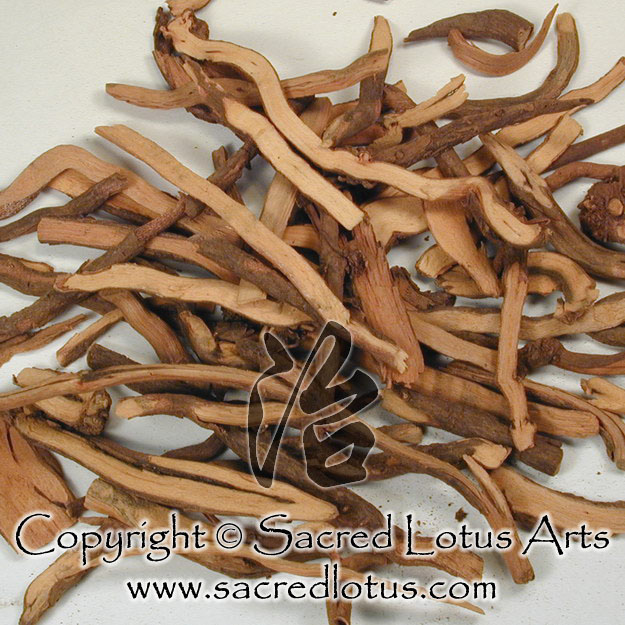
Materia Medica Data
- Category
- Herbs that Stop Bleeding
- Temperature
- Cold
- Nature & Flavour
- Bitter, Cold
- Channels Entered
- HT, LIV
- Latin (pharmaceutical)
- Radix Rubiae Cordifoliae
- Chinese
- 茜草
- Tone Marks
- qiàn căo
Chinese Herb Actions
What is Qian Cao Gen used for in Chinese medicine?
Qian Cao Gen (Madder Root) is a dual-direction blood herb — bitter and cold, it cools the blood to stop bleeding caused by heat, while at the same time invigorating the blood and dispelling stasis to unblock the channels and menses. This paired action — stopping bleeding without trapping stasis — is why materia medica sources group it with San Qi and Pu Huang among the “herbs that stop bleeding.”
Its traditional actions:
- Cools the blood and stops bleeding — heat-type bleeding such as coughing or vomiting blood, nosebleed, blood in the stool or urine, and uterine bleeding.
- Invigorates the blood and dispels stasis — blood-stasis pain in the chest, flank, and joints (Bi-type pain), and traumatic injury with swelling and pain.
- Unblocks the channels and menses — amenorrhea and delayed or blocked menstruation from blood stasis.
- Adjunct heat-toxin use — early-stage carbuncles, traditionally a secondary use alongside its main blood actions.
Raw (or wine-processed) Qian Cao Gen leans toward invigorating blood and unblocking the menses; charred Qian Cao Gen (Qian Cao Tan) is prepared specifically to strengthen its hemostatic action — see Notes for the raw-vs-charred distinction.
Source: cross-checked TCM materia medica consensus (Bensky-style differentiation of stop-bleeding herbs and multiple online sources) against this site’s own category (Herbs that Stop Bleeding). Traditional-use framing; not medical advice.
Chinese Herb Dosage
What is the typical dosage of Qian Cao Gen?
Commonly 9–15 g decocted, with sources reporting a range of about 6–15 g (occasionally cited up to 30 g maximum); a fluid tincture is sometimes dosed at 2–3 ml. Preparation changes the intended action: raw or wine-fried Qian Cao Gen is used to invigorate blood and unblock the menses/channels, while charred Qian Cao Gen (Qian Cao Tan) is processed specifically to boost its power to stop bleeding.
Note: reported ranges vary by source — general materia-medica references cluster around 9–15 g, while a Chinese clinical trial used an 18 g/day decoction for uterine bleeding (see Research). Dosage and preparation (raw vs. charred) should be set by a qualified practitioner for the specific pattern.
Source: cross-referenced against multiple online sources. Reference only — not a prescription.
Chinese Herb Contraindications & Cautions
Are there cautions for Qian Cao Gen?
Qian Cao Gen is generally cautioned in pregnancy and in Spleen/Stomach deficiency-cold, reflecting its blood-invigorating action and bitter-cold nature. Because raw Qian Cao Gen invigorates the blood, sources caution against its blood-moving use where no blood stasis is present, and it is not recommended for prolonged, long-term use.
- Pregnancy — caution or avoidance is advised due to its blood-invigorating action.
- Spleen/Stomach deficiency-cold — the bitter, cold nature can aggravate poor digestion or loose stools; use cautiously or combine with Spleen-protective herbs.
- Blood stasis absent — the blood-invigorating (raw) use is intended for stasis-type presentations; several references caution against this use when stasis is not present.
- Duration — not intended for long-term or prolonged use.
Source: multiple online sources (Bensky/Chen & Chen–derived clinical notes). Reference only, not medical advice; use under a qualified practitioner.
Chinese Herb Toxicity & Overdose
Traditional dosing is not associated with significant reported toxicity, but modern research flags a longer-term safety question specific to this plant family’s anthraquinone constituents. Crude ethanol extract shows relatively low acute toxicity (LD50 reported above 1,000 mg/kg in animal studies), but isolated anthraquinones typical of the genus — including rubiadin — produced kidney (renal tubule) preneoplastic changes and tumors in long-term, high-dose rodent studies, and related anthraquinones (alizarin, purpurin) showed DNA-intercalating, genotoxic activity in bacterial assays. A 2016 review of the botany, phytochemistry, pharmacology, and toxicology of this material explicitly calls for further ADMET (absorption/metabolism/toxicity) research.
Note: these anthraquinone toxicity/carcinogenicity findings come from long-term, high-dose animal studies of isolated compounds or concentrated extracts — not from clinical use at standard decoction doses — and some of the strongest genotoxicity data concerns the related species Rubia tinctorum rather than Rubia cordifolia itself. Included here as a neutral reference point, not a demonstrated clinical risk at traditional doses.
Source: PMID 27999402 (PMC 6274022, DOI 10.3390/molecules21121747), toxicology review; PMID 36160419 (PMC 9500525), pharmacology review. Reference note, not a safety guarantee.
-
This herb is considered slightly toxic.
(while some Chinese herbs are toxic, it must be noted that many come prepared, or are combined, to mitigate their toxicity)
Herb-Drug Interactions
No well-established clinical herb–drug interactions are documented for Qian Cao Gen. Preclinical research shows extracts can inhibit platelet aggregation (including via a platelet-activating-factor pathway), consistent with its traditional blood-invigorating action. Combined with that finding, practitioner awareness is reasonable for patients on anticoagulant or antiplatelet medication, particularly around procedures or with high-dose/prolonged use. This is precautionary, not a demonstrated clinical interaction. (Flagged for practitioner confirmation.)
Western / Biomedical Research
Chinese Herb Clinical Studies & Research
Provided as research context — a summary of published biomedical study, not a therapeutic or medical claim.
Is there modern research on Qian Cao Gen (Rubia cordifolia)?
Yes — a substantial preclinical pharmacology literature plus two Chinese clinical trials on uterine bleeding, though independent Western clinical trials are lacking. Phytochemical surveys report more than 100 compounds in the root, dominated by anthraquinones, naphthoquinones, and cyclic hexapeptides.
- Hemostasis / blood-invigorating mechanisms (preclinical) — extracts inhibit platelet aggregation, including platelet-activating-factor (PAF)-induced aggregation, offering a plausible mechanism for the traditional blood-invigorating action; cell/animal research, not clinical proof.
- Antitumor (preclinical) — anthraquinone constituents isolated from the root show cytotoxicity against cancer cell lines, with anthraquinones proposed to act by intercalating DNA and interfering with topoisomerase II; laboratory research only.
- Clinical (Chinese trials, reported in a 2022 review) — a comprehensive review of Rubia cordifolia summarizes two Chinese clinical trials of root decoctions for uterine bleeding: one in 110 women with IUD-related abnormal uterine bleeding (18 g/day decoction), reporting a 94.5% effective rate versus 81.8% for a comparator herbal product (yunnan baiyao); another in 184 women with dysfunctional uterine bleeding, reporting 90% effectiveness versus 78.1% for norethisterone. These figures are as summarized in the English-language review; the underlying Chinese-language trial reports were not independently retrieved, and neither is a Western-standard blinded RCT.
- Anti-inflammatory / antioxidant (preclinical) — additional pharmacology work reports anti-inflammatory and antioxidant activity for root extracts and isolated compounds.
Clinical evidence remains limited to the trials above; most supporting data is preclinical (cell/animal).
Note: this site’s own record records the Latin as “Radix Rubiae Cordifoliae,” while the Chinese Pharmacopoeia and recent research literature use “Rubiae Radix et Rhizoma” (root and rhizome) for the same medicinal material (Rubia cordifolia L.); the identity field is left unchanged pending owner confirmation. Channel attribution also varies by source: this site’s own record and some references list Heart and Liver, while other summaries list Liver alone (occasionally with Lung); Heart+Liver is used here as this site’s own record-rooted default.
Sources: PMID 36160419, PMC 9500525, DOI 10.3389/fphar.2022.965390 (comprehensive pharmacology/clinical review); PMID 27999402, PMC 6274022, DOI 10.3390/molecules21121747 (botany/phytochemistry/toxicology review); PMID 18239313, DOI 10.1248/cpb.56.213 (anticancer constituents, Chem Pharm Bull 2008). Research context, not a therapeutic claim.
Chinese Herb Notes
Raw vs. charred Qian Cao Gen — and how does it compare to San Qi?
Raw Qian Cao Gen invigorates blood and unblocks the menses; charring it (Qian Cao Tan) trades some of that cooling and stasis-moving power for stronger hemostatic action. Frying the root to charcoal weakens its cold nature and makes it more astringent, concentrating its use on stopping bleeding (hemoptysis, epistaxis, uterine bleeding) rather than moving blood.
- Raw / wine-processed Qian Cao Gen — cools blood, invigorates circulation, dispels stasis, unblocks the channels and menses; used for amenorrhea, stasis pain, and trauma.
- Charred Qian Cao Gen (Qian Cao Tan) — less cold, more astringent, focused on stopping heat-type and stasis-type bleeding (hemoptysis, epistaxis, uterine bleeding).
Compared with San Qi and Pu Huang — all three are classed as hemostatics that stop bleeding without leaving stasis behind. San Qi is warm and the most potent of the three at both stopping bleeding and moving blood, making it the first choice for trauma; Pu Huang is neutral-to-cool and favors gynecological/lower-burner stasis bleeding; Qian Cao Gen is the coldest of the three and is distinguished by targeting bleeding driven by heat in the blood, while also mildly moving blood and unblocking the collaterals.
Common combinations: with Sheng Di Huang and Ce Bai Ye to clear heat and cool the blood for heat-type bleeding; with Tao Ren and Hong Hua to invigorate blood for amenorrhea; with San Qi, Ru Xiang, and Mo Yao for traumatic swelling and pain. In the Sacred Lotus formula database it appears in Shi Hui San (Ten-Ash Powder, for heat-driven coughing/vomiting of blood) and Gu Chong Tang (Stabilize the Gushing Decoction, for uterine bleeding). (Traditional formula context, not treatment advice.)
Source: multiple online sources; this site’s own formula links (Shi Hui San, Gu Chong Tang). Cross-checked against Bensky-style differentiation of stop-bleeding herbs.
Sources & References
Compiled and edited by Thomas Dehli, Founder & Editor, Sacred Lotus Updated
The information here is referenced from numerous sources — teachers, practitioners, class notes from Five Branches University, the books below, and the published research literature, with citations given as resolvable PubMed identifiers. Where sources disagree, I have flagged the discrepancies directly. If facts couldn't be verified, I have left them out. How we source our content.
Reference information for students and practitioners — not medical advice. Consult a qualified practitioner. Terms of use.
Chinese Herbs Books & References
 https://amzn.to/3WfB3DK
 https://amzn.to/3DR1VUh
 https://amzn.to/42aMz73
 https://amzn.to/3PuD4bt