
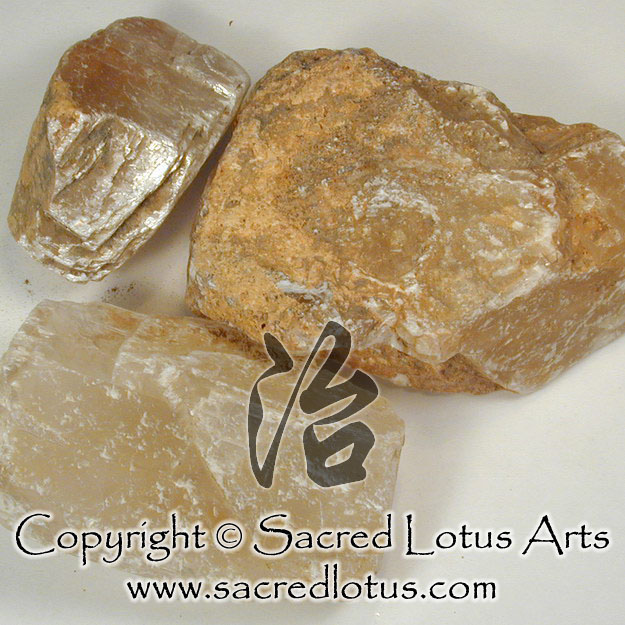
Materia Medica Data
- Category
- Herbs that Drain Fire
- Temperature
- Cold
- Nature & Flavour
- Spicy, Salty, Cold
- Channels Entered
- HT, ST, KI
- Latin (pharmaceutical)
- Calcitum
- Chinese
- 寒水石
- Tone Marks
- hán shuĭ shí
- Translation
- Cold Water Stone
Chinese Herb Actions
What is Han Shui Shi used for in Chinese medicine?
Han Shui Shi is a mineral — a stone, not a plant — used to drain fire and clear heat in febrile disease, and applied externally for burns and sores. Our record gives it as spicy, salty and cold, entering the Heart, Stomach and Kidney channels, in the category of herbs that drain fire. Its name means literally “cold water stone.”
Its traditional actions:
- Drains heat and fire — for febrile disease with high fever, thirst, irritability and a yellow tongue coating, and for summerheat presenting the same way. This is the principal internal use and the reason it sits in the fire-draining group.
- Clears heat and relieves toxicity locally — for mouth ulcers, sore throat and swollen tonsils.
- Applied externally for burns and scalds — the powdered mineral is used topically on burns, scalds and inflamed sores. This external use is as characteristic of the herb as its internal one.
Character of use: like the other cold mineral medicinals, it is a heavy, cold, draining substance with no tonifying quality at all. It is used briefly, for a clear excess-heat picture, and it is not a herb for long courses.
Source: our own herb record (category, nature, flavour, channels, translation, recorded actions); published materia medica consensus (Bensky, Materia Medica 3rd ed.; Chen & Chen), cross-referenced against multiple online sources. Traditional-use framing; not medical advice.
Chinese Herb Dosage
What is the typical dosage of Han Shui Shi?
9–30 g, decocted — and, as with the other hard mineral medicinals, cooked first. That range is what our record carries. Because it is a stone, the preparation matters as much as the number.
- 9–30 g in decoction, per our own record.
- Crushed and decocted first — hard minerals are broken up and boiled ahead of the other ingredients so that anything soluble has time to enter the water. This is the standard handling for the cold mineral group.
- Ground for external use — for burns, scalds and sores the mineral is powdered and applied topically rather than taken internally.
- Not a self-prescribed substance. Mineral medicinals are dispensed by a qualified practitioner, from pharmacopoeial-grade material of known origin.
Source: our own dosage record; preparation convention for hard mineral medicinals per published materia medica consensus, cross-referenced against multiple online sources. Reference only — not a prescription.
Chinese Herb Contraindications & Cautions
Are there cautions for Han Shui Shi?
Yes — our record records two, and both follow from what the substance is: a heavy, cold mineral with no tonifying action. It is not used unless there is genuine heat to drain.
- No true heat — caution where the presentation lacks real excess heat. A cold draining mineral given to someone without heat has nothing useful to do and can cause harm.
- Cold from Spleen and Stomach deficiency — caution. Cold minerals burden a weak, cold digestion; this is the standard contraindication for the whole cold-mineral group.
- Pregnancy and long-term use — cold, heavy minerals are used briefly for an acute excess picture and under practitioner supervision, not taken over long periods.
- Identity is itself a caution — because this name has been applied to more than one mineral (see the notes), what is dispensed under it should come from a supplier who can state which mineral it is. That is the practical safety issue for this herb.
Source: our own cautions record (both cautions as held); category cautions for cold mineral medicinals per published materia medica consensus, cross-referenced against multiple online sources. Neutral reference facts, not usage instructions.
Chinese Herb Toxicity & Overdose
Is Han Shui Shi toxic? Does it contain heavy metals?
Our record does not flag Han Shui Shi as toxic, and we could not locate any published survey that measures heavy-metal or trace-element content in this specific medicinal material. That is the honest answer and it is worth stating precisely rather than filling the gap with general claims about mineral or herbal medicines.
- What the substance is. As our record holds it, calcite — calcium carbonate, one of the most abundant minerals on earth and the same compound as limestone, chalk and eggshell. Calcium carbonate itself is not intrinsically toxic; the questions that attach to a mined mineral medicinal are about what else came out of the ground with it.
- What is documented as a general concern. A 2022 review of mineral drugs in Chinese medicine states that the safety of the class “is controversial owing to their heavy metals and strong toxicity” — a description of the debate around mineral medicinals as a category, and a legitimate reason to ask the question (PMID 35144660, PMC 8830990). It is not a measurement of what any batch of this mineral contains.
- What we are not saying. We are not transferring generic contamination claims onto this material. No market survey or elemental assay specific to Han Shui Shi / Calcitum was located, so none is cited, and we assert neither that it is contaminated nor that it is clean.
- Overdose and duration. The recorded dose range is wide and the material is heavy and cold; the traditional safeguards are short courses, a clear excess-heat indication, and practitioner supervision. Those are the practical limits, in the absence of modern toxicological data.
Bottom line as a reference fact: the sourcing question for mined mineral medicinals is legitimate and deposit-dependent, and it is sharpened here by the fact that the name itself can refer to more than one mineral. Tested, pharmacopoeial-grade material dispensed by a qualified practitioner is the relevant safeguard.
Source: our own herb record (no toxicity recorded); category-level concern as stated in PMID 35144660 / PMC 8830990 / DOI 10.1186/s13020-022-00577-9. Reference note, not a safety guarantee.
Herb-Drug Interactions
No established clinical herb–drug interactions are documented for Han Shui Shi, and no interaction studies of this material were located. One general, mechanism-level point applies to any calcium-carbonate-based substance taken by mouth: calcium carbonate is an antacid and binds a number of oral drugs in the gut — tetracycline and quinolone antibiotics, levothyroxine, bisphosphonates and certain iron preparations are the well-known examples — so absorption of medicines taken at the same time can in principle be reduced, and raising gastric pH can affect drugs whose absorption depends on stomach acid. Separating doses by a couple of hours is the ordinary precaution. (This is a property of calcium carbonate as a chemical, not a documented finding for this medicinal material or its traditional decoction; flagged for practitioner and prescriber confirmation.)
Western / Biomedical Research
Chinese Herb Clinical Studies & Research
Provided as research context — a summary of published biomedical study, not a therapeutic or medical claim.
Is there modern research on Han Shui Shi (Calcitum)?
Very little, and that is the accurate answer. We found no pharmacological, pharmacokinetic or clinical study of Han Shui Shi as a single medicinal. What exists is adjacent: work on the formulas that contain it, and a much larger body of work on the mineral it is most often confused with. Both are reported here as context, and neither is evidence about this mineral on its own.
- Formula-level research. A 2023 network-pharmacology study with experimental verification examined the antipyretic characteristics and mechanism of Zi Xue — the classical formula our records hold as Zi Xue Dan, which contains this mineral among roughly fifteen ingredients (PMID 38069658, PMC 11001279). Any fever-reducing effect there belongs to the formula, not to a single stone in it. The same paper is a useful illustration of the naming problem discussed in the notes, since it lists the mineral in one sense and gypsum separately in another.
- The comparator mineral is far better studied. Gypsum Fibrosum (Shi Gao), the mineral Han Shui Shi is most often conflated with, has an active modern literature: a 2024 Chinese-language review of its heat-clearing effect concludes that debate persists about the material basis and mechanism of its efficacy, and discusses a role for calcium ions in suppressing the raised temperature set point (PMID 38621892). That the better-studied of the two minerals still has a contested mechanism gives a fair sense of where the evidence stands for the less-studied one.
- Historical-text research. A 2025 analysis of mineral-medicine records across historical Chinese and Japanese medical texts documents how these minerals were named, paired and indicated over time, and is the source of the clearest published statement of the Han Shui Shi naming collision (PMID 41059207, PMC 12498019).
- Mineral medicinals as a class — a 2022 review surveys the modern development of mineral drugs from traditional medicine and states the safety debate around the category plainly (PMID 35144660, PMC 8830990).
Human evidence for this mineral: none located. No clinical trial of Han Shui Shi as a single agent was found, and the identity ambiguity would in any case make single-herb trial results difficult to interpret unless the mineral used were specified.
Sources: PMID 38069658 / PMC 11001279 / DOI 10.1080/13880209.2023.2287658 (Zi Xue antipyretic mechanism, formula level); PMID 38621892 / DOI 10.19540/j.cnki.cjcmm.20231204.601 (Gypsum Fibrosum heat-clearing review); PMID 41059207 / PMC 12498019 (mineral medicines in historical Chinese and Japanese texts; the naming collision); PMID 35144660 / PMC 8830990 / DOI 10.1186/s13020-022-00577-9 (mineral drugs as a class). Research context, not a therapeutic claim.
Chinese Herb Notes
What mineral is Han Shui Shi actually — calcite or gypsum?
This is a real identity problem, not a translation quibble: the name “Han Shui Shi” (寒水石) has been applied to more than one mineral, and which one you receive depends on the source and the region. Our own record identifies it as Calcitum — calcite, calcium carbonate (CaCO3). That is one of the two mainstream identifications and the one this site holds. The alternatives are documented, and readers comparing sources will meet them.
- Calcite (calcium carbonate). The identification our record uses. In northern Chinese practice the name is conventionally attached to calcite; the standard Chinese name for calcite as a mineral in its own right is a different term, 方解石 (Fang Jie Shi), which appears independently in historical Chinese and Japanese materia medica records (PMID 41059207, PMC 12498019).
- Gypsum (hydrated calcium sulfate). A 2025 analysis of mineral medicines recorded in historical Chinese and Japanese medical texts states the collision explicitly: “寒水石 (han shui shi) is both a synonym of gypsum and the standard name of crystalline mirabilite,” and the authors had to strip out the gypsum-sense records to keep their dataset clean (PMID 41059207, PMC 12498019). In southern Chinese practice the name has commonly meant a gypsum-type material.
- Crystalline mirabilite / glauberite (sulfate salts). The same source treats “crystalline mirabilite” as the standard referent of 寒水石. Glauberite — a mixed calcium–sodium sulfate — is also reported under this name in some materia medica. Our records hold a separate herb, Mang Xiao (芒礂, Natrii Sulfas, mirabilite / Glauber’s salt), which is the purgative sodium sulfate and a different medicinal entirely, despite the chemical overlap.
Why it matters. Calcium carbonate, calcium sulfate and sodium sulfate are three different chemicals with three different behaviours in water and in the gut. A name that can point to any of them is a substitution risk, and the confusion is not merely historical: a 2023 pharmacological study of the classical formula Zi Xue lists its mineral ingredient as “Mirabilitum Crystallina (Calcitum)” while also listing gypsum separately in the same formula (PMID 38069658, PMC 11001279) — two of the three senses colliding inside one modern paper.
How is Han Shui Shi different from Shi Gao (gypsum)?
They overlap in use, which is part of why they are confused — but as this site holds them they are distinct.
- Shi Gao (石膏, Gypsum Fibrosum, calcium sulfate) — sweet, spicy, very cold; Lung and Stomach channels. The flagship fire-draining mineral for high fever, great thirst, profuse sweating and a flooding pulse, and the mineral in the classical white-tiger pattern.
- Han Shui Shi (寒水石, as we hold it, calcite) — spicy, salty, cold; Heart, Stomach and Kidney channels. Slightly less cold, salty rather than sweet, reaching the Heart and Kidney rather than the Lung, and with the burns-and-sores external use.
- The practical consequence: both drain fire in the Stomach; Shi Gao is the choice for a Lung-and-Stomach yang-ming heat picture, Han Shui Shi where heat disturbs the Heart or where a topical application is wanted. They also appear together in the same formulas rather than substituting for one another.
Which formulas contain Han Shui Shi?
In our own formula records it appears in two:
- Zi Xue Dan (Purple Snow Special Pill, from the Imperial Grace Formulary of the Tai Ping Era), for blazing heat in the pericardium generating Liver wind — a cooling, orifice-opening emergency formula. The 1500 g figure recorded there is a batch weight for making up the pills, not a single dose.
- Gui Ling Gan Lu Yin (Cinnamon and Poria Sweet Dew Decoction, from the Discussion Illuminating the Yellow Emperor’s Basic Questions), for summerheat-damp with disrupted water metabolism, at 60 g.
Notably, both of those formulas also contain Shi Gao — the clearest possible evidence that the tradition treated the two minerals as complementary rather than interchangeable. (Traditional formula context, not treatment advice.)
Identity flagged, not corrected. Our record’s Latin (Calcitum) and Chinese (寒水石) are internally consistent and represent one legitimate, widely used identification. They are not the only one in circulation, and the alternatives above are documented in the literature. We have not altered the identity field; this is recorded for owner decision, and readers cross-referencing other sources should check which mineral a given source means before comparing dosages or actions.
Source: our own herb and formula records (Latin, Chinese, translation, channels, Zi Xue Dan and Gui Ling Gan Lu Yin compositions, Shi Gao and Mang Xiao records); the naming collision per PMID 41059207 / PMC 12498019 (analysis of mineral-medicine records in historical Chinese and Japanese medical texts); a modern instance of the collision per PMID 38069658 / PMC 11001279. Identity note for owner review, not a correction.
Sources & References
Compiled and edited by Thomas Dehli, Founder & Editor, Sacred Lotus Updated
The information here is referenced from numerous sources — teachers, practitioners, class notes from Five Branches University, the books below, and the published research literature, with citations given as resolvable PubMed identifiers. Where sources disagree, I have flagged the discrepancies directly. If facts couldn't be verified, I have left them out. How we source our content.
Reference information for students and practitioners — not medical advice. Consult a qualified practitioner. Terms of use.
Chinese Herbs Books & References
 https://amzn.to/3WfB3DK
 https://amzn.to/3DR1VUh
 https://amzn.to/42aMz73
 https://amzn.to/3PuD4bt